Author: Denis Avetisyan
A new analysis reveals the fundamental limits of simultaneously transmitting data and sensing the environment, paving the way for more efficient wireless systems.

This work characterizes the capacity-distortion tradeoff in state-dependent integrated sensing and communication systems, proving the optimality of separate source and channel coding.
Achieving simultaneous efficiency in communication and sensing remains a central challenge in emerging integrated sensing and communication (ISAC) systems. This paper, ‘Joint Source-Channel Coding for ISAC: Distortion Tradeoffs and Separation Theorems’, investigates the fundamental limits of performance in such systems through an information-theoretic lens. We rigorously demonstrate that optimal joint performance can be achieved even with separate source and channel coding strategies, establishing key tradeoffs between communication capacity, sensing distortion, and estimation cost. Could this separation principle unlock simpler, more practical ISAC system designs without sacrificing performance?
The Promise of Unified Sensing and Communication
Conventional wireless architectures historically compartmentalize communication and sensing, dedicating separate radio frequency (RF) chains and signal processing techniques to each task. This separation introduces significant inefficiencies, as it necessitates duplication of hardware components – transceivers, antennas, and associated circuitry – and leads to spectral congestion. Dedicated communication systems, for example, prioritize data transmission with little regard for environmental awareness, while radar or imaging systems operate independently, often interfering with communication signals. The result is a suboptimal use of the available spectrum and increased energy consumption, hindering the potential for truly pervasive and intelligent wireless networks capable of simultaneously connecting devices and perceiving the surrounding world. This fragmented approach limits the scalability and adaptability of modern wireless infrastructure, paving the way for innovative, unified solutions.
Conventional wireless systems historically compartmentalize communication and sensing, dedicating separate resources and infrastructure to each task. However, Integrated Sensing and Communication (ISAC) represents a fundamental shift, proposing a unified framework where waveforms are intentionally designed to simultaneously enable both data transmission and environmental perception. This isn’t merely a combination of technologies, but a synergistic approach; the same transmitted signals carry information and probe the surrounding world, allowing devices to ‘see’ and ‘communicate’ with a single transmission. This consolidation promises substantial gains in spectral and energy efficiency, reduced hardware complexity, and the potential for entirely new applications-from precise indoor localization and gesture recognition to sophisticated environmental monitoring and even enhanced radar systems-all powered by a single wireless infrastructure.
Achieving the full potential of Integrated Sensing and Communication (ISAC) necessitates a departure from conventional coding techniques. Traditional methods prioritize either reliable data transmission or precise environmental perception, but not both concurrently. Novel coding strategies are therefore being developed to address the inherent trade-offs between communication reliability and sensing accuracy; these approaches often involve waveform design and power allocation schemes that cleverly imbue transmitted signals with information useful for both purposes. For example, researchers are exploring techniques like massive MIMO and orthogonal frequency division multiplexing, modified to simultaneously optimize for minimizing bit error rates in communication and maximizing signal-to-noise ratio for sensing tasks. The challenge lies in crafting signals that are robust against noise and interference while still providing sufficient energy for accurate target detection and localization – a complex optimization problem requiring innovative mathematical frameworks and signal processing algorithms.
Joint Source-Channel Coding: A Cornerstone of ISAC Performance
Joint Source-Channel Coding (JSCC) represents a communication paradigm where the encoding and transmission of data are optimized considering both the source information and the characteristics of the communication channel. In the context of Integrated Sensing and Communication (ISAC), JSCC treats the sensed environmental data – such as target location or velocity – as information to be reliably communicated. This differs from traditional approaches where sensing and communication are treated as separate, independent processes. By jointly optimizing the encoding, modulation, and transmission schemes based on the statistical properties of the sensed data and the channel state information, JSCC can achieve improved reliability and spectral efficiency compared to separate optimization strategies. The approach allows for the design of waveforms that simultaneously fulfill sensing and communication objectives, effectively leveraging shared resources and mitigating potential interference between the two functionalities.
Joint Source-Channel Coding (JSCC) achieves efficient resource allocation by exploiting the statistical dependencies between the transmitted signal and the sensed information. Traditional communication systems treat these as separate entities, leading to suboptimal performance. JSCC, however, recognizes that the information being communicated and the environment being sensed are often correlated; for example, a transmitted signal may directly influence the sensed physical phenomenon. By jointly encoding and decoding these correlated signals, JSCC can reduce redundancy and improve overall system performance, specifically in bandwidth-limited or energy-constrained scenarios. This is accomplished by designing codes that account for the relationship between the transmitted data and the resulting sensed information, allowing for a more compact and reliable communication of both.
Effective implementation of Joint Source-Channel Coding (JSCC) is contingent upon detailed knowledge of the communication channel’s characteristics, and this is especially critical in state-dependent channels. State-dependent channels exhibit time-varying or signal-dependent behavior, meaning channel parameters like signal-to-noise ratio (SNR) or fading statistics are not fixed but are influenced by the state of the environment or the transmitted signal itself. Accurate modeling of these state transitions and their impact on the channel is necessary for optimal code design and resource allocation within the JSCC framework; ignoring state dependencies can lead to significant performance degradation as the coding scheme may be mismatched to the prevailing channel conditions. Specifically, knowledge of the conditional probability distribution of the channel state given the transmitted signal, p(h|x) , is essential for maximizing the achievable rate and minimizing sensing errors.
The Joint Source-Channel Coding (JSCC) Framework facilitates analysis of state-dependent relationships by defining a probabilistic model encompassing the source, channel, and sensing environment. This framework represents the transmitted signal x, the received signal y, and the sensed state s as jointly distributed random variables, allowing for the calculation of conditional probabilities such as p(y|x,s). By characterizing these conditional probabilities, the framework enables optimization of the transmission scheme based on the current state s, thereby maximizing the reliability of both communication and sensing. Specifically, the framework supports the design of codes that adapt to varying channel conditions and sensing requirements, improving overall Integrated Sensing and Communication (ISAC) system performance.
Defining the Limits: Capacity and Distortion in ISAC
The Capacity-Distortion Tradeoff defines the theoretical upper bound on the rate of reliable communication achievable when sensing data introduces a level of inaccuracy. This tradeoff establishes that increasing the communication rate necessitates accepting a higher degree of distortion in the sensed information, and conversely, reducing distortion requires a lower communication rate. The fundamental limit is not simply a matter of signal strength or channel noise, but a coupled constraint between the accuracy of the sensed data-critical for informed decision-making-and the efficiency of transmitting that data. This limitation arises because sensing processes are inherently imperfect, introducing errors that must be accounted for in the overall communication system design. Quantifying this tradeoff allows for optimized system performance by balancing communication efficiency with sensing accuracy requirements, as formalized by relationships between rate R and distortion D.
The State-Dependent Memoryless Channel (SDMC) fundamentally impacts the capacity-distortion tradeoff in Information Sensing and Communication (ISAC) systems by establishing a probabilistic link between the transmitted signal, the channel state, and the sensed information. Specifically, the channel’s conditional probability distribution, p(y|x,s) , where y is the received signal, x is the transmitted signal, and s represents the channel state, dictates how accurately the receiver can decode the transmitted information and simultaneously sense the state. Variations in this conditional probability, based on the channel state, directly affect both the achievable communication rate and the resulting sensing distortion; a channel with a more dispersed p(y|x,s) for a given state will generally lead to lower communication capacity and higher sensing distortion, necessitating a careful balancing of these parameters in system design.
Optimal design of Integrated Sensing and Communication (ISAC) systems requires precise quantification of both communication distortion and sensing distortion. Communication distortion, typically measured by metrics like Mean Squared Error (MSE), assesses the fidelity of the transmitted information received at the decoder. Sensing distortion quantifies the accuracy of the estimated state based on the sensed information; this is often represented by metrics like MSE between the true state and the estimated state. By explicitly characterizing these two distortion components, system parameters can be tuned to meet specific performance requirements, balancing the trade-off between reliable communication and accurate sensing; this allows for targeted optimization of resource allocation and coding schemes to achieve desired levels of both communication and sensing performance.
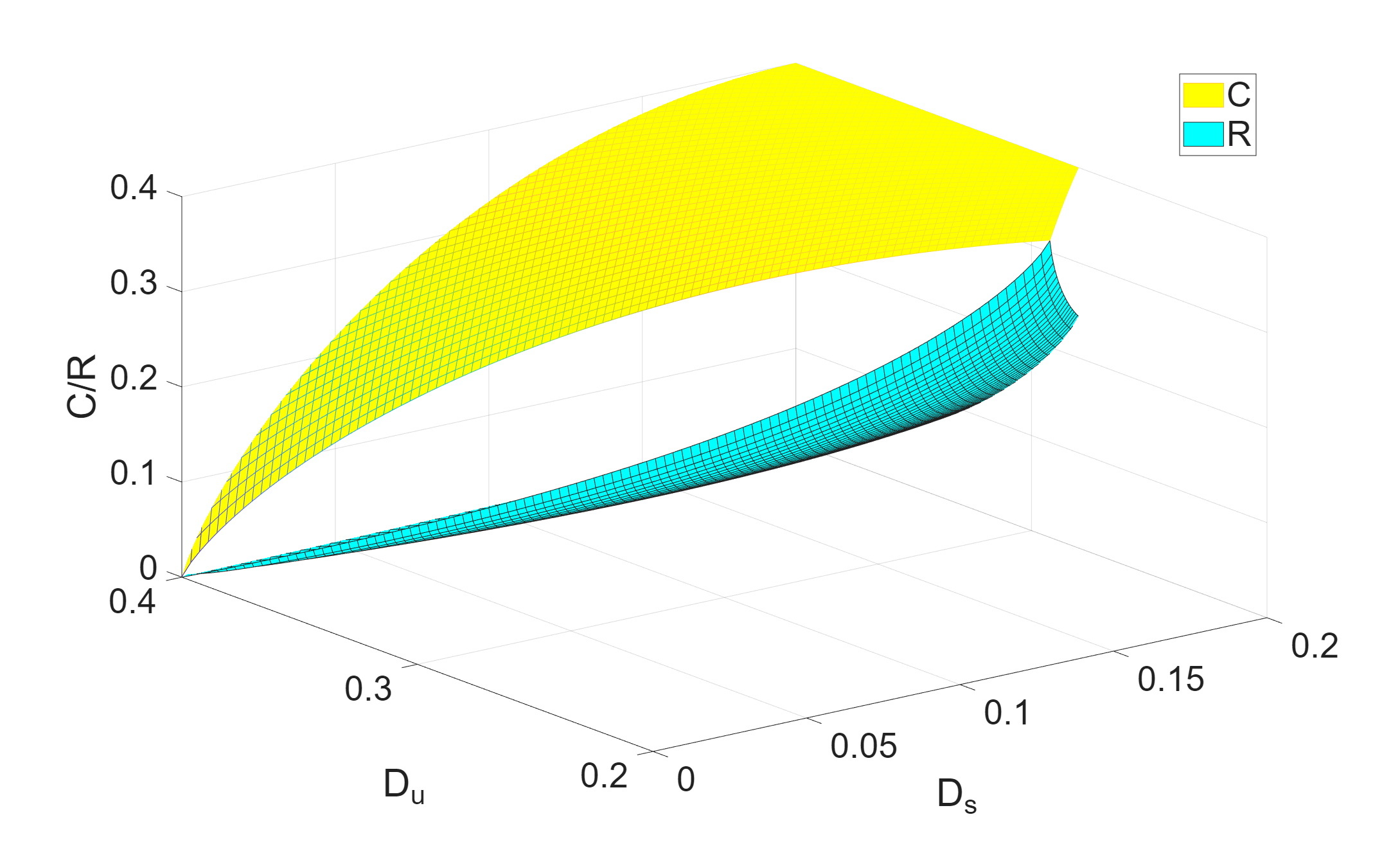
This work formally characterizes the capacity-distortion-cost tradeoff in Integrated Sensing and Communication (ISAC) systems, demonstrating that a separated source and channel coding approach maintains optimality. Specifically, the analysis proves that achieving the fundamental limits of performance does not require joint optimization of source and channel codes; independent design is sufficient. This is quantified by equations relating the communication rate R to both user distortion D_u and sensing distortion D_s. The derived equations establish the achievable rate-distortion region, validating the separation principle within the context of ISAC systems and providing a framework for practical system design based on established coding techniques.
Analysis of binary channel examples reveals a consistent relationship between the capacity-distortion tradeoff and the rate-distortion tradeoff. Specifically, the achievable capacity-distortion curve consistently exhibits a higher rate for a given distortion level compared to the rate-distortion curve. This indicates that, under a distortion constraint, a greater amount of information can be reliably transmitted utilizing the capacity-distortion approach. The relative positioning of these curves demonstrates the potential performance gains achievable through joint optimization of sensing and communication, as opposed to separate optimization of rate and distortion.
The rate-distortion tradeoff in ISAC systems is mathematically defined by equations incorporating channel parameters and specified distortion levels. These equations predict the minimum rate required to represent a signal given a maximum allowable distortion. Verification of this tradeoff is demonstrated at a specific operating point (0.16, 0.24, 0.3884), representing values for rate, sensing distortion, and communication distortion respectively, where the rate-distortion and capacity-distortion curves intersect. This intersection confirms the achievability of the derived bounds, indicating that the theoretical limits of performance can be practically attained under the specified conditions and parameter values.
Towards Practical Implementation: Analyzing ISAC Performance
Conventional communication systems often employ a separation-based approach, distinctly handling source compression and channel coding. While computationally simpler, this method frequently proves suboptimal for Integrated Sensing and Communication (ISAC) systems. ISAC’s inherent duality – simultaneously transmitting information and sensing signals – introduces dependencies that traditional techniques fail to adequately address. Specifically, the independent optimization of source and channel coding neglects the potential for joint design, where sensing requirements can influence coding strategies, and vice versa. This separation can lead to a performance gap, particularly in scenarios where sensing accuracy is paramount or channel conditions are unfavorable, as it doesn’t fully exploit the shared resources and information available within the ISAC framework. Consequently, advanced coding schemes are needed to bridge this gap and realize the full potential of ISAC systems.
The inherent delay in feedback within Integrated Sensing and Communication (ISAC) systems introduces significant complexities to coding design, particularly when modeled as a state-dependent memoryless channel. Unlike traditional communication paradigms with instantaneous feedback, ISAC’s delayed response means the transmitter lacks immediate knowledge of the channel’s state during transmission. This necessitates coding schemes robust to state uncertainty and capable of operating effectively with stale channel information. Consequently, optimizing code performance requires careful consideration of the delay duration and its impact on achievable rates; strategies must account for the mismatch between the assumed and actual channel states at the receiver. The resulting challenges demand innovative approaches beyond conventional coding techniques, potentially incorporating state estimation or partially observable Markov decision processes to mitigate the effects of delayed feedback and maximize system efficiency.
Determining the theoretical limits of information transmission in Integrated Sensing and Communication (ISAC) systems relies heavily on accurately calculating channel capacity – the maximum rate at which information can be reliably conveyed. The Blahut-Arimoto algorithm offers a robust iterative method for achieving this, particularly for channels where closed-form solutions are unavailable. This algorithm effectively optimizes the input probability distribution to maximize the mutual information between transmitted and received signals, even in the presence of noise and interference. By systematically refining this distribution, the algorithm converges towards the capacity of the channel, providing a benchmark against which practical coding schemes can be evaluated and improved. This computational power is crucial for informed design choices, allowing engineers to tailor communication strategies to the specific characteristics of the ISAC environment and push the boundaries of system performance – ultimately enabling more efficient and reliable data transmission alongside sensing capabilities.
Investigating the Binary Input Binary Output (BIBO) channel, despite its inherent simplicity, provides a crucial foundation for understanding the theoretical boundaries of Integrated Sensing and Communication (ISAC) systems. This reduced model allows researchers to rigorously analyze the capacity of the channel – the maximum rate at which information can be reliably transmitted – without being overwhelmed by the complexities of more realistic scenarios. By establishing these fundamental limits within the BIBO framework, it becomes possible to benchmark the performance of more sophisticated coding schemes and modulation techniques designed for practical ISAC implementations. Furthermore, insights gained from analyzing the BIBO channel can guide the development of novel algorithms and strategies aimed at approaching these theoretical limits, ultimately optimizing the efficiency and reliability of ISAC systems in complex environments. This approach allows for a clear understanding of the trade-offs between sensing accuracy and communication rate, informing the design of systems tailored to specific application requirements.
Looking Ahead: Future Directions and Emerging Applications
Advancing Joint Sensing and Communication (JSCC) towards real-world deployment necessitates the development of robust algorithms capable of navigating the intricacies of dynamic environments. Current research often assumes simplified scenarios, but practical Integrated Sensing and Communication (ISAC) systems will operate amidst constantly shifting conditions – fluctuating interference, mobile users, and varied channel characteristics. Consequently, future work must prioritize algorithms that can adapt to these complexities, optimizing resource allocation and waveform design in real-time. This includes exploring techniques like machine learning to predict environmental changes and proactively adjust sensing and communication parameters, ensuring reliable performance and maximizing the potential of JSCC in applications ranging from autonomous navigation to precision industrial control.
A comprehensive analysis of the Rate-Distortion Function is poised to reveal fundamental limits in Joint Sensing and Communication (JSCC) systems, specifically detailing the inherent trade-offs between the precision of environmental perception and the efficiency of data transmission. This function, mathematically representing the relationship between the amount of data used to represent a sensed signal and the resulting fidelity of that representation, allows researchers to quantify how much sensing accuracy must be sacrificed to achieve a given communication rate – or conversely, how much bandwidth is required to maintain a desired level of sensing performance. Understanding this tradeoff is crucial for designing JSCC systems optimized for specific applications; for instance, autonomous vehicles may prioritize sensing accuracy even at the cost of communication bandwidth, while industrial monitoring systems might favor efficient data transmission over extremely high-resolution sensing. Further investigation into the Rate-Distortion Function will therefore enable the development of intelligent resource allocation strategies and ultimately, more robust and adaptable JSCC systems.
Integrated Sensing and Communication (ISAC) technology promises a transformative impact across multiple sectors, extending beyond traditional wireless communication. In autonomous driving, ISAC can provide vehicles with highly accurate, real-time environmental perception – detecting pedestrians, other vehicles, and obstacles – all while maintaining seamless connectivity. Smart cities stand to benefit from ISAC’s ability to monitor infrastructure health, manage traffic flow, and enhance public safety through integrated sensing capabilities. Industrial automation can leverage ISAC for precise localization of robots, proactive maintenance of machinery via vibration analysis, and improved overall operational efficiency. This convergence of sensing and communication functionalities within a single system presents opportunities for creating more intelligent, responsive, and efficient systems across a broad spectrum of applications, potentially redefining how devices interact with and perceive their surroundings.
The trajectory of integrated sensing and communication (ISAC) points toward a future where wireless systems transcend simple data transmission. Continued innovation in this field promises to move beyond conventional designs, creating networks capable of simultaneously perceiving the environment and reliably exchanging information. This convergence isn’t merely about adding functionality; it’s about fundamentally reshaping wireless architectures for heightened efficiency and intelligence. Such advancements will enable systems to adapt dynamically to changing conditions, optimize resource allocation in real-time, and offer unprecedented levels of situational awareness – ultimately paving the way for more robust, self-aware, and responsive wireless infrastructure that underpins critical applications like autonomous navigation and smart infrastructure.
The presented work rigorously establishes the capacity-distortion tradeoff in integrated sensing and communication (ISAC) systems, demonstrating a surprising adherence to the separation principle. This echoes a sentiment expressed by Henri Poincaré: “It is through science we get rid of the habit of thinking that we think.” The analysis bypasses unnecessary complexity by proving that independent source and channel coding can achieve optimal joint performance, a testament to parsimony. The elimination of interdependence between sensing and communication coding, validated by the established theorems, exemplifies a reduction to essential elements – a forceful removal of superfluous thought, mirroring Poincaré’s emphasis on clarity through scientific rigor.
What Remains?
The demonstration of separation, while elegant, does not dissolve the practical difficulties. The analysis hinges on characterizing rate-distortion functions for estimation – a task that, even in this simplified binary channel scenario, quickly becomes intractable for all but the most rudimentary signal structures. Future work will inevitably confront the question of approximation: how much fidelity can be sacrificed in the mathematical model to gain computational tractability? The pursuit of optimality, divorced from feasibility, resembles a sculptor meticulously refining a design for a statue constructed of smoke.
Furthermore, the current framework implicitly assumes a static system. Real-world ISAC deployments will grapple with time-varying channels, dynamic environments, and potentially adversarial interference. Extending these results to non-stationary settings will demand a re-evaluation of the fundamental tradeoffs, and perhaps, a relinquishing of the comforting certainty offered by the separation principle. The elegance of a theorem, after all, diminishes when it fails to illuminate the messy reality.
The true challenge, then, lies not in proving what can be achieved, but in understanding what must be compromised. The problem is not merely one of information theory; it is one of resource allocation, and the subtle art of accepting imperfection. The work presented here has carved away much of the superfluous, leaving a core of fundamental limitations. What remains is the essential shape of the problem itself.
Original article: https://arxiv.org/pdf/2601.10470.pdf
Contact the author: https://www.linkedin.com/in/avetisyan/
See also:
- NTE Drift Guide (& Best Car Mods for Drifting)
- All Aswang Evidence & Weaknesses in Phasmophobia
- Conduit Crystal Location In Subnautica 2
- Where to Find Prescription in Where Winds Meet (Raw Leaf Porridge Quest)
- Diablo 4 Best Loot Filter Codes
- Boruto: Ikemoto Has Already Hinted At Sasuke’s New Eye After Return
- Best Burst & Full Auto Builds for the M16A4 in BF6
- Deltarune Chapter 1 100% Walkthrough: Complete Guide to Secrets and Bosses
- USD RUB PREDICTION
- GBP CNY PREDICTION
2026-01-19 02:50