The word ‘strategy’ has roots in ancient Greece, originally appearing as ‘strategia’. This term evolved into ‘strategi’ in Latin and has similar forms in several modern languages – ‘stratégie’ in French and German, ‘strategia’ in Italian and Spanish.
The word ‘strategy’ actually comes from the ancient Greek word strategos, which meant a military general. That’s what we’ll be focusing on today.
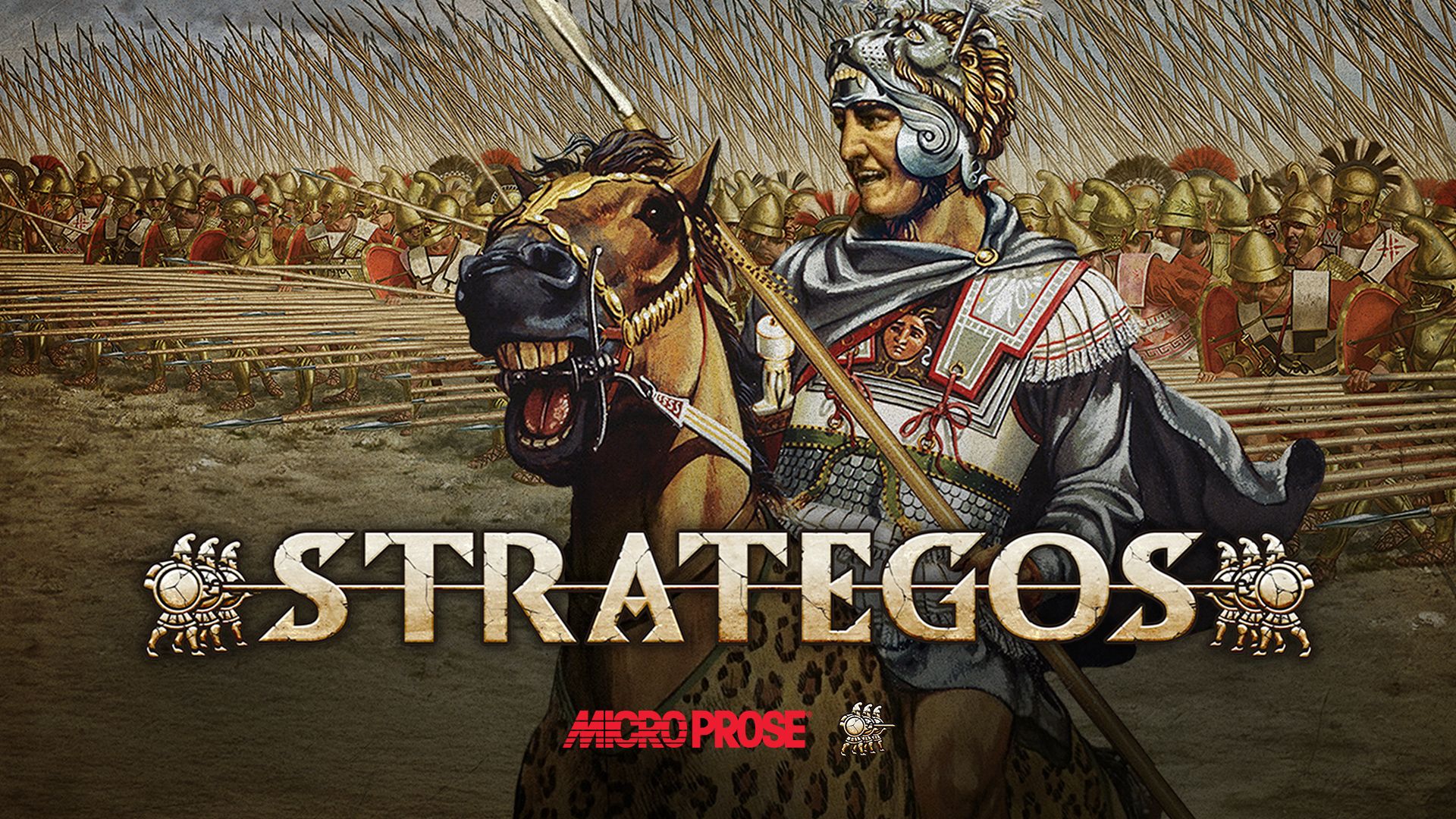
Strategos, a real-time strategy game from Strategos Games and published by MicroProse, lets you command famous armies throughout history. I’ve been following its development for some time, and I was thrilled to receive a review copy ahead of its January 20, 2026 release.
Just to be upfront, I tried to get a copy of Geoffrey Parker’s The Cambridge History of Warfare before this came out, but it didn’t arrive in time. So, if I get anything wrong about battles, I’m blaming that book!
Command School
The famous Russian General Alexander Suvorov believed that tough training makes fighting easier. While I haven’t read the book Parker mentioned, Strategos does a great job of explaining the fundamentals before getting into more complex topics.
The game starts with a short, three-part tutorial that teaches you how to play. After that, you’ll immediately face a challenge: a practice battle against a simplified AI opponent.
You can find detailed and accurate information about how well your units perform in various situations – and what affects those stats – in the Manual section, which is surprisingly tucked away under the Miscellaneous menu.
Strategos is like a digital version of Warhammer created by someone who loves history, but without the expensive and time-consuming hobby of collecting and painting miniatures.
Crossing the Rubicon
I’m a big fan of campaign modes, so starting with that seemed like the perfect way to begin playing Strategos. I quickly jumped in as Alexander, before he was famous, and found myself leading troops in the Battle of Chaeronea against the Athenians in 338 BCE.
Before each mission, you get to pick the specific types of units you want in your army. You have a limited number of slots to fill, but this lets you customize your forces while still keeping them focused on a core strategy. Usually, you’ll choose different variations within the same unit class, like various kinds of cavalry.
Strategos, like many strong real-time strategy games, lets you arrange your units before each match to fit your strategy. You can also stick with the standard setup if you prefer, which is what I did when I first started playing until I learned the ropes.
What really sets this game apart is how it handles commands. Your army leaders are directly linked to specific units, and they’re the only ones who can give orders during battle.
I quickly transformed into Alexander the Great and found myself in the middle of the Battle of Chaeronea, which took place in 338 BC.
When fighting calmed down, I could shout orders across a good distance, but usually, I depended on messengers – we called them Couriers – to deliver instructions. Like the swift Hermes, they raced through battles, and though they were usually successful, some didn’t make it. Because we had a limited number of Couriers, I had to carefully consider which orders were truly essential.
Strategos is a welcome change of pace – it avoids tedious micromanagement and lets you control your units with a surprisingly natural level of independence. It’s some of the best hands-off unit control I’ve experienced in a long time.
Like most real battles, fights in this game don’t usually end with one side completely defeated. It’s even possible for the side that suffered the most damage to win, as long as they held their position.
I noticed during the campaign that units don’t carry over between missions, which made it hard to feel like my army was consistently growing and evolving. I get why some losses might be expected and units replaced, especially with time passing between battles. However, it would have been great to have a stronger sense of connection to the same units throughout the whole campaign.
Mechanical Animals
In Strategos, while unit commanders need generals to initially give large-scale commands, they then operate on their own. We won’t go into the details of exactly how this works, but the result is you control the big picture of the battle – you don’t have to micromanage individual units like archers.
Okay, so this game isn’t afraid to throw curveballs at you. It feels really realistic because your guys don’t always do exactly what you tell them. Like, I had my infantry moving to a point, and they spotted an enemy they hadn’t expected, so they just… charged! It messed up my whole plan because it left my side open, and things quickly spiraled. Honestly though, even with the surprises, it’s made me a way better commander – I have to really think on my feet and adapt, which is awesome.
Subscribe to the newsletter for deeper Strategos tactics
In Strategos, the landscape significantly impacts gameplay, and it’s more than just forests slowing units down. Things like hills, plants, rivers, and even the type of ground all affect your troops. Different units react differently – archers on foot can move easily through woods, but cavalry find it difficult.
After you learn the detailed combat system in Strategos, the game gets progressively harder through its campaigns and historical battles. Later levels demand more precise play, but the challenge always feels reasonable and achievable.
Your infantry may […] charge to preserve themselves. This, in turn, may leave your flank exposed.
The biggest difficulty in Strategos is coordinating such large armies, making your initial battles seem small and insignificant. Losing is actually the best way to learn – a few defeats, combined with some focused thinking, will quickly help you improve your strategy.
I’m a bit conflicted about how the game looks and sounds. The music and battle noises create a good atmosphere, and the animations are cute, but the overall style feels somewhat cartoonish – it’s hard to tell if this was an intentional artistic decision or if it just looks a little old-fashioned.
While these minor issues don’t ruin the experience, and the game’s old-school feel can be nostalgic, it always feels like a bit more refinement would have made it truly great.
Closing Comments
Everyone experiences time the same way, but it’s been a long time since we’ve had a truly detailed and immersive strategy game focused on ancient warfare for PC. Strategos feels complete and offers engaging, realistic battles perfect for anyone who enjoys commanding armies. While the game wasn’t made with a huge budget, it prioritizes delivering compelling gameplay – just like a great historical commander focused on victory. Strategos succeeds where it counts and has the potential to become a classic real-time strategy title.
Read More
- Forza Horizon 6: Find the Ohtani Treasure Chest Location
- LEGO Batman Legacy of the Dark Knight Batcave Minikits & WayneTech Caches
- Diablo 4 Best Loot Filter Codes
- NTE Drift Guide (& Best Car Mods for Drifting)
- USD RUB PREDICTION
- USD CNY PREDICTION
- Cookie Run Kingdom Timeline of Fate Update Guide
- PS Plus Monthly Games for June 2026 Wish List
- Top 10 Must-Watch Isekai Anime on Crunchyroll Revealed!
- GBP CNY PREDICTION
2026-01-19 04:40