Author: Denis Avetisyan
A new study details how a future circular collider could dramatically improve our understanding of the Higgs boson by precisely measuring its decay into tau leptons.
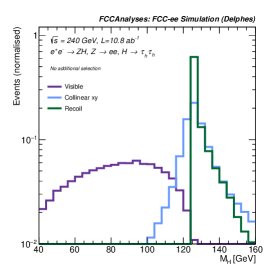
This paper estimates the achievable precision on the H→ττ cross-section at the FCC-ee, finding sub-percent accuracy is possible in ZH production, significantly exceeding current constraints.
Precise measurements of the Higgs boson’s properties remain a cornerstone of modern particle physics, yet current experiments are limited in their ability to fully characterize its couplings. This paper, ‘Measurements of H$\toττ$ cross-section at FCC-ee’, investigates the potential for high-precision measurements of the H \to \tau \tau decay channel at the proposed Future Circular Collider. Through detailed simulations, we demonstrate that sub-percent precision on the H \to \tau \tau cross-section is achievable in the ZH production mechanism, representing an order of magnitude improvement over existing LHC measurements. Will these enhanced capabilities unlock new insights into electroweak symmetry breaking and reveal potential deviations from the Standard Model?
Unveiling the Higgs: Patterns at the Energy Frontier
Despite its remarkable predictive power, the Standard Model of particle physics doesn’t fully account for the universe’s observed properties, particularly concerning the Higgs boson. While the Higgs mechanism successfully explains how fundamental particles acquire mass, the model provides no insight into why the Higgs boson possesses its observed mass, nor does it predict the existence of dark matter or explain the matter-antimatter asymmetry. Furthermore, the Standard Model cannot accommodate neutrino masses without modification. Consequently, physicists are meticulously studying the Higgs boson’s properties – its spin, parity, and interactions with other particles – searching for deviations from Standard Model predictions that could hint at new physics beyond its current limitations. Subtle discrepancies in these measurements could unveil the existence of undiscovered particles or forces, ultimately leading to a more complete understanding of the fundamental laws governing the universe.
The Higgs boson, a fundamental particle linked to mass, doesn’t simply vanish after its creation; it decays into other particles, and the precise patterns of these decays hold a key to understanding physics beyond the Standard Model. Examining decay modes like the Higgs boson transforming into a pair of tau leptons-heavier cousins of electrons-offers a particularly sensitive probe for new, undiscovered particles. Subtle deviations in the rate or properties of H \rightarrow \tau^+ \tau^- decays, compared to Standard Model predictions, could signal the existence of these particles interacting with the Higgs. This is because any new particle that couples to the Higgs would subtly alter the decay process, creating measurable anomalies. Therefore, meticulously characterizing these decay modes serves as a powerful tool to indirectly ‘see’ new physics, even if those particles are too massive to be directly produced in current experiments.
The pursuit of physics beyond the Standard Model hinges on increasingly precise measurements of known particles, and the Higgs boson presents a particularly compelling target. Current experiments face limitations in determining the rate at which the Higgs decays into pairs of tau leptons – a process sensitive to potential new particles influencing the interaction. To overcome these challenges, the proposed Future Circular Collider with electron-positron collisions (FCC-ee) is designed to deliver an unprecedented volume of data. This ambitious project aims to achieve sub-percent precision in measuring the H \rightarrow \tau \tau cross-section, effectively creating a high-resolution map of this decay channel and providing a sensitive probe for deviations from Standard Model predictions – deviations that could signal the existence of undiscovered particles or forces.
Simulating Reality: Modeling the Higgs Decay
Monte Carlo simulation is essential for accurate prediction of event yields in Higgs decay measurements due to the complexity of particle interactions and detector response. These simulations model the production and decay of Higgs bosons, as well as the subsequent interactions of the decay products within the detector material. By generating a large number of simulated events, researchers can statistically determine the expected signal rate – the number of Higgs decay events that will be observed – and estimate the associated background rates from other Standard Model processes. Accurate knowledge of both signal and background rates is critical for interpreting experimental data and extracting precise measurements of Higgs boson properties, such as its couplings and mass, and for distinguishing potential new physics signals.
The IDEA (Innovative Detector for Electron-positron Acceleration) detector concept is designed to facilitate rapid and comprehensive simulation studies relevant to the Future Circular Collider-electron-positron (FCC-ee) program. Unlike generic detector models, IDEA incorporates detailed geometrical and technological specifications – including a silicon tracker, calorimeter systems, and muon identification – that closely resemble a plausible detector implementation. This level of realism allows for the generation of simulated data with characteristics representative of actual experimental conditions, enabling accurate estimations of detector performance, event reconstruction efficiencies, and the impact of various systematic effects. The framework’s optimized software tools and computational efficiency are crucial for generating the vast datasets required to evaluate physics analyses and detector designs prior to construction of the FCC-ee.
Optimizing event selection strategies and accurately estimating systematic uncertainties are paramount to achieving the target precision on the κτ parameter in Higgs decay measurements. Simulations, utilizing frameworks like IDEA, allow for iterative refinement of analysis techniques, enabling researchers to identify and mitigate sources of uncertainty stemming from detector effects, background estimation, and theoretical modeling. The ability to precisely quantify these uncertainties is directly linked to the feasibility of reaching a relative uncertainty of 0.47% on κτ, a key goal for future high-luminosity colliders. These simulations permit exploration of various analysis parameters and selection criteria, identifying configurations that maximize signal sensitivity while minimizing the impact of systematic effects.
Reconstructing the Invisible: Decoding Tau Leptons
Tau leptons present a significant reconstruction challenge at colliders due to their rapid decay into a variety of hadronic and leptonic final states. Unlike electrons or muons, which typically decay into single, easily identifiable particles, tau leptons frequently decay into multiple pions, kaons, and/or neutrinos. This multi-particle decay results in a missing transverse momentum signature from the neutrinos, complicating momentum balancing and energy reconstruction. Furthermore, the presence of multiple closely spaced decay products makes it difficult to precisely determine the original tau lepton’s momentum, and the relatively short lifetime of the tau necessitates precise vertex reconstruction to distinguish tau decays from background originating from the primary collision or other sources. Consequently, advanced techniques are required to effectively identify and characterize tau leptons within high-energy physics events.
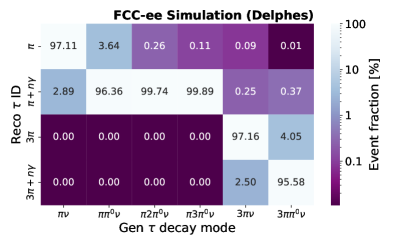
ParticleNet is a graph neural network designed to improve tau lepton reconstruction by treating decay vertices and associated particle tracks as nodes and edges within a graph structure. This allows the network to learn relationships between decay products that traditional methods may miss, effectively capturing the complex topologies of tau decays. The network utilizes a message-passing scheme where information is iteratively exchanged between nodes, enabling it to build a representation of the entire decay event. By incorporating information from the full decay topology, ParticleNet can more accurately identify and reconstruct tau leptons, particularly in challenging environments with high pile-up or overlapping signatures. The resulting improved reconstruction efficiency and accuracy directly contribute to enhanced sensitivity in searches for physics beyond the Standard Model.
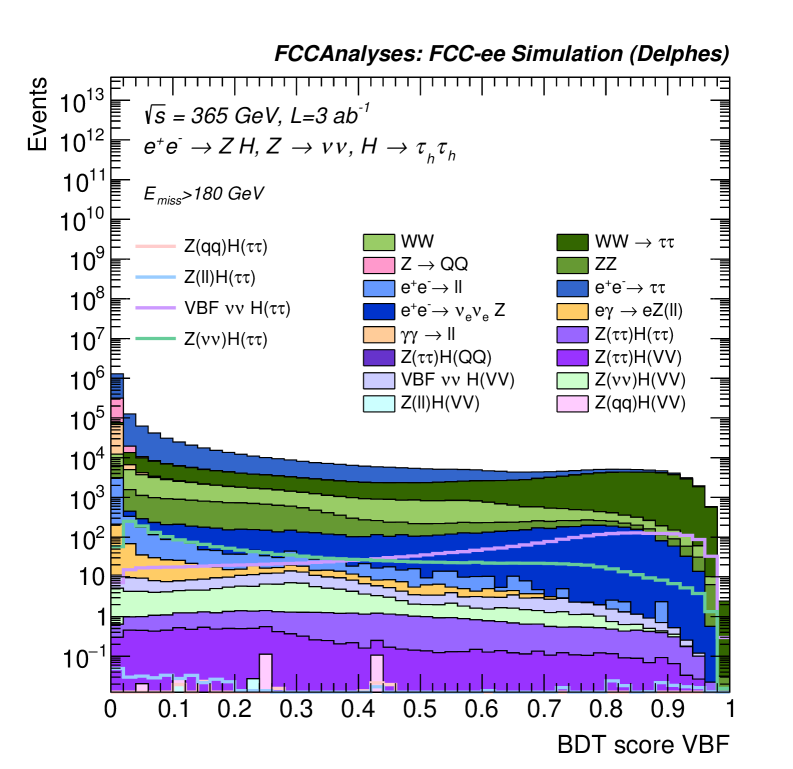
Following initial tau lepton reconstruction, a boosted decision tree (BDT) classifier is implemented to optimize signal-to-background discrimination in event selection. The BDT utilizes a multivariate analysis, incorporating kinematic variables of the reconstructed tau candidate and associated decay products as input features. Training is performed on simulated event samples, maximizing separation between signal events – those originating from true tau decays – and background events arising from misidentified jets or other processes. Optimization focuses on metrics such as the area under the receiver operating characteristic curve (AUC-ROC) and the resulting improvement in statistical significance of observed signal excesses. The BDT output serves as a discriminant variable, allowing for a data-driven selection of events enriched in genuine tau lepton signatures.
Precision and Beyond: Mapping the Higgs Sector
The decay of the Higgs boson into a pair of tau leptons provides a sensitive probe of the Higgs sector, and increasingly precise measurements of this rare process are actively constraining the strength of the Higgs’ interactions – its couplings – with other particles. Researchers utilize sophisticated Monte Carlo simulations to model the expected decay rates and distributions within the Standard Model, allowing for a detailed comparison with experimental data. By meticulously analyzing the observed decay patterns, physicists can test whether the Higgs boson behaves as predicted, or if subtle deviations suggest the influence of undiscovered particles or interactions beyond the current theoretical framework. These precise measurements aren’t simply about confirming existing knowledge; they represent a powerful search for new physics hidden within the seemingly well-understood decay of a fundamental particle.
The intricacies of Higgs boson interactions are elegantly untangled through the Kappa Framework, a mathematical tool designed to parameterize the strength of its couplings to other particles. This framework doesn’t attempt to model the fundamental interactions themselves, but rather quantifies how much these interactions deviate from predictions made by the Standard Model. Each coupling is represented by a ‘kappa’ (κ) value; a κ of 1 signifies a Standard Model-like interaction, while deviations indicate potential new physics at play. By precisely measuring these κ values for different decay channels – such as the Higgs decaying into pairs of Z bosons, W bosons, or tau leptons – physicists can systematically map the Higgs sector and search for subtle hints of particles or forces beyond those currently known, effectively transforming complex interaction strengths into a set of readily comparable parameters.
The future of Higgs boson research hinges on achieving unprecedented measurement precision. Current efforts aim to determine the couplings of the Higgs boson to other particles with a relative accuracy of 0.1% for the coupling to the Z boson (κZ), 0.29% for the coupling to the W boson (κW), and 0.78% for the total decay width (ΓH). These ambitious goals, if realized, will dramatically sharpen the picture of the Higgs sector, allowing physicists to rigorously test the Standard Model’s predictions and search for subtle deviations that could unveil the presence of new, undiscovered particles or interactions. Such refined measurements don’t simply confirm existing knowledge; they open a window onto potential physics beyond the Standard Model, potentially revealing clues about dark matter, extra dimensions, or other exotic phenomena.
The Higgs boson, while confirming a crucial piece of the Standard Model, also presents a window for exploring physics beyond it. Precise measurements of how the Higgs interacts – its couplings – with other particles are therefore paramount. Any discernible departure from the Standard Model’s predicted coupling strengths wouldn’t simply be a refinement of existing knowledge, but a potential beacon indicating the presence of new, undiscovered particles or forces. These deviations could manifest as subtle alterations in decay rates or interaction probabilities, hinting at interactions with ‘dark sector’ particles, extra dimensions, or other theoretical constructs currently beyond the reach of direct observation. Consequently, ongoing and future experiments meticulously analyzing Higgs couplings represent a powerful search strategy for unraveling the mysteries that lie beyond our current understanding of the universe.
Looking Ahead: Colliders and Production Mechanisms
The Future Circular Collider – electron positron (FCC-ee) anticipates a wealth of Higgs boson production through several distinct channels, most notably via the association of a Z boson – known as ZH production – and through the process of Vector Boson Fusion (VBF). These aren’t mutually exclusive pathways; rather, they represent complementary avenues for generating and observing H bosons. ZH production, where a Higgs boson is created alongside a Z boson, is expected to dominate the overall yield, while VBF – involving the fusion of two vector bosons to create a Higgs – offers a cleaner signature, albeit at a lower rate. Leveraging both production modes allows physicists to probe the Higgs boson’s properties with unprecedented statistical power, enhancing the potential for discovering subtle deviations from Standard Model predictions and unlocking deeper insights into the fundamental laws of nature.
The Future Circular Collider – electron positron (FCC-ee) is anticipated to revolutionize Higgs boson studies through the prodigious collection of approximately two million Higgs bosons produced via the ZH decay channel. This remarkable feat will be achieved with an integrated luminosity of 10.8 inverse femtobarns – a measure of the total ‘amount’ of data collected – representing a substantial increase over current colliders. This massive dataset will allow for unprecedented precision measurements of the Higgs boson’s properties and its interactions with other particles, potentially revealing subtle deviations from the Standard Model and offering clues to new physics beyond it. The sheer number of events will enable detailed studies of rare decay modes and provide a sensitive search for any unexpected phenomena associated with the Higgs boson, pushing the boundaries of particle physics knowledge.
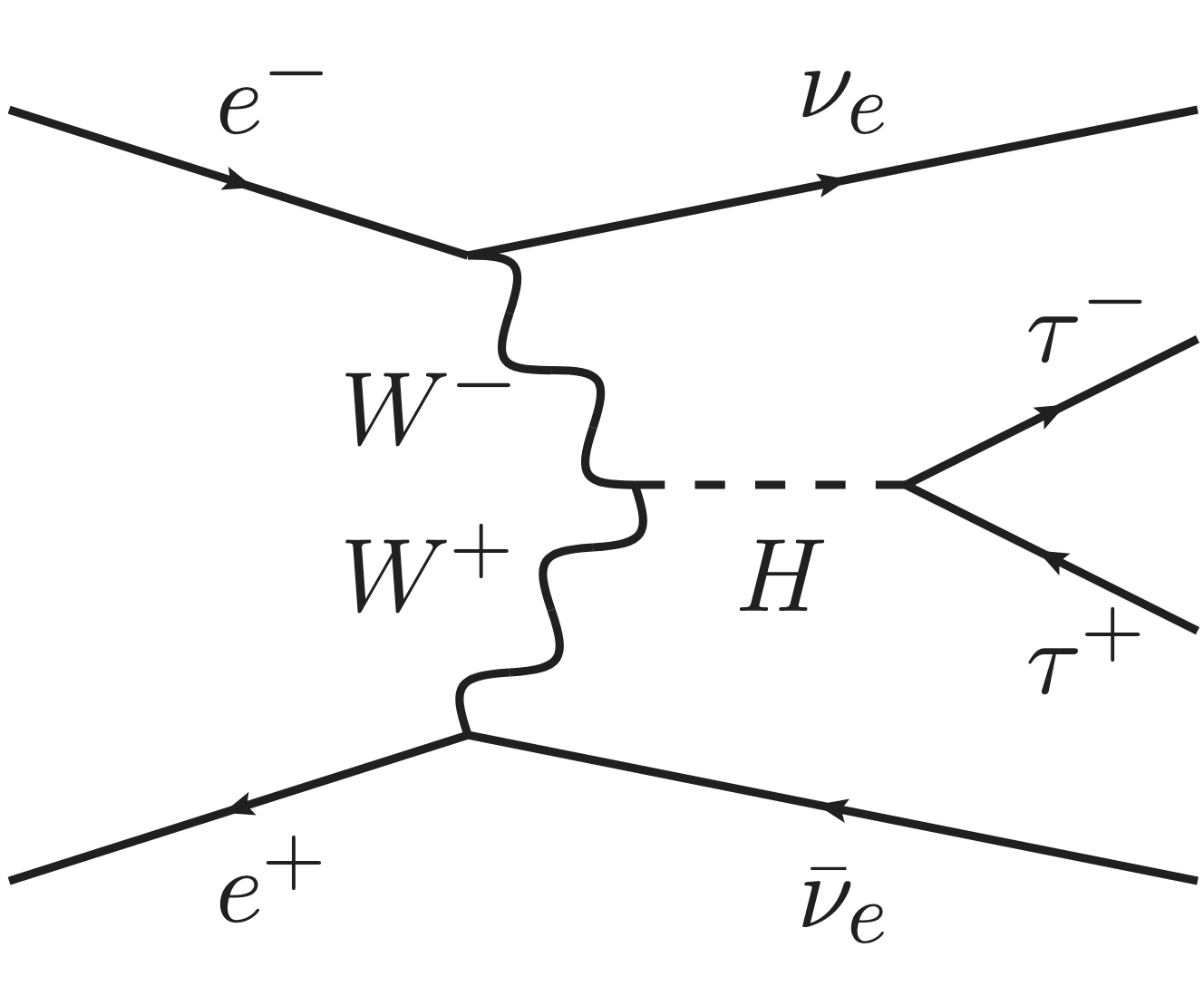
The Future Circular Collider with electron-positron collisions (FCC-ee) anticipates accumulating an integrated luminosity of 3 inverse femtobarns (ab-1) through Vector Boson Fusion (VBF) production of Higgs bosons. This substantial luminosity represents a significant increase over current colliders and will enable detailed studies of the Higgs boson’s interactions with itself and other particles via VBF. Unlike the more common ZH production mode, VBF relies on the exchange of W and Z bosons to initiate the collision, offering a complementary production mechanism and providing a cleaner signal with reduced background noise. The projected 3 ab-1 of VBF data will therefore be crucial for precisely measuring the Higgs boson’s self-coupling and searching for subtle deviations from the Standard Model, potentially revealing hints of new physics beyond current understanding.
The precise characterization of the Z boson’s influence within the ZH production process – where a Higgs boson is created in association with a Z boson – is paramount to fully unlocking the potential of future collider experiments. This production mode is anticipated to yield the largest number of Higgs bosons at facilities like the Future Circular Collider-ee (FCC-ee), but maximizing its discovery power requires a detailed understanding of the subtle interplay between the Higgs and Z bosons. Accurate theoretical predictions, informed by precise measurements of Z boson properties and decay modes, are crucial for distinguishing genuine Higgs signals from background noise. By refining these models, physicists can optimize data analysis techniques and enhance the sensitivity to rare or unexpected Higgs decays, potentially revealing physics beyond the Standard Model. Ultimately, a thorough grasp of the Z boson’s role isn’t simply about improving statistics; it’s about sharpening the lens through which scientists will explore the fundamental nature of mass and the universe itself.
Ongoing research prioritizes refinements to both detector technology and data analysis methodologies, aiming to extract the maximum possible precision from future collider experiments. This includes investigations into novel detector materials offering improved resolution and granularity, as well as the development of sophisticated algorithms for reconstructing particle trajectories and identifying decay products. Particular attention is being given to techniques that mitigate the effects of background noise and enhance the signal-to-noise ratio, crucial for observing rare processes and subtle deviations from Standard Model predictions. These optimizations aren’t merely incremental improvements; they represent a concerted effort to push the boundaries of what’s measurable, unlocking the potential for unprecedented insights into the fundamental laws governing the universe and potentially revealing physics beyond our current understanding.
The pursuit of precision in measurements, as detailed in this study of H→ττ decay at the FCC-ee, mirrors a fundamental aspect of understanding complex systems. Rigorous analysis, including careful consideration of Monte Carlo simulations and boosted decision trees, allows for increasingly refined observations. This echoes Albert Camus’s sentiment: “The purpose of a good life is to live it with intensity and clarity.” The study exemplifies this principle by meticulously examining the boundaries of data and potential sources of error, ensuring the resulting measurements are not merely numbers, but a clear and intense reflection of the underlying physics of electroweak symmetry breaking. The achievable sub-percent precision isn’t simply a technical feat; it’s a clarification of the fundamental forces at play.
Beyond the Horizon
The demonstrated potential for sub-percent precision in H→ττ measurements at a future FCC-ee represents a sharpening of focus, but also a stark revelation of existing boundaries. The precision hinges, naturally, on the fidelity of Monte Carlo simulations – elegant constructs built on approximations of reality. It is worth pondering what systematic effects, currently unmodeled or underestimated, might lurk just beyond the reach of current theoretical frameworks. The signal, while theoretically clean, is fundamentally defined by the decay products; a deeper investigation into tau identification and energy calibration will be essential, particularly in the context of boosted decays where resolution limits become acutely apparent.
The pursuit of increasingly precise measurements is, in a sense, a search for the unexpected. While the Standard Model continues to withstand scrutiny, the real power of this work may not lie in confirming existing predictions, but in illuminating deviations – faint whispers that hint at physics beyond the current paradigm. One must ask: what new sources of background, or previously unaccounted-for interference effects, might emerge when the signal is known to this degree of accuracy?
Ultimately, the path forward demands a rigorous assessment of not only what is measured, but what remains unseen. The exploration of tau pair production is a journey into the heart of electroweak symmetry breaking, and like all journeys, its true destination may lie far beyond the initially charted course.
Original article: https://arxiv.org/pdf/2601.11383.pdf
Contact the author: https://www.linkedin.com/in/avetisyan/
See also:
- Forza Horizon 6: Find the Ohtani Treasure Chest Location
- NTE Drift Guide (& Best Car Mods for Drifting)
- Diablo 4 Best Loot Filter Codes
- Boruto: Ikemoto Has Already Hinted At Sasuke’s New Eye After Return
- LEGO Batman Legacy of the Dark Knight Batcave Minikits & WayneTech Caches
- USD RUB PREDICTION
- Where to Find Prescription in Where Winds Meet (Raw Leaf Porridge Quest)
- Top 10 Must-Watch Isekai Anime on Crunchyroll Revealed!
- Deltarune Chapter 1 100% Walkthrough: Complete Guide to Secrets and Bosses
- GBP CNY PREDICTION
2026-01-21 03:39