Author: Denis Avetisyan
New research reveals a significant reduction in the energy loss experienced by fast-moving particles as they traverse the ultra-hot quark-gluon plasma created in heavy-ion collisions.
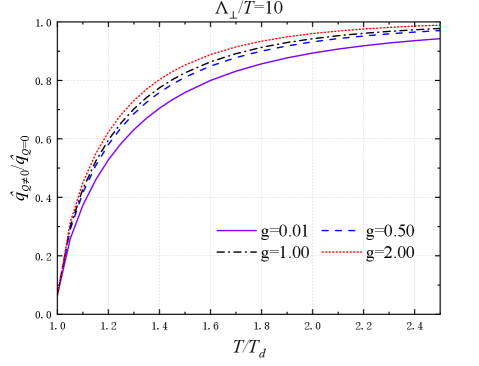
Analysis using background field effective theory demonstrates suppression of the jet quenching parameter near the critical temperature of the quark-gluon plasma.
Understanding the dynamics of energy loss in the quark-gluon plasma remains a central challenge in heavy-ion collision physics. This work, ‘Suppression of the jet quenching parameter near the critical temperature’, investigates the behavior of the jet quenching parameter – a key quantity characterizing this energy loss – utilizing a background field effective theory to account for non-perturbative effects near the deconfining phase transition. Our calculations reveal a significant suppression of the jet quenching parameter in this critical region, consistent with lattice simulations, driven by modifications to the parton distribution function. How can these findings refine our understanding of thermalization and transport coefficients within the strongly coupled medium created in relativistic heavy-ion collisions?
Unveiling the Primordial Fire: A Journey into Quark-Gluon Plasma
The quest to understand matter at its most fundamental level has led physicists to recreate, for fleeting moments, the conditions believed to have existed microseconds after the Big Bang. This pursuit centers on the Quark-Gluon Plasma (QGP), an extraordinarily hot and dense state where quarks and gluons – typically confined within protons and neutrons – are liberated. Creating the QGP demands colliding heavy ions, such as gold or lead, at near-light speeds, effectively compressing an immense amount of energy into a minuscule volume. However, this extreme state of matter exists for only a fraction of a second before cooling and transitioning back into ordinary hadronic matter, presenting immense experimental and theoretical challenges. The very nature of the strong force – the interaction binding quarks and gluons – undergoes a dramatic shift within the QGP, transitioning from a confining force to a more screened, almost fluid-like interaction. Consequently, studying the QGP requires innovative techniques to indirectly probe its properties, pushing the boundaries of both experimental capabilities and theoretical understanding of strong interactions.
The fleeting existence of the Quark-Gluon Plasma (QGP), lasting only fractions of a second at temperatures exceeding those found in the core of stars, renders direct observation fundamentally impossible. Consequently, scientists rely on indirect methods to characterize this extreme state of matter. A key technique involves examining the phenomenon of ‘jet quenching’, where high-energy particles – jets – produced in heavy-ion collisions lose energy as they traverse the QGP. The degree to which these jets are suppressed, or ‘quenched’, provides crucial insights into the plasma’s density and properties. By meticulously analyzing the altered characteristics of these jets – their energy, angular distribution, and composition – researchers can reconstruct a picture of the QGP’s behavior and test the predictions of theoretical models, effectively ‘seeing’ the unobservable through its effects on other particles.
Deciphering how energetic particles lose energy while traversing the Quark-Gluon Plasma (QGP) is paramount to extracting meaningful insights from heavy-ion collision experiments. This energy loss, observed as a suppression of high-momentum particles, isn’t simply frictional; it arises from a complex interplay of interactions with the QGP’s constituent quarks and gluons. Theoretical models propose various mechanisms, including the collisional loss – where particles directly interact with medium constituents – and the radiative loss, where particles emit gluons as they accelerate through the dense medium. Precisely distinguishing between these contributions, and accounting for their dependence on factors like particle type and energy, allows researchers to map the QGP’s transport properties – its viscosity, density, and temperature – and ultimately test the fundamental theory of strong interactions, Quantum Chromodynamics, under extreme conditions. The detailed study of this energy dissipation serves as a powerful probe of the QGP’s internal structure and dynamics, bridging the gap between theoretical predictions and experimental observations.
Quantifying the Interaction: The Jet Quenching Parameter as a Window into the QGP
The jet quenching parameter, denoted as q̂, quantifies the average transverse momentum transferred to a high-energy parton – typically a quark or gluon – while it propagates through the quark-gluon plasma (QGP). This parameter is not a measure of energy loss, but rather the rate of momentum change due to multiple scattering interactions with the QGP constituents. A larger q̂ value indicates a stronger interaction and greater deflection of the parton from its original trajectory, leading to observable effects like jet suppression and modification in high-energy particle collisions. Determining q̂ allows for comparisons between theoretical models describing the QGP and experimental data obtained from heavy-ion collisions, providing insights into the transport properties of this strongly coupled medium.
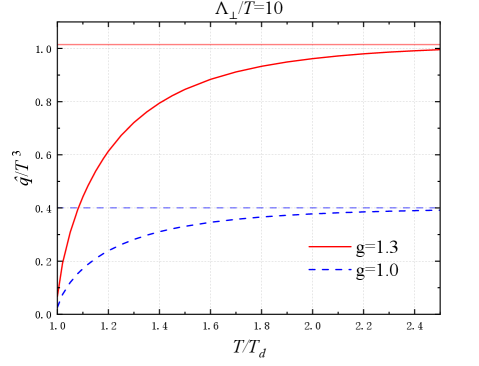
The jet quenching parameter q\hat{} serves as a critical link between theoretical models of the quark-gluon plasma (QGP) and experimentally observed jet suppression. Precise determination of q\hat{} allows for quantitative comparison between calculated energy loss predictions and the degree to which high-transverse momentum particles are attenuated as they traverse the QGP. Recent analysis indicates a substantial decrease in q\hat{} as the system approaches the critical temperature T_c, suggesting a diminished interaction strength between partons and the medium in proximity to the phase transition. This reduction in q\hat{} near T_c impacts the interpretation of jet quenching data and necessitates refinement of theoretical frameworks to accurately describe the evolving properties of the QGP.
Accurate prediction and refinement of the jet quenching parameter, q\hat{}, necessitate a theoretical framework capable of modeling the non-perturbative dynamics of the Quark-Gluon Plasma (QGP). This requires accounting for both elastic and inelastic scattering processes between the traversing parton and the QGP constituents, including gluons and light quarks. Furthermore, the framework must incorporate the effects of finite QGP density, temperature gradients, and collective flow, all of which influence the momentum transfer. Validating these theoretical predictions requires comparison with experimental data obtained from heavy-ion collisions, where jet quenching is observed as suppression of high-transverse momentum particles. Sophisticated models, often employing techniques from perturbative Quantum Chromodynamics (pQCD) and strong coupling approaches like AdS/CFT correspondence, are continuously being developed and refined to better capture the intricacies of these interactions and provide more precise values for q\hat{}.
First Principles Determination: Lattice QCD and Beyond in Mapping the QGP
Lattice Quantum Chromodynamics (Lattice QCD) represents a computationally intensive, yet fundamentally rigorous, method for determining the quark-gluon plasma (QGP) transport coefficient, \hat{q} , directly from the Standard Model. Unlike perturbative approaches which rely on approximations valid in specific regimes, Lattice QCD discretizes spacetime into a four-dimensional lattice, allowing for the non-perturbative evaluation of \hat{q} without dependence on a coupling constant. This calculation involves simulating the dynamics of quarks and gluons on this lattice, typically employing computationally expensive numerical methods. The resulting values for \hat{q} serve as a crucial benchmark against which other theoretical calculations, such as those derived from kinetic theory or hydrodynamics, can be validated and refined, providing a first-principles determination of this key QGP property.
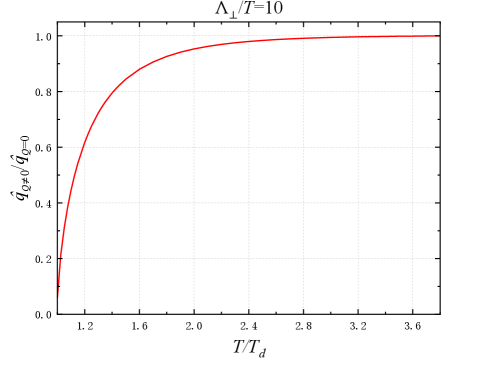
Background Field Effective Theory (BFEFT) addresses the non-perturbative nature of the Quark-Gluon Plasma (QGP) by introducing a static, external color field. This approach allows for the investigation of color screening effects, where the effective color charge decreases due to the surrounding medium. Specifically, BFEFT calculations demonstrate a suppression of the \hat{q} \hat{q} correlator-a key component in determining the transport coefficient \hat{q} -as the QGP approaches its critical temperature. This suppression arises from the Debye screening of color charges within the plasma, altering the dynamics of heavy-ion collisions and influencing observed collective flow phenomena. The framework provides a means to incorporate medium effects beyond perturbative expansions, offering a complementary approach to Lattice QCD calculations of \hat{q} .
Hard Thermal Loop (HTL) resummation is a crucial technique for enhancing the convergence of perturbative calculations of \hat{q} , the transport coefficient governing the shear viscosity of the Quark-Gluon Plasma (QGP). Standard perturbative expansions in Quantum Chromodynamics (QCD) often diverge or converge slowly at the temperatures relevant to the QGP due to the strong coupling. HTL resummation addresses this by systematically including a large class of diagrams that account for the thermal effects of soft gluon emissions. This effectively modifies the QCD coupling constant and Debye screening mass, leading to a reduced coupling and improved convergence. In the dense QGP environment, where screening is enhanced, HTL resummation is particularly important for obtaining reliable estimates of \hat{q} and accurately modeling the QGP’s hydrodynamic behavior.
The Medium’s Imprint: How QGP Properties Govern Energy Loss
The quark-gluon plasma (QGP) exhibits a unique property: color charges are effectively screened due to the abundance of mobile charges within it. This screening is quantified by the Debye mass, \mu_D, which dictates the range over which the strong force operates within the plasma. A larger Debye mass implies stronger screening and a reduced interaction strength between partons-the constituent quarks and gluons. Consequently, \mu_D directly influences the parameter \hat{q}, representing the average momentum transfer per unit length experienced by a traversing parton. A greater Debye mass leads to a smaller \hat{q}, lessening the rate of energy loss as the parton moves through the QGP, and fundamentally altering predictions for observables sensitive to this interaction.
Calculations of energy lost by energetic particles traversing the quark-gluon plasma are profoundly impacted by the running coupling, a fundamental feature of the strong interaction. This coupling isn’t constant; instead, it diminishes as the energy scale increases – a phenomenon known as asymptotic freedom. Consequently, at the extremely high temperatures and densities of the quark-gluon plasma, the effective strength of the strong force, and thus the rate of parton interactions, is significantly reduced compared to lower energy scenarios. This energy-scale dependence necessitates careful consideration when modeling energy loss, as simplified approaches employing a fixed coupling constant can lead to substantial inaccuracies in predicting the quenching of jet production. Accurate calculations require incorporating the \Lambda_{QCD} scale and the corresponding beta function to properly account for how the coupling changes with the momentum transfer during interactions within the plasma.
Partons traversing the quark-gluon plasma (QGP) lose energy through two primary pathways: collisional and radiative processes. Collisional energy loss arises from direct interactions with the medium’s constituents, while radiative energy loss occurs via the emission of gluons. This study reveals a complex relationship between these mechanisms, demonstrating that the ratio of radiative to collisional energy loss – represented by q̂ to q – does not simply increase with temperature. Instead, the q̂/q ratio exhibits a non-monotonic temperature dependence, reaching a minimum at a temperature near the Debye temperature, Td. This finding suggests a transition in the dominant energy loss mechanism as the QGP heats up, with implications for understanding jet quenching and the transport properties of this exotic state of matter.
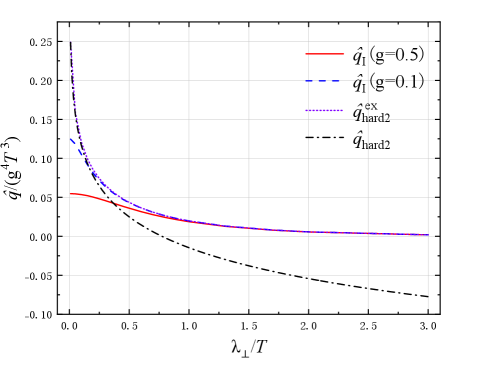
![The dimensionless quantity <span class="katex-eq" data-katex-display="false">q^{\hat{q}}</span> is shown as a function of <span class="katex-eq" data-katex-display="false"> \Lambda_{\perp}/T </span> for varying gauge couplings, comparing results from Eq. (13) with a simplified <span class="katex-eq" data-katex-display="false"> |{\cal M}|^{2} </span> approximation from Ref. [11] and the soft limit given in Eq. (4).](https://arxiv.org/html/2601.11230v1/x4.png)
Looking Ahead: The Polyakov Loop as a Window into the QGP Phase Structure
The quark-gluon plasma (QGP), a state of matter existing at extremely high temperatures, undergoes a phase transition from hadronic matter characterized by confinement to a deconfined state where quarks and gluons are free. The Polyakov loop, a crucial order parameter in quantum chromodynamics (QCD), effectively captures this transition by quantifying the free energy cost of inserting a static quark-antiquark pair. A non-zero Polyakov loop indicates a deconfined state, while a loop tending towards zero signals confinement; thus, its value provides a direct measure of the QGP’s degree of deconfinement. Investigating the Polyakov loop isn’t merely about identifying a phase boundary, however; it offers a window into the complex, non-perturbative dynamics governing the QGP, including the behavior of color fields and the screening of interactions between quarks and gluons, ultimately shaping the QGP’s collective properties and transport coefficients.
The relationship between the Polyakov loop and the calculation of \hat{q}, a key parameter describing the jet quenching within the quark-gluon plasma (QGP), reveals a fundamental connection between the QGP’s phase structure and its transport properties. The Polyakov loop, acting as an order parameter for confinement, essentially signals the degree to which quarks and gluons are liberated within the plasma. By linking its value to \hat{q}, researchers gain insight into how the QGP’s state – whether it’s more or less deconfined – directly influences the energy loss experienced by high-energy particles traversing it. This connection allows for a deeper understanding of how the QGP’s microscopic properties, dictated by its phase, translate into macroscopic observables related to particle suppression and flow, ultimately refining models used to characterize this extreme state of matter created in heavy-ion collisions.
Recent investigations have yielded a specific parametrization-(1 - 43.89<i>q^2 + 113.74</i>q^3)-for the ratio of q̂ to q, offering a novel approach to modeling the influence of the background field on the jet quenching parameter. This functional form effectively captures the relationship between the order parameter and the medium’s response to energetic particles traversing the quark-gluon plasma (QGP). By accurately representing this interplay, the parametrization allows for refined calculations of jet quenching, ultimately providing a more detailed understanding of the QGP’s properties and its impact on observables from heavy-ion collisions. The precision afforded by this mathematical description facilitates predictive modeling and allows researchers to explore the complex dynamics governing particle production within the extremely hot and dense environment created in these collisions.
The study’s exploration of the jet quenching parameter and its suppression near the critical temperature echoes a principle of refined understanding. The research demonstrates that as the quark-gluon plasma approaches deconfinement, this parameter-a measure of energy loss-diminishes significantly. This subtle shift, crucial to understanding the plasma’s properties, exemplifies how a nuanced approach reveals deeper truths. As Simone de Beauvoir once stated, “One is not born, but rather becomes, a woman.” Similarly, the quark-gluon plasma doesn’t simply exist; its properties emerge through the complex interplay of forces, revealing themselves only through careful observation and theoretical refinement. The elegance of this work lies in its ability to illuminate this emergence, highlighting the delicate balance within the system.
Further Horizons
The observed suppression of the jet quenching parameter near the deconfinement temperature is not merely a numerical curiosity. It suggests that the transition to the quark-gluon plasma is not a sudden, violent rupture, but a more gradual softening – a yielding of the strong force’s grip. This hints at a complex interplay between short-range correlations and long-range fluctuations, a dance that current models, reliant on often-crude approximations, struggle to fully capture. The elegance of a truly predictive theory demands a more nuanced description of the plasma’s initial state, accounting for pre-equilibrium dynamics with greater fidelity.
Future investigations must address the limitations inherent in relying solely on transport coefficients. These macroscopic descriptors, while useful, obscure the microscopic origins of energy loss. A more complete understanding requires a deeper connection to the underlying degrees of freedom – the explicit inclusion of color-singlet formation and the detailed accounting of gluon occupancy. The pursuit of this understanding is not simply about refining parameters; it is about revealing the intrinsic logic of the plasma itself.
One anticipates that refinements in effective field theories, coupled with advances in lattice QCD calculations, will offer increasingly stringent tests of theoretical predictions. The goal, after all, is not simply to describe the quark-gluon plasma, but to understand why it exists, and how its properties emerge from the fundamental laws governing the strong interaction. A truly satisfying explanation will be both predictive and, dare one say, beautiful.
Original article: https://arxiv.org/pdf/2601.11230.pdf
Contact the author: https://www.linkedin.com/in/avetisyan/
See also:
- Forza Horizon 6: Find the Ohtani Treasure Chest Location
- NTE Drift Guide (& Best Car Mods for Drifting)
- Diablo 4 Best Loot Filter Codes
- LEGO Batman Legacy of the Dark Knight Batcave Minikits & WayneTech Caches
- Boruto: Ikemoto Has Already Hinted At Sasuke’s New Eye After Return
- USD RUB PREDICTION
- Where to Find Prescription in Where Winds Meet (Raw Leaf Porridge Quest)
- Top 10 Must-Watch Isekai Anime on Crunchyroll Revealed!
- GBP CNY PREDICTION
- Deltarune Chapter 1 100% Walkthrough: Complete Guide to Secrets and Bosses
2026-01-21 05:19