Author: Denis Avetisyan
A new approach combining aerial drones and reconfigurable intelligent surfaces dramatically improves the reliability of secure millimeter wave communications.

This work presents a chance-constrained optimization framework for minimizing secrecy outage probability in hybrid RIS-UAV networks utilizing deterministic approximation and convex optimization techniques.
Securing wireless communications in the face of evolving threats and complex channel conditions remains a significant challenge. This is addressed in ‘Chance-Constrained Secrecy Optimization in Hybrid RIS-Empowered and UAV-Assisted Networks’, which investigates a novel architecture integrating unmanned aerial vehicles (UAVs) with reconfigurable intelligent surfaces (RIS) – including both terrestrial and holographic deployments – to minimize secrecy outage probability. By formulating a robust optimization framework accounting for user mobility, hardware impairments, and colluding eavesdroppers, the authors demonstrate substantial performance gains compared to conventional approaches, achieving significant reductions in secrecy-outage probability. Could this hybrid RIS and UAV paradigm represent a key enabling technology for future secure and reliable millimeter-wave communications?
Beyond the Limits of Conventional Wireless
Contemporary wireless networks face escalating demands for seamless connectivity and accelerated data transmission, a challenge acutely felt in increasingly complex environments. The proliferation of devices, coupled with bandwidth-intensive applications, is pushing existing infrastructure to its limits; signal propagation is often hindered by obstacles like buildings, foliage, and even atmospheric conditions, leading to dropped connections and reduced performance. This difficulty isn’t simply a matter of adding more base stations, as traditional deployments struggle to provide reliable coverage indoors and in dense urban areas due to limitations in signal penetration and the high costs associated with extensive infrastructure. Consequently, innovative approaches to wireless communication are crucial to satisfy the growing need for robust and dependable connectivity in all settings.
Conventional wireless network design relies heavily on direct, unobstructed paths between base stations and devices, a limitation known as line-of-sight restriction. This necessitates a high density of base stations, particularly in urban canyons, indoor environments, and areas with significant foliage, to ensure reliable coverage. The resulting infrastructure is not only expensive to deploy and maintain – requiring substantial real estate, power, and backhaul connectivity – but also introduces considerable logistical challenges. Each additional base station adds to operational costs and complicates network management, hindering the scalability needed to support the ever-increasing demand for mobile data and the proliferation of connected devices. Consequently, overcoming these limitations is paramount to achieving truly ubiquitous and cost-effective wireless connectivity.
The proliferation of extended reality (XR) and the increasing automation of industrial processes are driving unprecedented demands on wireless communication systems. XR applications, encompassing virtual, augmented, and mixed reality, require extremely low latency and ultra-high bandwidth to deliver seamless and immersive experiences; current networks often struggle to meet these stringent requirements. Simultaneously, industrial automation, with its emphasis on real-time control of robots, sensors, and machinery, demands highly reliable and deterministic wireless connections. These emerging applications necessitate a shift beyond conventional wireless architectures, calling for solutions that are not only capable of supporting higher data rates but also of adapting dynamically to varying environmental conditions and ensuring consistently reliable performance in critical operational scenarios. Consequently, research and development are heavily focused on innovative technologies – such as intelligent reflecting surfaces, massive MIMO, and advanced network slicing – to build wireless networks capable of powering the future of immersive experiences and automated industries.
The performance of modern wireless systems is fundamentally linked to how accurately the radio propagation environment – the wireless channel – is represented. Developing precise channel models is therefore crucial for designing reliable and efficient communication links, especially as demand for data-intensive applications increases. These models aren’t created in isolation; instead, they are heavily guided by standards set forth by 3GPP, the global standardization body for mobile telecommunications. 3GPP standards define scenarios, parameters, and methodologies for channel modeling, ensuring interoperability and allowing for realistic simulation and testing of new wireless technologies. By adhering to these guidelines, engineers can predict signal strength, interference, and other channel characteristics, optimizing network performance and paving the way for advancements in areas like 5G, 6G, and beyond – enabling robust connectivity even in challenging environments.
Reflecting a New Paradigm: Intelligent Wireless Surfaces
Reconfigurable Intelligent Surfaces (RIS) represent a departure from traditional wireless infrastructure by employing large, planar arrays of passive reflecting elements. These elements can individually adjust the phase and/or amplitude of incident electromagnetic waves, enabling precise control over signal propagation. Unlike active relaying or massive MIMO, RIS require minimal RF chains, resulting in significantly lower hardware costs and energy consumption. This passive operation drastically reduces power requirements, potentially enabling deployment in locations where active infrastructure is impractical or cost-prohibitive. By intelligently reflecting signals, RIS can enhance signal strength, extend coverage range, mitigate interference, and improve network capacity without the complexity and expense associated with traditional base station upgrades or densification.
Advanced Reconfigurable Intelligent Surface (RIS) architectures extend capabilities beyond simple signal reflection. Simultaneously Transmitting and Reflecting RIS (STAR-RIS) allows for both the reflection of incoming signals and the transmission of independent signals, increasing spectral efficiency and enabling multi-user communication. Holographic RIS (H-RIS) utilizes a large number of reflecting elements to synthesize arbitrary wavefronts, enabling precise beamforming and focusing capabilities. This is achieved through precise control of phase shifts introduced by each element, allowing for dynamic control of the signal’s amplitude and direction of arrival. These architectures move beyond passive reflection, offering greater flexibility in managing wireless propagation and improving link reliability.
Unmanned Aerial Vehicles (UAVs) offer a dynamic approach to wireless network coverage by functioning as mobile deployment platforms for Reconfigurable Intelligent Surfaces (RIS). Traditional static RIS deployments are limited by fixed geometries and inability to respond to changing environments. UAV-based RIS deployment allows for on-demand positioning to bypass obstacles, enhance signal strength in shadowed areas, and create adaptive coverage footprints. This is particularly useful in scenarios with temporary obstructions, rapidly changing user densities, or where establishing fixed infrastructure is impractical or cost-prohibitive. By intelligently positioning RIS elements via UAVs, signal reflections can be steered to improve signal-to-noise ratio and data rates for targeted users, offering a flexible and responsive network solution.
Effective channel estimation is critical for optimizing the deployment of Reconfigurable Intelligent Surface (RIS) enabled platforms, such as those utilizing Unmanned Aerial Vehicles (UAVs). Accurate channel state information (CSI) allows for precise beamforming and reflection control at the RIS, maximizing signal strength and minimizing interference. This estimation process is complicated by the dynamic nature of wireless channels and the mobility of both the UAV platform and potential user equipment. Techniques employed include pilot-based methods, leveraging known signals to estimate channel characteristics, and exploitation of channel reciprocity, where uplink and downlink channels are assumed to be similar. Furthermore, machine learning algorithms are increasingly utilized to predict channel variations and enhance the accuracy of estimation, particularly in complex and rapidly changing environments. The quality of channel estimation directly impacts the achievable data rate, reliability, and energy efficiency of the wireless communication system.
Optimizing Signal Control: Methods for Enhanced Performance
Beamforming is a signal processing technique utilized in wireless communication systems to concentrate radio frequency (RF) energy in a specific direction. Both base stations (BS) and intelligent reflecting surfaces (RIS) employ beamforming to enhance signal strength and improve signal-to-interference-plus-noise ratio (SINR) for targeted user equipment. This is achieved by manipulating the phase and amplitude of signals transmitted or reflected from multiple antenna elements. By constructively interfering signals in the desired direction and destructively interfering signals in other directions, beamforming mitigates path loss and interference, ultimately increasing data rates and extending communication range. The technique relies on knowledge of the channel state information (CSI) between the transmitter and receiver to calculate the appropriate beamforming weights.
Successive Convex Approximation (SCA) is employed in signal control optimization due to the inherent non-convexity of many related problems. Non-convex optimization challenges, where a globally optimal solution cannot be guaranteed through standard convex optimization techniques, frequently arise when optimizing beamforming weights and Reflecting Intelligent Surface (RIS) configurations. SCA iteratively approximates the non-convex problem with a series of convex approximations. Each approximation is solvable using well-established convex optimization algorithms. By repeatedly solving these approximations and updating the solution, SCA converges towards a locally optimal solution. This approach is particularly useful when dealing with constraints that introduce non-convexity, such as those related to power limitations or signal quality requirements. The accuracy of the solution depends on the tightness of the convex approximations and the number of iterations performed.
Alternating Optimization is a commonly employed technique for optimizing wireless communication systems incorporating intelligent reflecting surfaces (RIS). This method addresses the complexity of jointly optimizing RIS configurations – including phase shifts applied to reflected signals – and base station beamforming weights. The process involves iteratively refining these parameters; first, the beamforming weights are optimized assuming fixed RIS settings, and then the RIS configuration is optimized with the beamforming weights held constant. This cycle repeats until convergence, effectively maximizing received signal strength and minimizing inter-user interference. The algorithm’s efficiency stems from breaking down a complex, non-convex problem into a series of more manageable convex sub-problems, each solvable with standard optimization techniques.
The performance of signal control optimization techniques, including beamforming and intelligent reflecting surface control, is fundamentally limited by the fidelity of channel modeling and the effective management of Error Vector Magnitude (EVM). Accurate channel estimation, accounting for path loss, fading, and interference, is crucial for deriving optimal beamforming weights and RIS configurations. EVM, a measure of signal distortion, directly impacts the Signal-to-Interference-plus-Noise Ratio (SINR) and, consequently, data throughput; high EVM necessitates more robust modulation and coding schemes, reducing spectral efficiency. Therefore, algorithms must not only optimize signal transmission but also incorporate mechanisms to predict and mitigate EVM degradation caused by channel impairments and hardware non-linearities. Failure to accurately model these factors results in sub-optimal performance and reduced system capacity.
Securing the Future: Impact and Expanding Horizons
Intelligent reflecting surfaces and adaptive wireless platforms promise a substantial leap forward in network performance and reach. By dynamically controlling the propagation of radio waves, these technologies effectively reshape the wireless environment, boosting signal quality and expanding coverage areas – particularly in challenging environments like dense urban settings or within buildings. This enhanced
Intelligent control of signal propagation offers a promising pathway to fortify wireless communication security and mitigate the threat of eavesdropping. Recent advancements demonstrate the ability to substantially reduce
Despite promising results, realizing the full potential of reconfigurable intelligent surfaces (RIS) demands continued innovation in algorithm development and practical implementation. Current research focuses on creating robust algorithms capable of dynamically configuring the RIS to adapt to rapidly changing wireless environments and user demands. These algorithms must efficiently optimize signal reflection to maximize quality of service (QoS) while simultaneously minimizing security vulnerabilities. However, transitioning from controlled simulations to real-world deployment introduces significant challenges, including dealing with imperfect channel estimation, hardware limitations, and the complexities of multi-user scenarios. Overcoming these hurdles requires further investigation into cost-effective RIS hardware designs, scalable optimization techniques, and methods for seamless integration with existing wireless infrastructure, ultimately paving the way for truly intelligent and adaptive wireless networks.
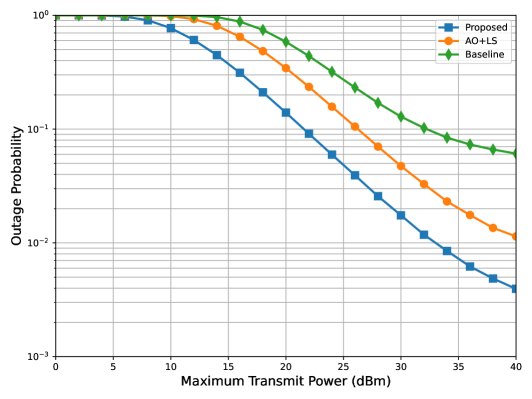
Performance evaluations reveal the proposed system’s significant advantages in securing wireless communications. Specifically, the system achieves a five-fold reduction in secrecy outage probability when operating at 30 dBm transmit power, indicating a substantially lower risk of unauthorized access to transmitted data. Furthermore, the system demonstrates a minimized outage cost of 0.60 while maintaining a quality of service requirement of 1 Mbps/Hz; this represents a marked improvement over competing optimization approaches, which registered outage costs of 0.70 and 0.85 under identical conditions. These results collectively highlight the system’s enhanced reliability and efficiency in delivering secure and dependable wireless connectivity, suggesting a substantial advancement in protecting sensitive information during transmission.
The trajectory of wireless communication is decisively shifting toward networks defined by intelligence, adaptability, and robust security, a transformation fueled by recent advances in reconfigurable intelligent surfaces and dynamic resource allocation. These technologies promise not only to enhance
The pursuit of efficient communication, as detailed in the study of hybrid RIS-empowered networks, echoes a fundamental principle of elegant design. It prioritizes delivering information with minimal overhead, maximizing signal integrity against disruptive forces. This aligns perfectly with Barbara Liskov’s assertion: “The best programs are the ones that are easy to understand.” The paper’s focus on minimizing secrecy outage probability through careful architectural choices – leveraging both UAVs and RIS – demonstrates a commitment to lossless compression of communication, removing unnecessary vulnerabilities and streamlining the pathway to secure data transmission. Every optimization, every carefully placed reflective surface, contributes to a clearer, more reliable signal – a testament to the power of subtraction in achieving impactful results.
Further Refinements
The pursuit of secrecy, as this work demonstrates, inevitably simplifies to a problem of resource allocation. The hybrid architecture – terrestrial reflectors augmented by aerial platforms – offers demonstrable gains, yet remains tethered to assumptions of deterministic channel approximation. A natural progression lies in embracing stochastic models that account for the inherent unpredictability of millimeter wave propagation, particularly in complex urban environments. The current formulation minimizes outage probability; future iterations might prioritize expected conditional secrecy capacity, a metric more closely aligned with actual data throughput.
The optimization itself, while rigorous, rests on convex approximations. While pragmatically efficient, this introduces a degree of suboptimality. Exploring methods to tighten these approximations, or to directly address the non-convexity through techniques like penalty decomposition, could yield marginal but meaningful improvements. Moreover, the analysis currently treats the UAV trajectory as fixed. Allowing the UAV to dynamically adjust its position, informed by real-time channel state information, presents a more ambitious, and potentially more fruitful, line of inquiry.
Ultimately, the value of such investigations isn’t merely in achieving lower outage probabilities. It resides in stripping away the unnecessary complexity of wireless systems, revealing the core principles that govern secure communication. The elegance of a solution, after all, isn’t measured by its intricacy, but by its capacity to distill a problem to its essential form.
Original article: https://arxiv.org/pdf/2601.22499.pdf
Contact the author: https://www.linkedin.com/in/avetisyan/
See also:
- All Skyblazer Armor Locations in Crimson Desert
- All Shadow Armor Locations in Crimson Desert
- How to Get the Sunset Reed Armor Set and Hollow Visage Sword in Crimson Desert
- Marni Laser Helm Location & Upgrade in Crimson Desert
- Best Bows in Crimson Desert
- All Helfryn Armor Locations in Crimson Desert
- All Golden Greed Armor Locations in Crimson Desert
- How to Craft the Elegant Carmine Armor in Crimson Desert
- Keeping Large AI Models Connected Through Network Chaos
- One Piece Chapter 1179 Preview: The Real Imu Arrives in Elbaf
2026-02-02 20:18