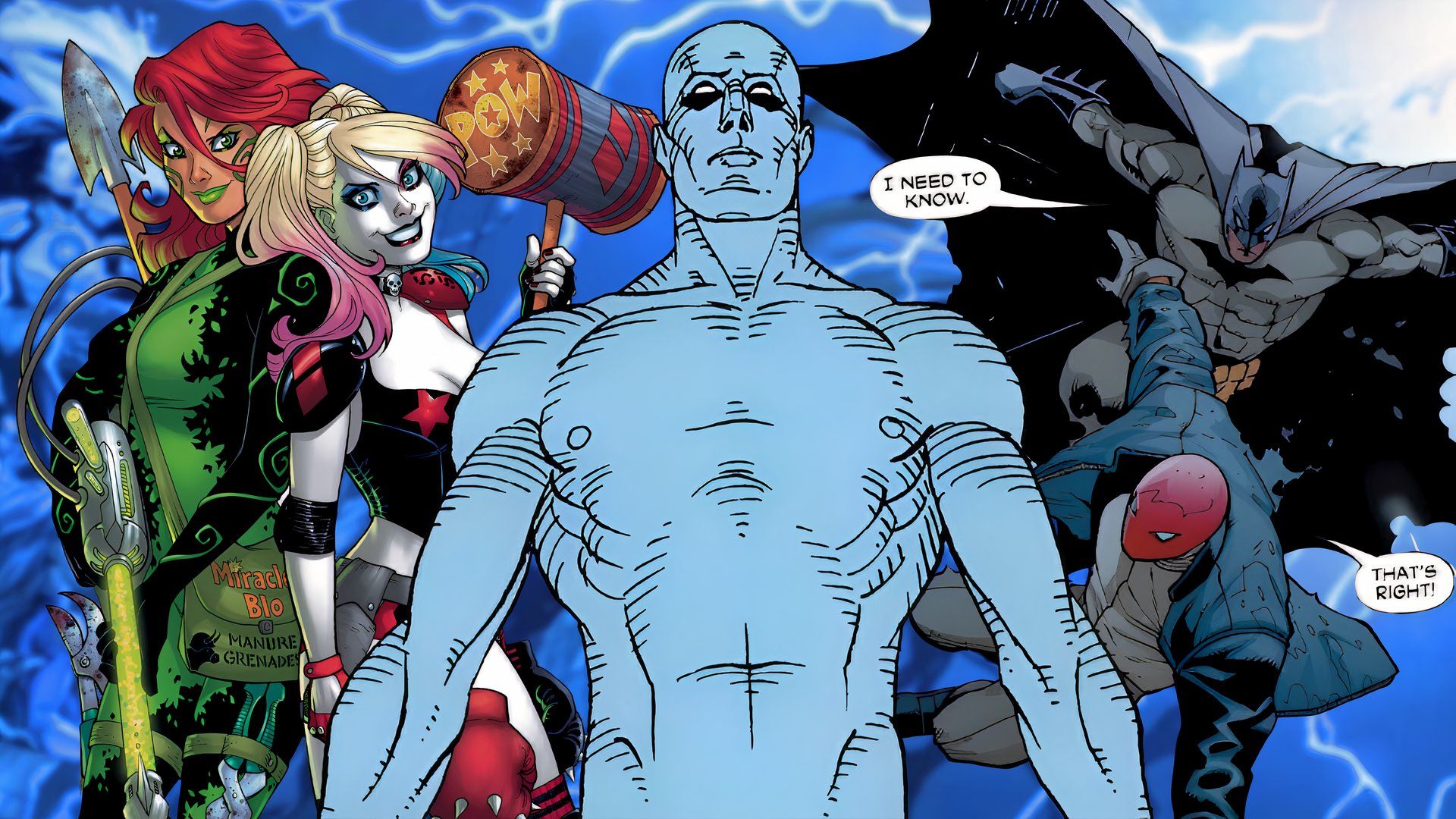
The world of DC Comics is huge, and fans have tons of theories about its characters. While recent stories are trying new things – like the idea that Darkseid created the bleak Absolute Universe – many fans still fondly remember older storylines and how much they mattered. They still debate what happened to heroes during past “Crises,” or argue about which stories are officially part of the DC Universe after each major reset.
Fans used to eagerly discuss the strengths of different characters, predict how battles would go, and even guess what would happen in major storylines. They’d often head to online forums to talk about big events in DC Comics, debating whether rumors and theories were true. Some of these theories initially seemed far-fetched, but DC Comics would sometimes drop hints that fans were actually on the right track.
There Were Three Jokers
Joker’s Shifting Personalities Felt More Like Separate People
Batman and the Joker are inseparable, and their contrasting natures have long been a topic of discussion among comic book fans. One puzzling aspect of the Joker is his inconsistent portrayal – he’s been shown as calculating, then violent and over-the-top, and finally as a deeply disturbed and hopeless character. This lack of a consistent personality has led to speculation. Some believe it’s simply due to the Joker’s fractured psyche, while others theorize that ‘the Joker’ isn’t a single person, but a role filled by different individuals all connected by their opposition to Batman. The comics finally offered an explanation in 2015’s Darkseid War, when Batman, using Metron’s chair, gained universal knowledge.
When Batman asked the Joker for his real name, he didn’t get an answer – instead, three different Jokers appeared, leaving fans confused. The 2020 story, “Three Jokers,” finally revealed the truth: “The Joker” wasn’t one person, but a title held by three different men throughout history. These were the Criminal (the original Joker from the Golden Age), the Clown (who killed Jason Todd during the Silver Age), and the Comedian (responsible for paralyzing Barbara Gordon in the Modern Age). It was then revealed that the Criminal Joker had eliminated the other two, Batman actually knew the Joker’s true identity all along, and the appearance of “Three Jokers” was simply the Joker switching between his different personalities.
Darkseid Has Been An Avatar All Along
A God Has No Business Showing His Real Form To Mere Mortals
Darkseid is widely considered the most intimidating villain in comic books, and he even served as the original inspiration for Marvel’s Thanos. Created by Jack Kirby as part of his “Fourth World” series, Darkseid is a New God meant to represent pure evil, and he quickly became a major villain throughout the entire DC Universe. Despite his power, his schemes are consistently stopped by Superman and the Justice League. Interestingly, the extent of his power varies; sometimes he’s an overwhelmingly powerful threat, while other times even Batman can avoid his signature Omega Beams.
Some fans believe Darkseid’s powers seem inconsistent because, as a god, he requires an earthly form, or avatar, to maintain a stable presence in our world. Others dismiss this as a justification for poor storytelling, but writer Grant Morrison supported the idea in 2008 with the storyline Final Crisis. This story revealed that reality was breaking down because the original Darkseid, his true divine form, was dying. The 2014 DC Multiverse Map further clarified this, officially placing the New Gods in a dimension beyond the DC Multiverse, meaning each Darkseid across different universes is merely a piece of a larger, unified being. By 2021’s Infinite Frontier, Darkseid had returned to operating from the shadows, having merged all his past incarnations into a single Godhead and gained awareness of all his previous existences, including those from before and after major DC Universe reboots like Crisis and New 52.
Magog In “Kingdom Come” Is A Cable Parody
It’s All About The Pockets, The Guns, And The Edge
Fans looking for something different from long, continuous comic book stories often discover Kingdom Come, a 1996 tale by Mark Waid with stunning artwork by Alex Ross. It presents a future where classic superheroes clash with a new generation of more aggressive heroes. One of these new heroes is Magog, marketed as the successor to Superman. Unlike the hopeful Superman, Magog is equipped with a glowing eye, a robotic arm, a powerful energy staff, and numerous pockets, making him a very different kind of hero.
Fans have noticed a funny resemblance between the character Magog and Cable. Alex Ross actually confirmed this, stating that Magog was intentionally designed as a parody of Cable. Specifically, Magog’s look mocks the popular 1990s superhero trend of tough, scarred characters with dark storylines and overly-equipped costumes – trading practical boot design for an excessive number of pockets.
 Find all 10 pairs Results
Doctor Manhattan Indeed Created The New 52 Multiverse
The Hand In The Light Was A Meme That Made Sense
Even though it was published decades ago, Watchmen is still highly regarded in the comic book world for its unique artwork, insightful social and political themes, and its reimagining of the superhero concept. Because of this, DC Comics largely left Watchmen untouched after its 1986 release—until the 2010s. Facing declining sales, DC published a Watchmen prequel, Before Watchmen, and altered the timeline in Flashpoint. The Flashpoint storyline was especially significant, leading to a company-wide reboot called The New 52, which introduced a darker, more modern take on the DC multiverse and its younger heroes.
After the reboot known as The New 52 didn’t connect with readers, DC Comics tried relaunching their universe again with Rebirth. The initial teasers for Rebirth showed heroes reaching for a light, which hid a mysterious hand, sparking fan speculation – many joked it belonged to Doctor Manhattan. Rebirth #1 then revealed a shocking twist: ten years had been erased from the DC Universe’s timeline. The only clue was a bloodied yellow smiley face pin, a direct reference to the Watchmen comic. This quickly led fans to believe Doctor Manhattan was involved, and some even thought he was responsible for everything. Rebirth #7 confirmed these suspicions, revealing that Doctor Manhattan had actually created The New 52 in an attempt to disrupt the generally optimistic DC Multiverse. Finally, in 2018’s Doomsday Clock, Superman managed to convince Doctor Manhattan to restore the timeline.
Jason Todd Is The Red Hood
Some Felt It Was Way Too Early To Resurrect Him
In recent comics, Jason Todd is usually seen as the Red Hood – the rebellious member of the Bat Family known for using guns and violence, which Batman disapproves of. However, long-time fans remember Jason’s start as the second Robin, initially introduced as a thief trying to steal the Batmobile’s tires. He was already known for his fiery temper, but the biggest surprise came in 1988 with the storyline A Death in the Family. DC Comics actually let fans vote on whether Jason would live or die after being captured by the Joker. The Joker brutally tortured Jason and then blew him up in a warehouse (in Batman #427), and in the following issue (Batman #428), Batman discovered Jason’s body – a decision made by fans by a narrow margin of just 72 votes.
When Tim Drake became the new Robin in 1989, the death of Jason Todd pushed the Batman stories into significantly darker territory. Jason remained absent from the comics until 2003, when the “Hush” storyline revealed his empty coffin. The situation escalated in 2004 with “Under the Hood,” which introduced a new Red Hood character who took a far more violent approach to dealing with criminals in Gotham. Importantly, this Red Hood was intimately familiar with Batman’s equipment, strategies, and secret identity. While many fans suspected Jason was the Red Hood, some were hesitant, feeling his death was still too recent. The story reached its peak when Batman was stunned to discover his former student operating as a criminal, with Jason revealed to be alive and filled with intense anger.
Harley Quinn And Poison Ivy Are Lovers
There Was Already Tension In The Comics
Although Harley Quinn is now a well-known DC Comics character, she first became popular not in the comic books, but in Batman: The Animated Series. It was the show that really established her as a recurring villain and sparked the Harley Quinn x Poison Ivy pairing. This began in the 1993 episode Harley and Ivy, where Harley, after being abandoned by the Joker, teams up with Poison Ivy. Throughout the episode, Ivy criticizes the Joker’s mistreatment of Harley and even gives her a special serum that boosts her physical abilities – a concept later adopted in the comics.
From the beginning of their partnership, Harley Quinn and Poison Ivy hinted at a deeper connection than just friendship. When Harley officially joined the DC Comics world in 1999, fans began to suspect a romance, especially after seeing them use affectionate nicknames and become physically closer. After years of speculation, a 2015 tweet confirmed they were girlfriends, but in a non-traditional, non-jealous relationship. The comic Harley Quinn #25 in 2017 further suggested they were in an ongoing, intimate relationship.
Jim Gordon Knew Batman’s Alter Ego All Along
One Of Comics History’s Best Open Secrets
The Bat-Signal is a crucial part of the Batman story, and Commissioner Jim Gordon is usually the one who alerts Batman to trouble in Gotham. But some fans have wondered: given Gordon’s rank, wouldn’t he have figured out Batman is actually Bruce Wayne? Some believe Batman is simply too good at concealing his identity. However, another idea is that Jim Gordon has always known Batman’s secret, and he simply chooses to act as if he doesn’t.
This analysis suggests Jim Gordon likely intentionally overlooked clues about Batman’s true identity – Bruce Wayne – because he understood how vital Batman was to Gotham City. Throughout the comics, Gordon consistently demonstrates his sharp detective skills. For example, in Batman: Year One, he acknowledges his reliance on his glasses after Bruce saves his son, implying he’d recognize Bruce without them. In No Man’s Land, he deliberately avoids fully identifying Batman, suggesting he could have known Bruce’s identity for “years” if he’d truly tried. And in The Robin Factor, he quickly picks up on the new Robin (Jason Todd) and notices Batman’s sadness when Robin is gone. While it’s never explicitly stated, the comics strongly imply Gordon always knew Bruce was Batman.
Read More
- Quantum Agents: Scaling Reinforcement Learning with Distributed Quantum Computing
- Boruto: Two Blue Vortex Chapter 33 Preview — The Final Battle Vs Mamushi Begins
- All Skyblazer Armor Locations in Crimson Desert
- Every Melee and Ranged Weapon in Windrose
- How to Get the Sunset Reed Armor Set and Hollow Visage Sword in Crimson Desert
- One Piece Chapter 1180 Release Date And Where To Read
- New Avatar: The Last Airbender Movie Leaked Online
- USD RUB PREDICTION
- All Shadow Armor Locations in Crimson Desert
- Zhuang Fangyi Build In Arknights Endfield
2026-02-18 04:39