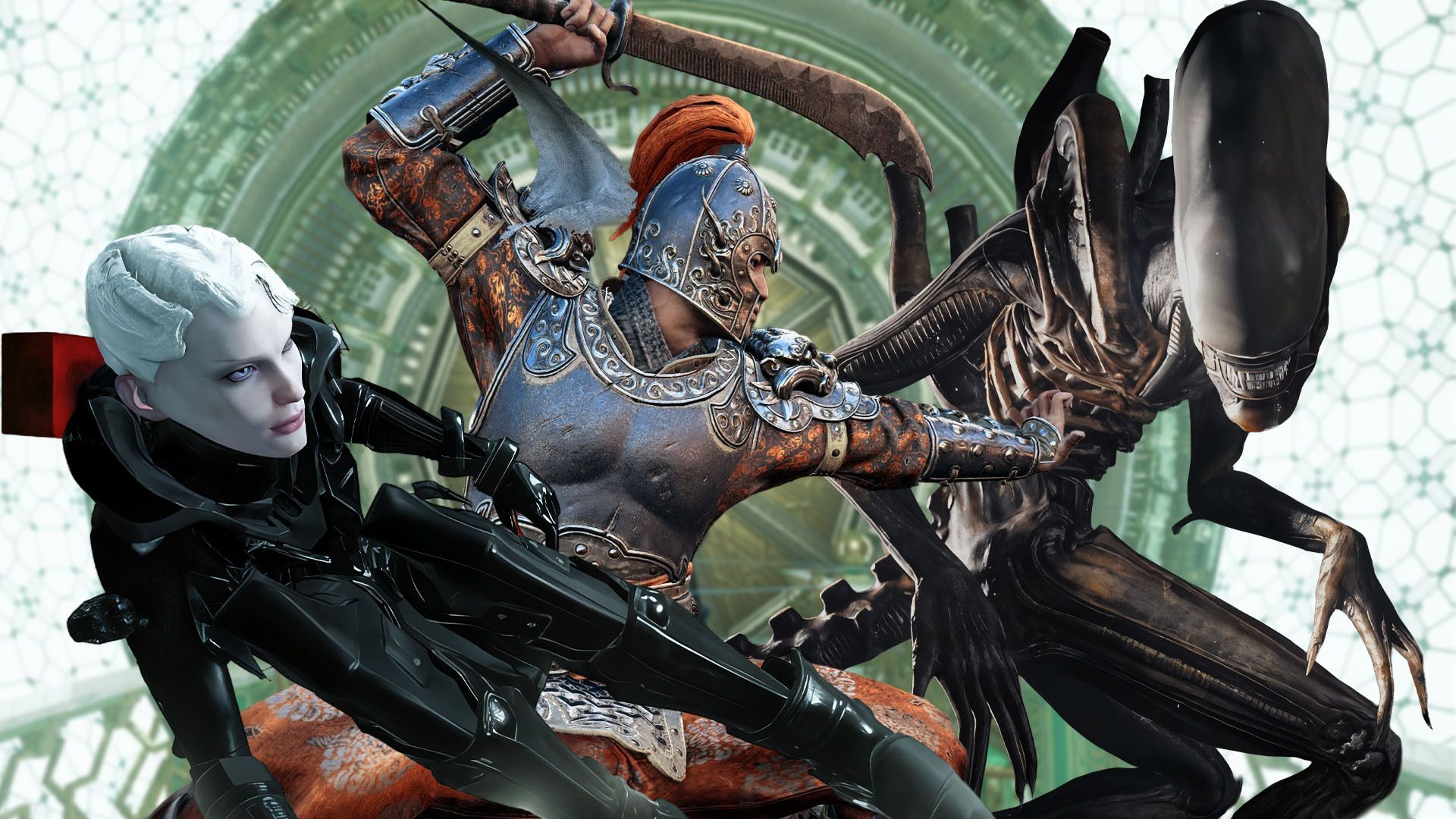
Most video game enemies aren’t just simple, predictable obstacles. Some are designed with intelligence, allowing them to learn from your actions and react accordingly. This makes the gameplay feel more dynamic and less like following a set pattern. In games with this kind of adaptive AI, relying on the same strategies over and over can be dangerous.
If you repeatedly use the same tactics – like a favorite hiding spot, weapon, or attack – your opponents will likely figure it out and start to defend against it. For example, enemies might get better armor or start checking your usual hiding places. Games that adapt to your playstyle reward trying new things, because you need to change your approach once opponents learn what you’re doing.
 Rearrange the covers into the correct US release order.
Your Order
Results
— —
Alien: Isolation
The Xenomorph That Adjusts to A Player’s Repeated Actions
- Survival horror game where the player must evade a single, highly intelligent Xenomorph on a decaying space station.
- The game emphasizes stealth, resource management, and environmental awareness over direct combat.
Alien: Isolation creates a terrifying experience by making you feel like you’re being hunted, rather than constantly running from something. You’re trapped on Sevastopol Station, a rundown space station overrun with dangerous people, broken robots, and a single, deadly Xenomorph. Because supplies are scarce and weapons aren’t always dependable, you’ll need to be careful, observant, and strategic to survive – quick reactions aren’t enough.
The Alien in this game doesn’t follow a set pattern. It responds to what the player does – noises, movement, and how they play. Making loud sounds, repeatedly hiding in the same places, or taking the same routes makes it more likely to find you. The Alien also gets smarter over time; if you use the same tricks again and again, they’ll stop working. This makes it feel like the Alien is learning and adapting its hunt. The game’s AI makes the Alien seem aware of your location and limits its ‘senses’ to what’s realistic. This design keeps the challenge intense without feeling cheap. For example, if the Alien has caught you hiding in a locker before, it might start checking them more often, or wait longer near your usual hiding spots.
Middle-Earth: Shadow of Mordor
Orcs That Remember and Adapt
- Third-person action game set in Tolkien’s world where players fight and manipulate Orc hierarchies.
- The Nemesis System causes enemies to remember encounters and change traits and aggressiveness.
Middle-earth: Shadow of Mordor featured a groundbreaking approach to enemy AI. Its Nemesis System closely follows every encounter between the player and the orc enemies. This means that orcs will grow stronger based on their interactions with the player – if they defeat you, survive your attacks, or experience certain events in battle, they’ll remember you, become more powerful, and even react differently the next time you meet.
In Middle-Earth: Shadow of Mordor, orc enemies remember their encounters with you and react accordingly. For example, an orc burned in a fight might become afraid of fire, while one you showed mercy to might treat you differently. This system, called the Nemesis System, ensures every game feels unique because of the countless ways orc personalities and relationships can develop. You can even turn these orcs into allies and have them fight alongside you.
Echo
Enemies That Copy Your Exact Actions
- A stealth game where the enemy AI literally learns from every action the player takes.
- Each group of enemies copies exactly the player’s abilities from previous cycles. So, if a player sprinted, shot, jumped, etc., the enemies learn those actions next.
In the game, enemies adapt to your playstyle in a unique way, demonstrated by a feature called Echo. Essentially, Echo penalizes skilled players by having enemies learn and replicate their strategies. You play as En, exploring a palace where the lights regularly cycle on and off, causing a system reset. With each reset, enemy clones—the Echoes—copy everything you did in the previous round. This means if you frequently sprinted, jumped over obstacles, used weapons, or crouched, the Echoes will start doing those things too.
These enemies learn by mirroring the player’s actions, making them increasingly difficult to predict and overcome. Players must constantly adapt their strategies, as techniques they once depended on are now used against them. This leads to a consistently challenging experience, where every decision helps the enemy learn and improve.
Metal Gear Solid 5: The Phantom Pain
Guards Learn to Counter a Player’s Repeated Attack Patterns
- A sprawling stealth-action open world with tactical freedom and base-building elements.
- Enemy forces adjust equipment and tactics based on player behavior.
In Metal Gear Solid 5: The Phantom Pain, you have a lot of freedom in how you play. The game pays attention to your choices – how you tackle missions, if you prefer stealth or direct attacks, and what weapons you use. If you consistently use certain strategies, like long-range shots or headshots, the enemies will learn and change their behavior. They might start wearing helmets more often or increase their patrols to stay alert, reacting directly to how you play the game.
In Metal Gear Solid V: The Phantom Pain, enemies are smart. They can detect how you move, notice if you’ve taken out other soldiers, and will adapt their behavior – changing their patrol routes, taking cover, or calling for backup. The game encourages players to try different strategies instead of repeating the same one, because using the same tactics over and over will make things more difficult. Varying your approach keeps enemies guessing. Although the AI doesn’t truly learn like a human, it definitely reacts to predictable patterns and works to overcome them.
Rain World
Predators That Memorize Your Routes and Set Up New Ambushes
- Harsh survival platformer where a creature called a slugcat must navigate a hostile ecosystem.
- Creatures operate independently and respond dynamically to movement and sound.
I’ve been playing Rain World, and it’s fascinating how the creatures behave. It’s not like some games where enemies learn from you directly, like in Echo or Metal Gear Solid 5. Instead, it feels like a real ecosystem. The predators, like lizards, don’t just attack – they stalk, they run away when they’re scared, they even sleep! They hunt together, and they definitely react to what I do – the sounds I make, and even just how I move around. It makes everything feel so much more alive and responsive.
The lizards that hunt you in Rain World aren’t just enemies – they have distinct personalities and learn from your actions. For example, if you keep escaping a lizard by taking the same path, it might change its route to anticipate and block you.
Galactic Civilizations 2: Dread Lords
AI Empires That Adjust Strategy
- Turn-based 4X space strategy game.
- AI empires adjust strategy based on player decisions.
The AI in Galactic Civilizations 2 doesn’t focus on enemies learning your specific tactics. Instead, it changes its overall strategy based on how you play the game. Opponents will modify their technology, build different fleets, and choose new diplomatic approaches to counter your actions across the galaxy.
When you choose a higher difficulty level, the AI gets economic and strategic advantages. It also adapts by building ships specifically designed to challenge your playstyle – for example, if you rely on lasers, it will create ships with strong shields. This makes the AI feel dynamic and responsive throughout the game, reacting to your choices and strategies as you play.
For Honor
Advanced Bots That Track a Player’s Attack Patterns to Predict Their Next Move
- A competitive fighting game where players choose heroes from different factions like Knights, Vikings, and Samurai.
- While mostly a multiplayer game, it features enemy bots that attempt to mimic or counter player behavior.
In the game For Honor, combat is special because it focuses on your character’s position, timing, and the direction you attack. When practicing against computer-controlled opponents, you can choose how challenging they are. At higher difficulty levels, these opponents will use a wider range of attacks, and will block and dodge more often, making them react more realistically to your moves.
While the basic AI doesn’t remember your actions from previous matches, more advanced bots learn and adapt during a single fight. They’ll try to block your common attacks or defend against the directions you usually aim for – it’s a basic way they respond to how you play in the moment.
Read More
- Quantum Agents: Scaling Reinforcement Learning with Distributed Quantum Computing
- All Skyblazer Armor Locations in Crimson Desert
- Every Melee and Ranged Weapon in Windrose
- How to Get the Sunset Reed Armor Set and Hollow Visage Sword in Crimson Desert
- Zhuang Fangyi Build In Arknights Endfield
- Windrose Glorious Hunters Quest Guide (Broken Musket)
- Black Sun Shield Location In Crimson Desert (Buried Treasure Quest)
- Best Dual-Wield Swords Build in Crimson Desert
- Jojo’s Bizarre Adventure Ties Frieren As MyAnimeList’s New #1 Anime
- Invincible: 10 Strongest Viltrumites in Season 4, Ranked
2026-02-20 02:38