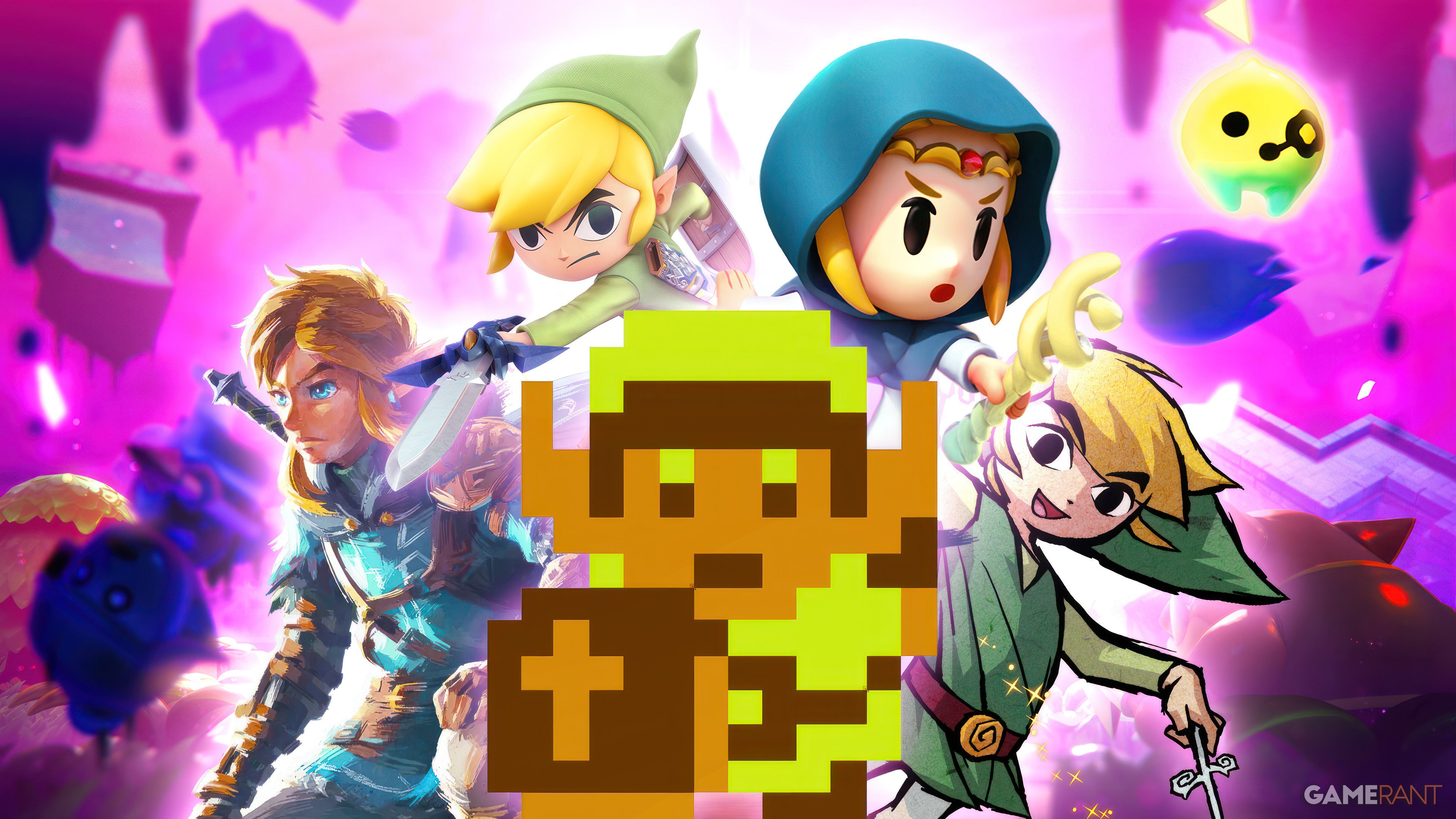
When The Legend of Zelda first came out in 1986, it didn’t seem like it would change gaming forever. It was a simple top-down adventure game featuring a quiet, green-clad hero with just a wooden sword. Yet, even Nintendo likely didn’t realize how influential it would become. Though it appeared basic, the game’s underlying design contained ideas that would deeply impact the industry, and many games today still build upon those concepts. In the years since its release, The Legend of Zelda fundamentally altered how developers created game worlds, gave players freedom, and structured long-term gameplay.
Even after 40 years, The Legend of Zelda continues to influence the video game industry. In fact, at least three Zelda titles consistently rank among the top 10 greatest video games of all time. A recent analysis, which combined data from over 900 “greatest games” lists, confirmed this, placing Breath of the Wild, Ocarina of Time, and A Link to the Past all within the top 10, with Breath of the Wild taking the number one spot. This is a unique accomplishment – no other franchise, including Super Mario, has managed to have so many games ranked so highly, proving the lasting impact Zelda has had on gaming since its debut four decades ago.
In 1986, Zelda Introduced Players to an Open World That Trusted Them
Growing up with games in the 80s meant most of them were pretty straightforward – you went from level to level, and things just got harder and harder. But then The Legend of Zelda came out in 1986, and it was totally different! It didn’t really tell you what to do. You just started in the world of Hyrule with almost no instructions and were expected to explore and figure things out on your own. Honestly, when I play games like Breath of the Wild or Tears of the Kingdom now, that feeling of freedom and discovery… I always thought that was a newer thing! But no, Zelda was doing that over 40 years ago. It was revolutionary!
Who’s That Character?  Identify the silhouettes before time runs out.
Results
High Score: 0 —
Before Zelda, most console games revealed their worlds step-by-step, unlocking areas as the player progressed. The game world only existed as the developers intended you to see it. Zelda, released in 1986, changed that by presenting a fully realized overworld from the start. Players could explore almost anywhere and complete dungeons in any order they chose. What was truly remarkable was that the game didn’t hold your hand – it simply let you explore and discover things on your own, making curiosity its own reward.
As a huge fan, one of the things that really blew me away about The Legend of Zelda was how it let you save your progress! Before that, most console games were like arcade games – you had to finish them in one go. But Zelda changed everything. It felt like a real, living world you could explore at your own pace, and it remembered everything you did even when you turned off the console. It wasn’t just a game; it was an adventure you could pick up whenever you wanted, and that was revolutionary!
The Second Quest in the original 1986 Zelda is a very early example of what’s now commonly called “New Game Plus” – a feature where you can replay the game with some of your progress carried over.
Looking back, Zelda really changed everything for console gaming. Before that, most games were pretty linear – you started at the beginning and went straight to the end. Zelda let you explore the world however you wanted, and your progress actually stuck – you could turn off the console and pick up right where you left off. A game called Pop and Chips had saving way back in ’85, but Zelda is what really made it a standard feature. While some older PC games were open-world, Zelda brought that feeling to consoles, and that’s where most people were gaming. Honestly, it basically created the action-adventure genre as we know it, influenced tons of RPGs that mixed action with storytelling, and just raised the bar for all games going forward.
Zelda’s Ability to Reinvent Itself Without Losing Itself Has Added Years to Its Influence
Even if Nintendo had only released the first Zelda game in 1986, it would still be remembered for its impact on gaming. But as of 2026, the Zelda series includes over 30 games, with more than 20 being core, official entries. Few video game franchises last that long, and Zelda‘s success is largely due to its ability to evolve and stay fresh without losing what makes it special. This constant reinvention allows it to consistently push boundaries with new gameplay ideas, making it a leader in the industry. Zelda games often become huge hits, something most franchises can only dream of.
Ocarina of Time’s Z-targeting System Became the Blueprint for Nearly Every 3D Action Game Thereafter
Released in 1998, The Legend of Zelda: Ocarina of Time successfully brought the series’ core concepts into a 3D world while still challenging players to think for themselves. While the game introduced many impactful ideas to the Zelda franchise, its innovative Z-targeting system revolutionized 3D combat. This system, which allowed players to lock onto enemies, greatly influenced the design of countless action games, including modern “Souls-like” titles. Though Mega Man Legends (released in 1997) featured a similar lock-on mechanic, it lacked the smooth movement and focused camera control that Ocarina of Time perfected. Ocarina of Time’s Z-targeting essentially became the standard for 3D action games going forward.
Breath of the Wild Reintroduced Gaming to the Original Zelda’s Groundbreaking Design Philosophy
In 2017, Zelda: Breath of the Wild arrived and quickly became one of the most popular games of the 2000s. It felt like a fresh take on the original 1986 classic, letting players explore a huge, intriguing Hyrule with very few instructions and almost endless freedom. Players could travel anywhere, climb anything, play with the game’s physics, and find their own solutions to challenges. Tears of the Kingdom built on this idea even further, giving players tools like Link’s Ultrahand ability to encourage creativity and improvisation instead of just following a set path.
The upcoming game Crimson Desert from Pearl Abyss features a skill that strongly resembles Link’s Ultrahand ability from The Legend of Zelda: Tears of the Kingdom.
Following the success of Breath of the Wild and Tears of the Kingdom, many other games have taken inspiration from The Legend of Zelda formula. Breath of the Wild’s innovative design – its realistic physics, interactive world, and focus on letting players create their own experiences – had a huge impact on open-world games. Titles like Elden Ring, Genshin Impact, Sable, and Dredge have all acknowledged Breath of the Wild as a key influence, and it’s clear the game has shaped many others, even if their developers haven’t publicly said so.
Despite changes over the years, the Zelda series has stayed true to its core. Even when Breath of the Wild was called a major shift, it was actually a return to the series’ roots. It took the original Zelda from 1986 and updated it with modern technology and open-world gameplay, which is probably why it was so well-received. At a time when many open-world games felt stale and overly complex, Breath of the Wild simplified things, trusting players to explore and figure things out on their own. This just reinforces how often the gaming industry looks to Zelda as a model for good game design.
Although some called Breath of the Wild a huge change for the Zelda series, it actually felt like a return to the series’ roots, as predictable as that might seem.
Even after 40 years since the original The Legend of Zelda introduced a new kind of adventure, it doesn’t quite get the recognition as a groundbreaking game that it deserves. Back in 1986, it showed developers that players thrive on freedom, intriguing mysteries, and worlds that challenge them. Today, in 2026, that same approach continues to shape game design, particularly as developers strive for deeper immersion and more rewarding exploration. Simply put, The Legend of Zelda has repeatedly redefined what players expect from games, and the fact that developers still look to it for inspiration after all these years demonstrates how timeless its core ideas truly are.
Read More
- Every Melee and Ranged Weapon in Windrose
- All Skyblazer Armor Locations in Crimson Desert
- How to Get the Sunset Reed Armor Set and Hollow Visage Sword in Crimson Desert
- Quantum Agents: Scaling Reinforcement Learning with Distributed Quantum Computing
- Jojo’s Bizarre Adventure Ties Frieren As MyAnimeList’s New #1 Anime
- Top 10 Must-Watch Isekai Anime on Crunchyroll Revealed!
- Grime 2 Map Unlock Guide: Find Seals & Fast Travel
- Re:Zero Season 4 Episode 3 Release Date & Where to Watch
- All Upcoming Banners in Umamusume Global
- Black Sun Shield Location In Crimson Desert (Buried Treasure Quest)
2026-02-20 18:38