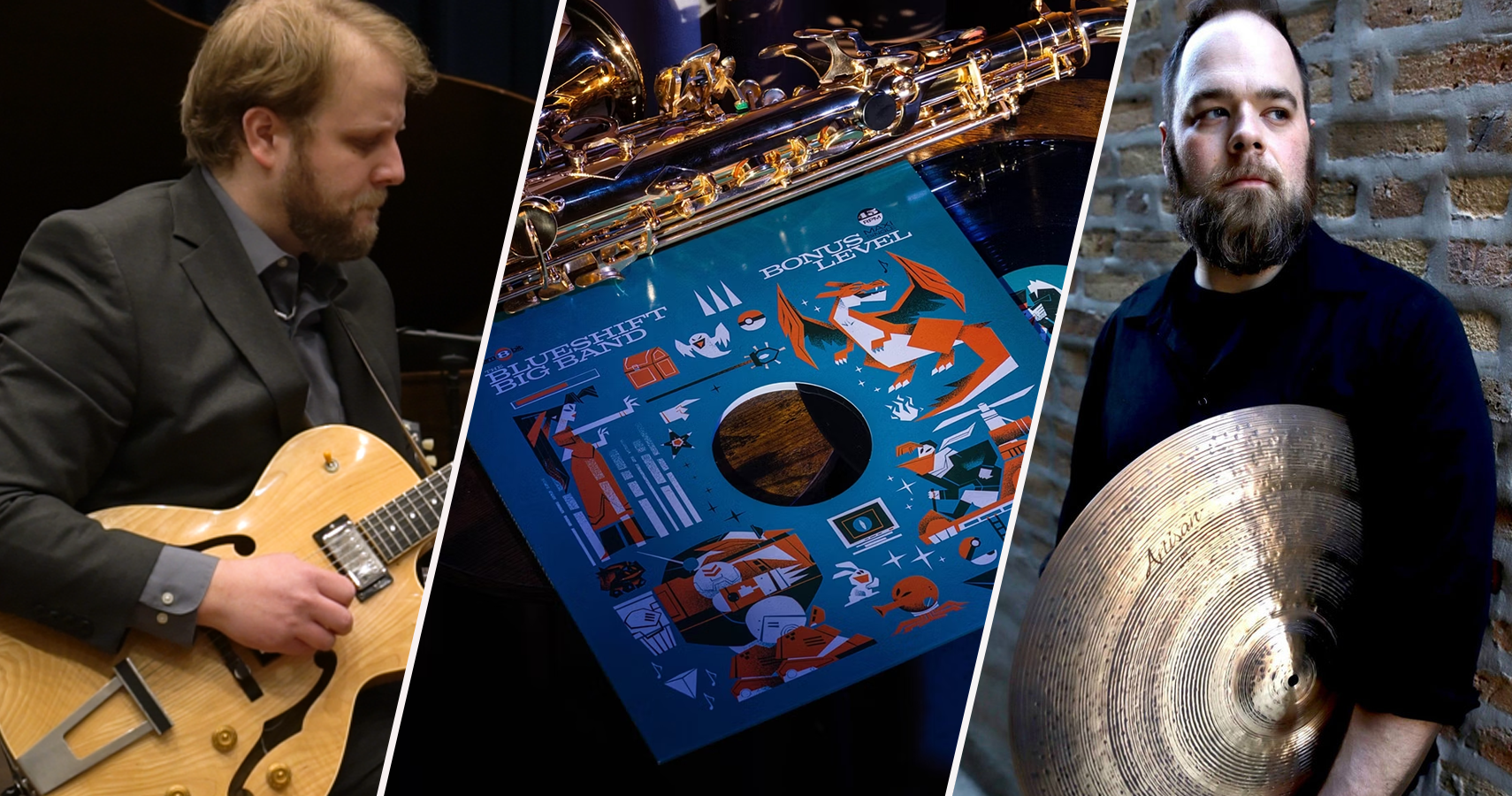
Blueshift Big Band has released a new album, teaming up with iam8bit for another edition of their Joystick Jazz series. Titled Joystick Jazz: The Blueshift Big Band Plays Iconic Video Game Hits (BONUS LEVEL), the album features jazzy remixes of classic video game themes, including music from Pokémon Red & Blue, Final Fantasy VII, and Sonic the Hedgehog 2.
TopMob recently spoke with Joel Baer and Chris Parsons, the leaders of Blueshift Big Band. They discussed the band’s musical journey, what it’s like to play in a big band today, their shared love for the Nintendo 64, the creativity behind video game music, and the idea that modern video game soundtracks are becoming this generation’s version of traditional folk music.
TopMob: How’d you both get your start in music?
Chris Parsons began piano lessons around age five or six. He’d always preferred guitar, but his mother insisted he learn piano first, and he later realized she was right – knowing how to play piano set him apart in college. He always felt music would be a central part of his life, and that feeling solidified in high school when he discovered Big Band Jazz at Elmhurst College. This experience showed him he could build a career in music without needing to become a famous performer. Ultimately, music was the only path that truly felt right for him, aside from perhaps becoming a carpenter.
Joel Baer’s father was a drummer who inspired him from a young age. He remembers watching his dad play regularly after being captivated by Ringo Starr on television. A pivotal moment came when Joel was eleven; his father shared a Buddy Rich album from 1966, which opened his eyes to the incredible potential of drumming. Music had always been present in Joel’s life, and he began playing around age seven, eventually performing with others as a teenager.
How did you two meet and start collaborating?
I met Joel during my senior year at Elmhurst College. He had just transferred there, so we only played music together for a year, but we quickly became friends. We started by playing blues and church gigs, and then, after not playing regularly for a while, Joel came up with the idea of forming a big band, which led to the creation of Blue Shift. We initially played just once a month. We soon decided we wanted to create our own original music and recordings. Joel and I have been friends for a long time, and as musicians, starting a band is a great way to spend time with your friends – otherwise, it’s hard to see them!
Are there any particular video game soundtracks or songs that have really influenced and inspired your sound?
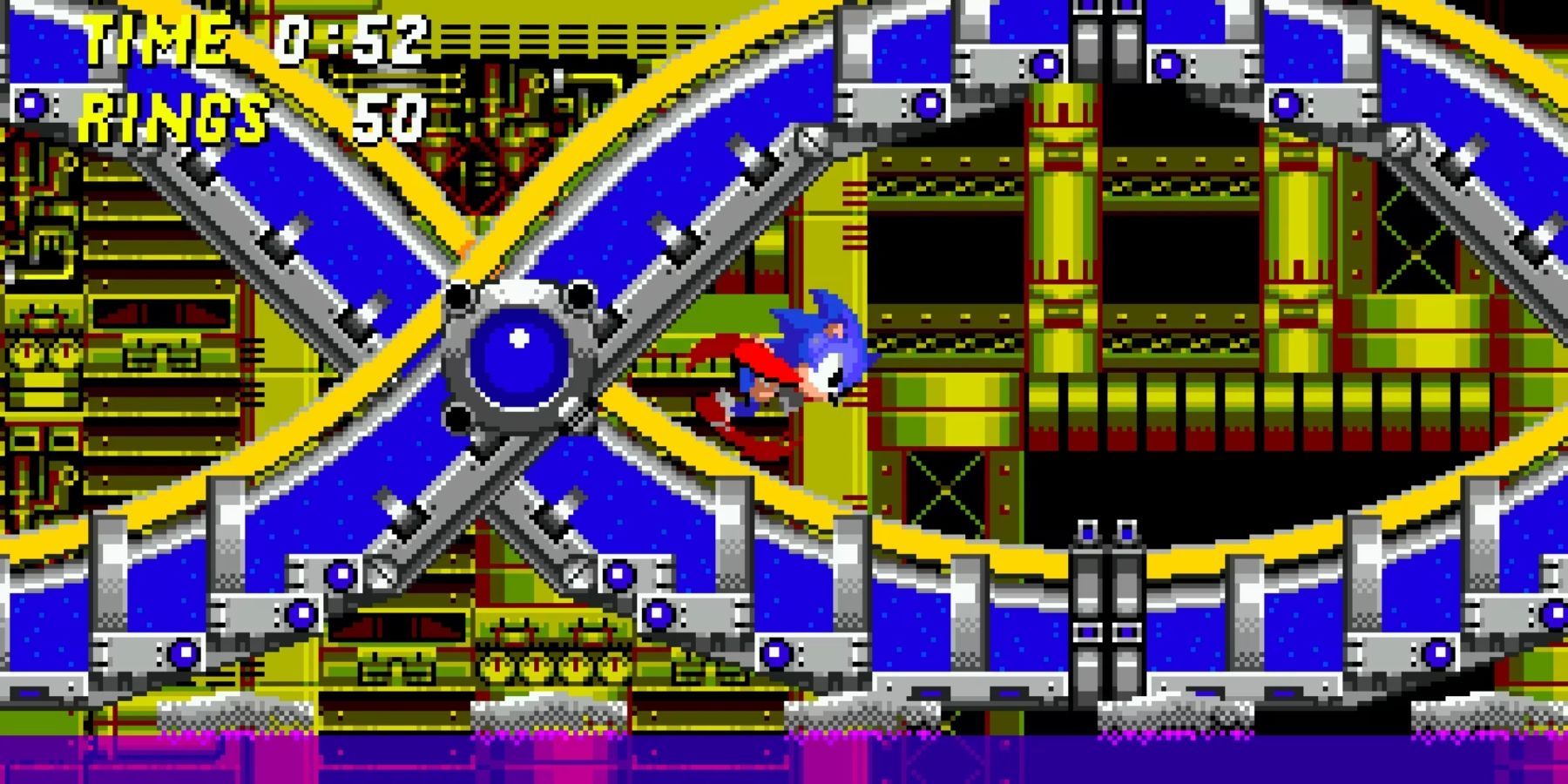
I’ll jump in on that one first. I really love the music from Sonic 2. We’ve featured it on Bonus Level, specifically with the Casino Night Zone track. Aside from Super Mario 64, Sonic 2 is probably the game we’ve done the most arrangements and remixes from. I played it a lot as a kid, and that soundtrack—especially Chemical Plant Zone—really captivated me and kept me hooked, even when the levels were challenging. I’m not sure if it directly influenced our overall sound, but it definitely guided my interest in covering video game music, particularly retro and old-school games I enjoyed growing up.
I really grew up with the Nintendo 64, and I’m particularly drawn to the music, especially the Mario soundtrack. I hadn’t thought much about video game music until Joel suggested we explore it. What excited me was that it was a completely new musical territory for our big band jazz style. Over the past seven years, jazz standards have often come from forgotten Broadway shows, so this felt like a chance to inspire our writers and arrangers with melodies and harmonies from music we all grew up with. It’s been fantastic to see how their fresh take on this familiar music can revitalize our love for big band jazz. It’s really fun to combine the style, instrumentation, and approach we love with these new sounds and ideas from the people we enjoy working with.
Where did the idea of Joystick Jazz originate from?
Joel Bael believes video game music has become the defining music of our generation – short, memorable tunes we hear repeatedly. He sees a lot of potential in these melodies, imagining them expanded into fuller arrangements, which is what his band aims to do. He was searching for something fresh and personal, and while he enjoyed The Advantage, he felt the world of video game music arrangements was largely unexplored. As Chris pointed out, few large bands are doing this kind of work, allowing them to be among the first to create arrangements of songs like ‘Redial’ from Bomberman. This is exciting because, unlike jazz standards which have been covered countless times, they’re bringing something new and original to the table.
I love that idea of video game music as our generation’s folk music. Building on that a little bit more, what do you feel like are the differences between performing something from a video game and arranging it, versus something from the more traditional musical canon?
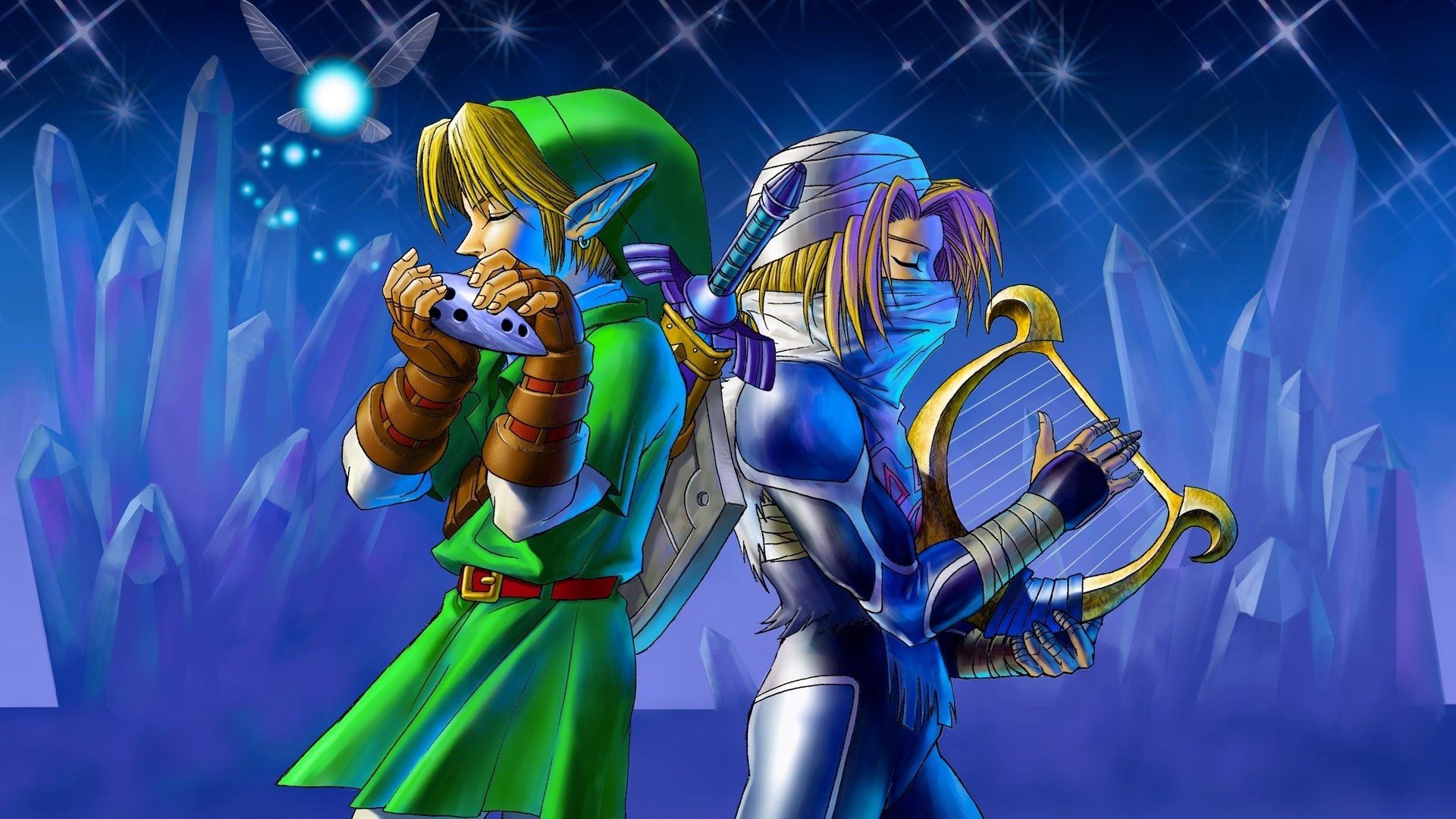
People really connect with these game melodies. It’s different from the music older generations grew up with, but that history is still valuable. When we first arranged the Ocarina of Time medley for our album, I learned it inside and out. Then, during the pandemic, I was playing through the game again and realized I knew the final dungeon’s music – because I’d played it so many times! Big band music creates a connection for listeners, even if it’s presented in a new way. While a big band in 2026 might seem unusual, we do it because we’re passionate about it. We also want to introduce people to this kind of instrumentation and musical style. As Joel pointed out, it’s a way to tap into the same nostalgic feelings people have for the music they grew up with – like our parents with the Beatles or their parents with Glenn Miller. For us, those iconic games are Sonic and Mario.
What’s the song selection process like for each volume of Joystick Jazz? How do you determine which tracks you want to arrange? What’s the copyright situation, and getting permission to do specific tracks like?
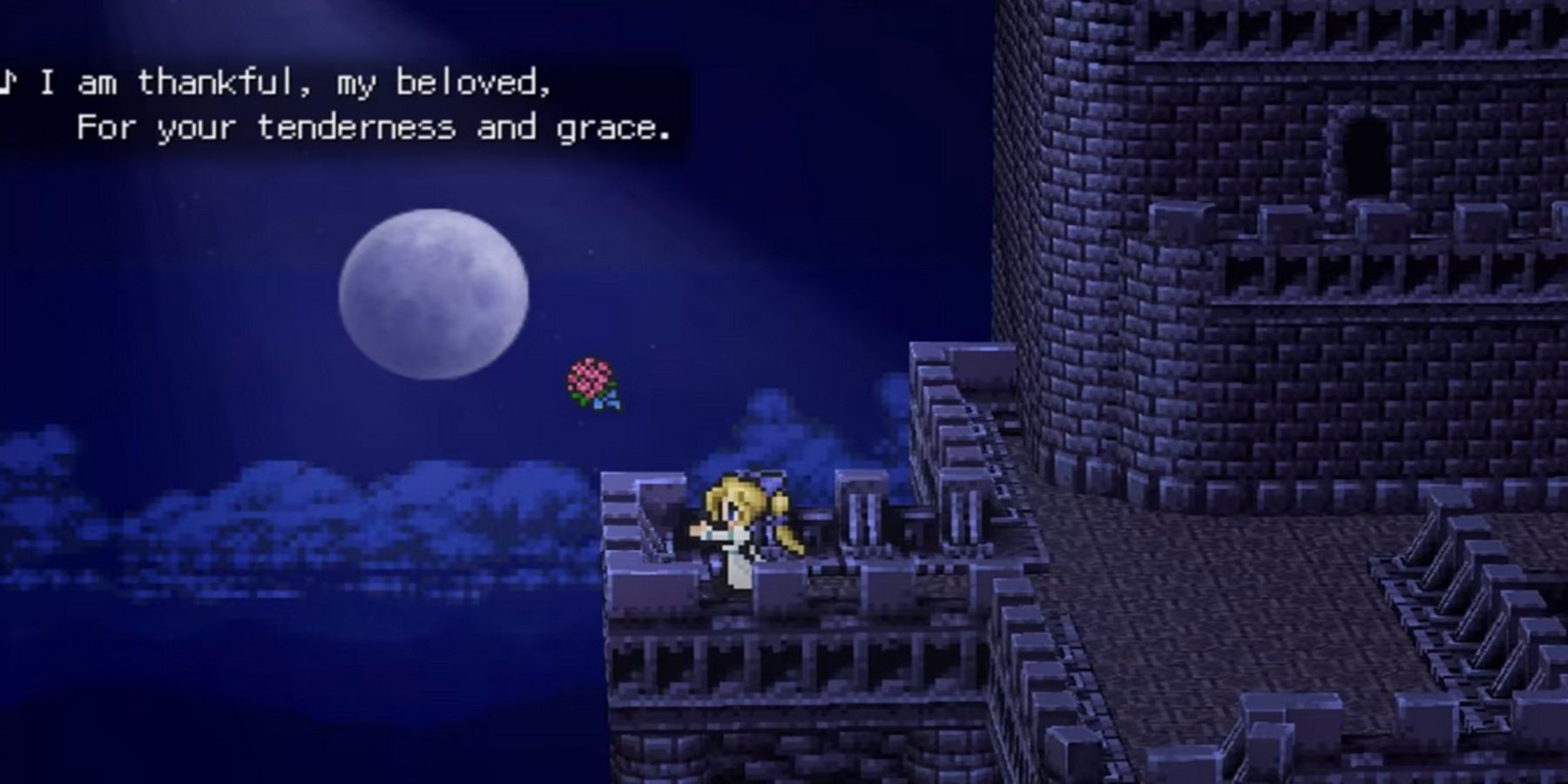
When it comes to copyright, iam8bit has been a huge help – we don’t handle licensing ourselves. Now, we always check our song lists with them before starting a project to ensure everything is legally clear. Initially, we and our arrangers both had tunes we were interested in. For example, on our first album, Joystick Jazz Volume One, we included a jazz arrangement of “Flash Man” from Mega Man 2. We knew a musician named Ritchie Payless who had recreated the entire Mega Man 2 soundtrack in MIDI for a school project, and he played trombone, so he was the perfect person to arrange it. He understood the music beyond just the main melody. Beyond that, we first consider whether we enjoy the game itself – games like Banjo, Ocarina of Time, and Sonic were all favorites. Then, we look at what our arrangers are passionate about. We worked with Joe Clark on Joystick Jazz Volume Two, and he suggested a suite from Grim Fandango. I hadn’t played it yet, but I loved the music, so we went with it. He’s just finished another project for us – a 45-minute suite from Final Fantasy VI. He wanted to focus on one game and create a really comprehensive arrangement. So, sometimes the arrangers take the lead in choosing the music.
Are there any major games you still want to cover that you haven’t yet for Joystick Jazz?
Joel Baer says their band is really focused on the music of the Nintendo 64 era. While they’re currently working on arrangements of Final Fantasy VI (which hasn’t been released yet), they’re especially excited about bringing the sounds of games like Chrono Trigger, Star Fox, Dire, Dire Docks, and Lost Woods to life in their performances. They’re even working on an arrangement of GoldenEye. These are all games Baer loves and feels a strong personal connection to, and he spends a lot of time playing them.
I haven’t really played video games since the GameCube, though I did play a bit of Wii. Getting back into it now has been fun, even though it’s a little difficult with grad school and two kids. I’m planning to really dive back in once I’m finished with school – I’m already thinking about getting a Switch! What’s struck me most is how huge the gaming world is and how enthusiastic people are about it. We were lucky enough to play at Mag Fest in early 2025, and I was amazed by the passion for the music. I’m still pretty new to all of this, so it’s great when friends like Ritchie Payless or Christian Sanchez, who’s worked on Sonic, ask for our input. It opens up a whole new world to me. Hearing these melodies and realizing how old they are – sometimes 20 years old! – makes me wonder why I haven’t discovered them before. That’s what’s exciting. We’ve pretty much played Super Mario 64 as much as we can, so now I need to figure out what game to tackle next.
You’re very Nintendo 64 forward, so I’m sure Koji Kondo’s compositions come up a lot, but are there any other notable and favorite video game composers you just love tackling, or want to really dive into?
I’m really excited about the music of Masato Nakamura, especially from Sonic 1 and 2. We still have a lot of Sonic 2 music we want to record and release – completing that would be a dream for me. I also love anything by Grant Kirkhope. We’re preparing for a concert featuring string arrangements from Perfect Dark, GoldenEye, and Banjo-Kazooie. I admire composers like David Wise, Yasunori Mitsuda (Chrono Trigger), and of course, Nobuo Uematsu. We have a large collection of Koji Kondo’s music, including some unreleased recordings we’re working on. Koji is a legend to me – along with Masato Nakamura, he first got me into game music. The melodies from Super Mario World really define my childhood.

With your latest release, what was the reasoning behind going with a Bonus Level launch, as opposed to a more traditional volume four?
When Chris and I were working on ‘Joystick Jazz Two’ and ‘Three’, we had some ideas for the next installment. We pitched an idea for ‘Volume Four’ to iam8bit that included more Mario-themed music. They loved the idea and suggested we create a whole record dedicated to Mario! During the recording sessions for ‘Volume Three’, we had some extra studio time and began arranging Mario tunes, even though we didn’t have a specific plan for them yet. We recorded these songs with the idea that we could use them later. Once we had enough material, we sent it to iam8bit and asked if they’d be interested in releasing it as a short EP. We were really excited about the music. And, true to form, iam8bit came up with a fantastic way to package and present it, including releasing it as a high-quality 45 RPM record, which is something special.
On that note, vinyl had a bit of a comeback these past few years. Records are still very huge. How do you personally resonate with that?
I really wish I’d done this surrounded by my vinyl collection – I’m a big fan! The best part about collecting big band records is that they’re affordable, and not many people are into them, so I’ve built up a pretty extensive collection. I just love the feeling of holding a record – it represents the whole creative process, from writing the music and working with other musicians, to recording and finally having a tangible result. It’s amazing to be able to share that physical piece of work with listeners.
Chris Parsons loves the physical nature of vinyl records – the fact that you can actually hold them. Growing up with CDs, he’s built up a large collection, but he’s been surprised and pleased to see teenagers buying vinyl at their shows. These kids have grown up with streaming services like Spotify and Apple Music and never experienced CDs or record players themselves. Chris recently got his record player working again, and he finds the process of playing a record – taking the time to listen to an album from start to finish – is a much more engaging experience than simply hitting play on a digital playlist. It really makes you focus and actively listen to the music.
It might be like picking a favorite child, but give us a favorite track from the Joystick Jazz series.
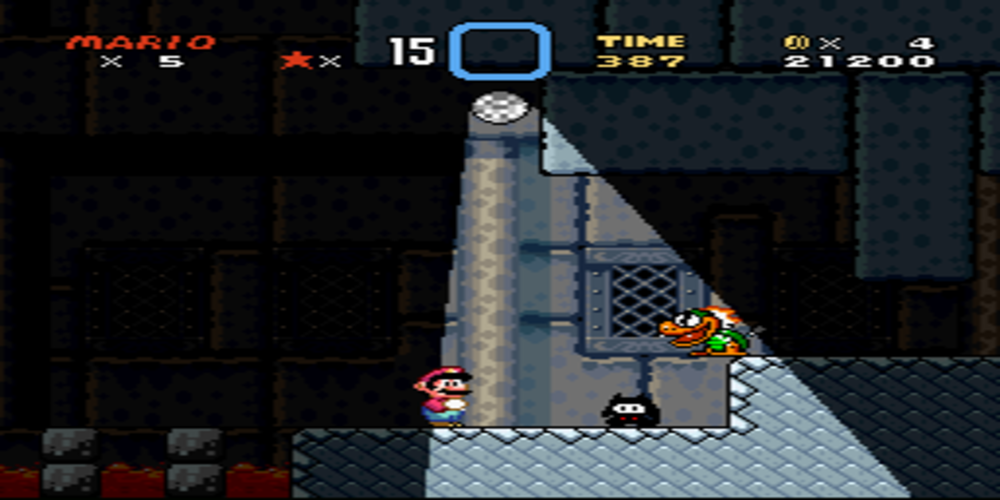
Joel Baer says his favorite piece is the Castle Theme from Super Mario World, specifically the arrangement by Neil Carson on Volume Three. He loves the original composition by Koji Kondo, and enjoys both playing and listening to it, considering it a fantastic piece of music, especially within the big band genre.
I’m surprised you didn’t pick something from Sonic 2.
Okay, if I’m allowed a little bending of the rules, I’d have to say ‘Aquatic Ruin Zone’ really stands out. It’s an arrangement Sam Wolsk did, and honestly, I just love playing it. It’s a genuinely fun piece.
I still love performing the Ocarina of Time medley the most. It’s hard to say if it’s because it’s on the album, or just because it’s so much fun to play live. We performed it at Mag Fest last year with about 1,000 people behind me, and as soon as the first few notes started, the crowd instantly recognized it. It was an amazing feeling.
So what’s next for Joystick Jazz’s future?
We’re heading into the studio this weekend to record a new album, but I can’t say exactly when it will be released. We’re aiming to get it out very quickly, though.
 Rearrange the covers into the correct US release order.
Your Order
Results
— —
What’s been your favorite part about collaborating and working together, both on these video game arrangements and your own original works together?
It’s amazing that we’re still performing big band music in 2026. We’re fortunate to be in Chicago, where there’s a dedicated audience for this style, no matter the specific music. A big part of our appeal is that we attract older listeners who appreciate the sound – it’s a refreshing change from what they’re used to. Honestly, I’m surprised it works – having a band of 17 to 19 people, coordinating everyone’s schedules and rehearsals, is a huge undertaking. When we were in college, big bands only existed on campus, not in the real world. But we’ve made it happen, and we’re playing shows at least twice a month, sometimes even more. I handle all the music selection, and we already have ten gigs booked for this year. Joel and I are truly passionate about big band, and that’s why it’s working. We knew going in that this wouldn’t be a money-making venture, it’s purely a labor of love. It’s grown into something special, attracting talented arrangers, collaborators, and, surprisingly, fans! It’s overwhelming in the best way – people actually like this! We’ve connected with incredible artists, and we’re able to provide a platform for their creativity.
What do you want your audiences and fans to really take away from your music and your concerts?
I’m a big fan of Joel Baer and Blue Shift, and what really strikes me is how seriously they take the music itself, while still managing to have a blast on stage. Watching them, especially in videos like the one from Mag Fest, you can just feel the energy and how much they enjoy playing with each other. It’s clear they’re focused on delivering a really polished performance of music that, honestly, doesn’t always get the respect it deserves. They put so much care into the arrangements and the live performance, but they also aren’t afraid to cheer each other on – if someone’s doing something cool, they let them know! It’s this amazing back-and-forth energy with the audience too – they’re really creating something special together, and it’s infectious. It’s just a really positive and collaborative vibe all around.
What audiences see is a group of musicians who genuinely enjoy playing together. It’s not always easy to create that atmosphere, but this band is built on a core group of dedicated people – even our substitutes are regulars. This isn’t a side project for anyone; it’s a priority, and that energy shines through in our performances. We’ve always admired and tried to emulate the feel of legendary big bands like the Count Basie and Clayton-Hamilton Jazz Orchestras, and that’s what we aim for – a real sense of family on stage.
On this subject of taking the music seriously, is video game music art?
Joel Baer believes video game music is a legitimate art form. While not all of it is exceptional, the best examples are truly incredible. He points to the limitations of older hardware, like the 8-bit and 16-bit systems, and highlights the remarkable work of composers like Koji Kondo and Masato Nakamura. It’s astounding how beautiful music could be created on a Super Nintendo cartridge! He acknowledges some people only remember the simple ‘bleeps and bloops’ of early games and might not appreciate how far the music has come. Baer suggests listening to a game like Final Fantasy VI as proof; he finds the Super Nintendo’s sound quite appealing and believes even someone unfamiliar with it would recognize the music’s beauty.
Favorite video games of all time?
Joel Baer mentioned a few of his favorite video game soundtracks: Super Mario World, Sonic 2, Star Fox 64, GoldenEye 007, and Final Fantasy VII. While it’s not his overall favorite, he considers Final Fantasy VII to have the best soundtrack of all the Final Fantasy games.
What about you, Chris?
Chris Parsons says Super Mario 64 is the best, and while he doesn’t consider himself a video game expert, he’s confident in that opinion.
Read More
- All Skyblazer Armor Locations in Crimson Desert
- One Piece Chapter 1180 Release Date And Where To Read
- How to Get the Sunset Reed Armor Set and Hollow Visage Sword in Crimson Desert
- All Shadow Armor Locations in Crimson Desert
- All Golden Greed Armor Locations in Crimson Desert
- How to Beat Stonewalker Antiquum at the Gate of Truth in Crimson Desert
- All Helfryn Armor Locations in Crimson Desert
- Marni Laser Helm Location & Upgrade in Crimson Desert
- Black Sun Shield Location In Crimson Desert (Buried Treasure Quest)
- All Icewing Armor Locations in Crimson Desert
2026-04-10 22:09