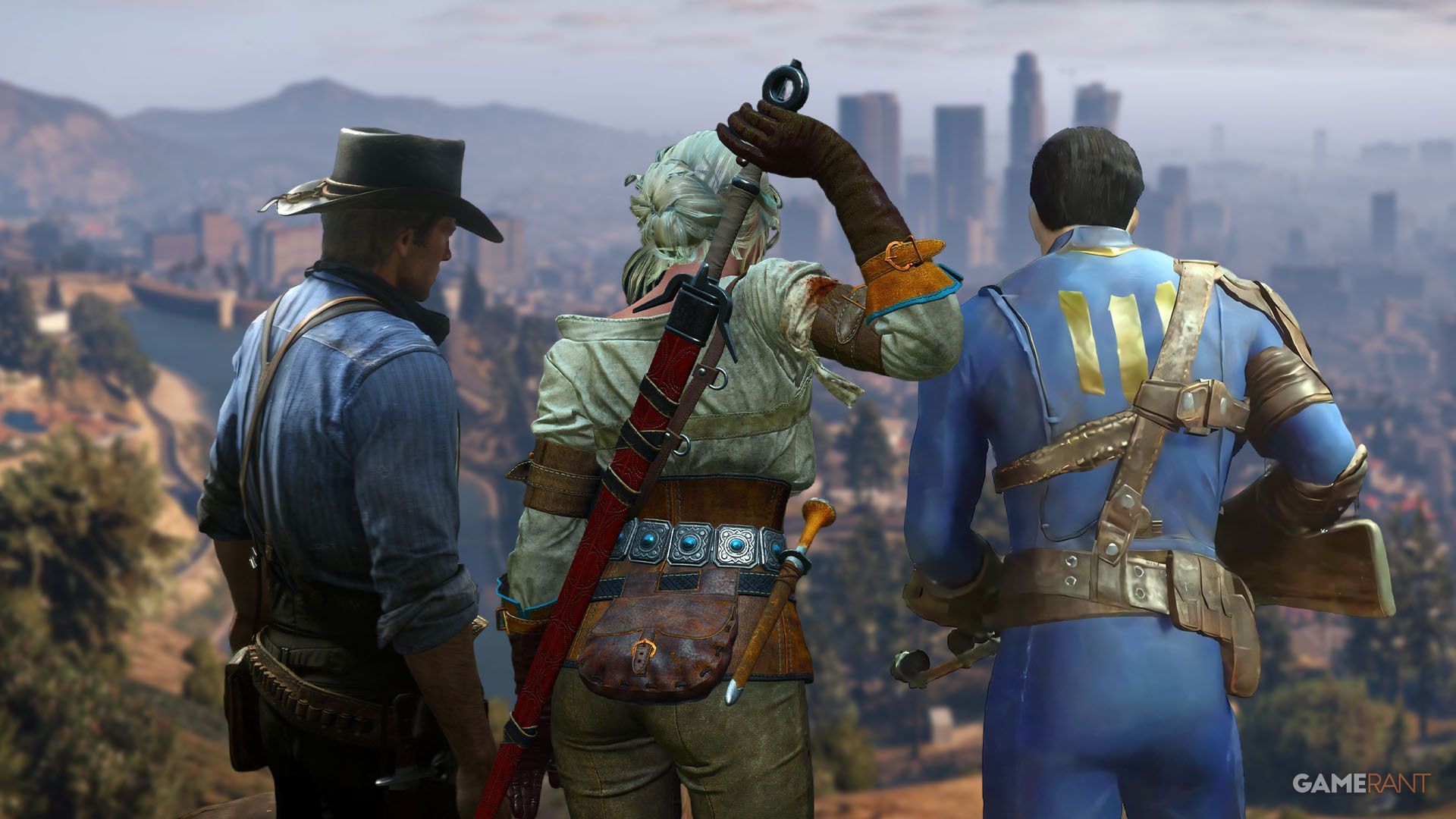
Open-world games have become incredibly popular over the last twenty years, and the technology behind them has improved dramatically. It’s amazing to see how much you can now do in these games. Titles like Red Dead Redemption 2, Cyberpunk 2077, and The Legend of Zelda: Breath of the Wild consistently introduce new ideas and create immersive, believable, and magical worlds that truly impress players.
To be honest, I’m starting to feel a little tired of open-world games, and it seems like many others are too. The focus has become so much about making worlds bigger and bigger that it’s left players feeling uninspired. This might lead to some significant changes in upcoming open-world RPGs. While there’s no certainty, I believe the genre is on the verge of a transformation, learning from the successes and failures of games we already know. I’ll be using examples from those existing games to explain what I mean.
Identity Fantasies, Not Power Fantasies
Unique Player-Oriented Stories
Players have always enjoyed creating incredibly powerful characters in games with character customization. We’ve seen this with popular builds like bleed-focused characters in Elden Ring and stealth archers in Skyrim. But now, players are looking for something more than just power. They want characters with depth and a clear identity – the ability to define who their character is. This means more features that shape a character’s personality and a game world that reacts to those choices. The path a player chooses should significantly impact how the game unfolds.
Games like Cyberpunk 2077 let you choose a background or ‘life path’ – like being a corporate employee, a street urchin, or a nomad. While each path has a different opening, they don’t significantly change the main game, which is a little disappointing. You do get one unique quest in the second act depending on your choice, but it doesn’t feel impactful enough. For example, it would have been great if a Street Kid was treated differently by security in certain areas, or if Nomads faced more hostility from gangs. These background choices should do more than just add flavor; they should genuinely shape your experience and make your story feel unique within the game’s world.
Finishing The Game Isn’t The Main Goal
Games Want You To Stay
Many open-world RPGs are shifting their focus from simply finishing the main story to enjoying the overall experience. Often, the side quests, exploration, and everyday activities—like hunting, crafting, or building relationships—are more captivating than the central plot. We’re seeing games where just being in the world feels rewarding, and this trend suggests open-world RPGs are increasingly becoming more like detailed simulations, a direction many games have already begun to explore.
Games like Skyrim first showed us this trend with its Hearthfire expansion, allowing players to build homes. Fallout 4 and Starfield expanded on this with extensive settlement building, offering endless and highly replayable side content. Bethesda’s radiant quests also prioritize replayability, regardless of their overall quality. More recently, Cyberpunk 2077 added repeatable hangouts with romanceable characters in your apartment, letting you postpone certain story beats as long as you like. I expect open-world games to continue focusing on these types of ongoing activities, though I hope we see an improvement over the design of radiant quests.
Choices Ripple Through The World
Dialogue Isn’t The Only Place For Consequences
Players highly value meaningful choices. It’s incredibly frustrating when a seemingly important decision has no impact on the game world. We’ve seen this problem repeatedly in open-world RPGs, but I think players are finally demanding better. Games are starting to respond with systems like Honor and Reputation – look at Red Dead Redemption 2 and Kingdom Come: Deliverance – and these systems could be key to creating truly immersive and realistic game worlds.
Our biggest inspiration is definitely The Witcher 3, particularly how Geralt’s choices have far-reaching consequences that aren’t immediately obvious. We’re also heavily influenced by Baldur’s Gate 3, even though it’s not an open-world game. Like Baldur’s Gate 3, our game will feature decisions that genuinely impact the world around the player – for example, wiping out the Grove will lock you out of the Last Light, while letting Isobel be captured will lead to its downfall. We want impactful choices that truly change the game world, not just superficial ones.
More Hybrid Genre Games
Expect Flavors Of Immersive Sims, Survival Crafts, And More
I’ve mentioned this before, but open-world RPGs are increasingly blending with other genres. We’ve seen this happen for years – think about the survival and crafting elements in games like Fallout and The Elder Scrolls, or the immersive sim features in Cyberpunk 2077, where how you build your character changes how you experience the world and complete quests. Survival crafting has been particularly trendy lately, and it’s likely we’ll see even more games use these features, as they encourage players to keep playing instead of rushing to the end.
I’m really interested in seeing the game branch out into different types of gameplay, like strategy and management simulations. While not everyone enjoyed the base-building in Fallout 4, I think that kind of feature can be really engaging if done well. For instance, imagine a game like Project Orion where you’re managing resources and building relationships with gangs in a cyberpunk setting. It might appeal to a specific audience, but I believe open-world RPGs are ripe for some big changes and fresh ideas.
Success Is Measured By Longevity
Launch Weeks Aren’t The Main Event Anymore
Big open-world role-playing games are taking much longer to develop these days. Grand Theft Auto 6 will launch more than ten years after GTA 5, and The Elder Scrolls 6 will likely be released over fifteen years after Skyrim. This shows that game developers are now focusing more on how long a game stays popular, rather than just when it comes out. They’re doing this by creating downloadable content (DLC) to keep players engaged for years, and by releasing updated versions and remasters, like we’ve seen with multiple releases of Skyrim.
The quality of downloadable content has been mixed. Many players feel successful games shouldn’t need paid DLC to feel complete, though substantial, well-made expansions like Phantom Liberty – especially when offered with free upgrades – are a positive step. However, major game releases will likely become less frequent, particularly after the troubled launch of Cyberpunk 2077, which served as a cautionary tale. Adding to this, the current economic climate means fewer players can justify buying new games at full price. Most will wait for discounts, improvements, and free content before investing in the complete experience.
However, I expect some exceptions, such as GTA 6. Its launch and pre-orders are going to be huge.
Bigger Worlds Aren’t The Goal Anymore
Hand-Crafted, Tighter Experiences Are Returning
Early video games often had limited worlds, leaving much to the player’s imagination. If you saw a distant mountain, you generally couldn’t go there. Open-world games changed that, letting players actually explore everything they see. As Todd Howard famously put it, “See that mountain? You can climb it!” This simple statement perfectly captures the freedom and scope these games offered.
While expansive open worlds were once the goal, games like Starfield have shown that size isn’t everything. Starfield relied heavily on automatically generated planets, but this approach ultimately detracted from the qualities that made previous Bethesda games so engaging: carefully designed locations, interesting secrets, and environments that told stories. Although some elements were reused, each place felt unique, which made the worlds feel believable, even if they weren’t huge. The real question is, what’s the point of a massive world if it’s just filled with repetitive content? Hopefully, Starfield will teach future open-world games that quality and originality are more important than sheer size.
Read More
- All Skyblazer Armor Locations in Crimson Desert
- One Piece Chapter 1180 Release Date And Where To Read
- How to Get the Sunset Reed Armor Set and Hollow Visage Sword in Crimson Desert
- All Shadow Armor Locations in Crimson Desert
- How to Beat Stonewalker Antiquum at the Gate of Truth in Crimson Desert
- All Golden Greed Armor Locations in Crimson Desert
- All Helfryn Armor Locations in Crimson Desert
- Marni Laser Helm Location & Upgrade in Crimson Desert
- Cassius Morten Armor Set Locations in Crimson Desert
- USD RUB PREDICTION
2025-12-29 08:35