Author: Denis Avetisyan
A new framework, MedExChain, enables seamless and secure patient health record exchange between disparate blockchain systems and resource-constrained IoT medical devices.

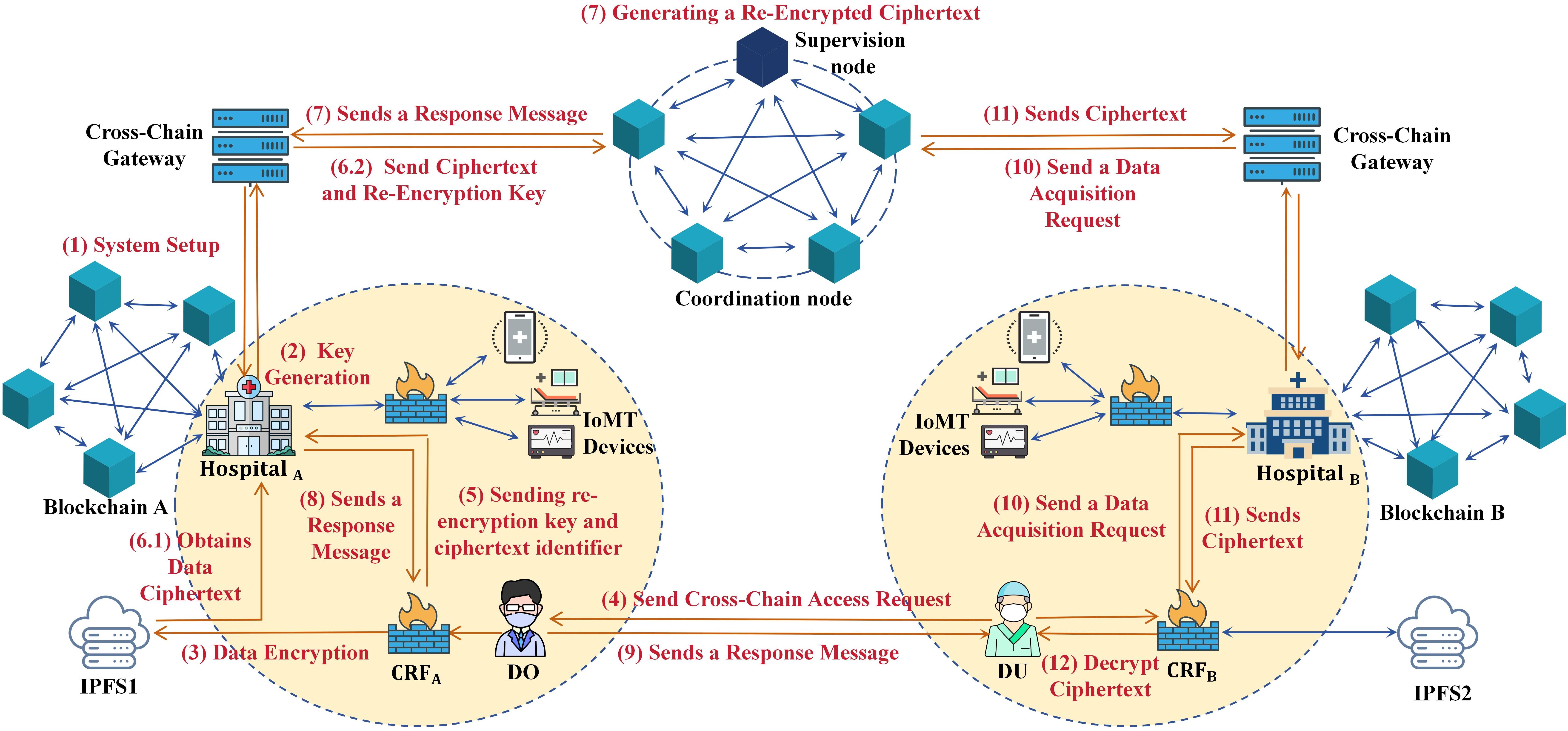
MedExChain leverages cross-chain data sharing, attribute-based encryption, and proxy re-encryption to address the challenges of interoperability and security in healthcare data management.
While the increasing deployment of Internet of Medical Things (IoMT) generates valuable patient data, secure and efficient sharing of Personal Health Records (PHR) across disparate blockchain systems remains a significant challenge. This paper introduces ‘MedExChain: Enabling Secure and Efffcient PHR Sharing Across Heterogeneous Blockchains’, a novel cross-chain data sharing scheme designed to overcome these limitations. MedExChain leverages proxy re-encryption and a blockchain audit mechanism to ensure both security and performance, even with resource-constrained IoMT devices. Could this approach unlock a new era of interoperable and patient-centric healthcare data exchange?
The Inevitable Fragmentation of Healthcare Data
Contemporary healthcare frequently operates with fragmented Personal Health Records, a significant obstacle to both patient wellbeing and medical advancement. Data pertaining to an individual’s health journey is often dispersed across numerous, unconnected systems – hospitals, specialists, pharmacies, and insurance providers – creating a disjointed and incomplete picture. This lack of holistic information impedes a physician’s ability to make fully informed diagnoses and treatment plans, potentially leading to medical errors or suboptimal care. Furthermore, the inability to aggregate and analyze this siloed data hinders crucial population health studies, limits the effectiveness of preventative medicine initiatives, and slows the development of new therapies. The resulting inefficiencies not only compromise patient care but also contribute to rising healthcare costs and diminished research opportunities.
Despite the promise of blockchain technology to revolutionize health data management, current implementations frequently struggle with interoperability – the ability of different blockchain networks to seamlessly communicate and exchange information. This limitation arises because many healthcare organizations adopt disparate blockchain platforms, each with unique protocols and data formats, creating isolated “islands” of health information. Consequently, a patient’s complete medical history may remain fragmented across multiple blockchains, hindering comprehensive care and limiting the potential for large-scale data analysis. The lack of standardized interfaces and governance frameworks prevents the cohesive flow of data, effectively negating the benefits of decentralized technology and requiring complex, often insecure, workarounds for data sharing between heterogeneous networks.
The fragmentation of health data doesn’t simply create logistical hurdles; it actively undermines the security of sensitive patient information and significantly restricts advancements in medical science. Dispersed records, lacking unified access controls, become prime targets for breaches, exposing individuals to identity theft and potentially compromising their care. Furthermore, the inability to aggregate and analyze comprehensive datasets hinders the development of effective preventative medicine strategies and slows the pace of crucial research. Without a holistic view of patient histories, identifying patterns, predicting outbreaks, and personalizing treatments remains a considerable challenge, limiting the potential of data-driven healthcare to improve population health and individual wellbeing.

A Cross-Chain Remedy for Data Silos
MedExChain addresses the challenge of interoperability in healthcare data exchange by enabling secure Personal Health Record (PHR) sharing across disparate blockchain networks. The scheme employs advanced cryptographic techniques, specifically focusing on facilitating communication between heterogeneous blockchain systems that lack native interoperability features. This is achieved through a design that abstracts away the underlying blockchain technology, allowing PHRs to be securely accessed and shared regardless of the originating or destination chain. The system prioritizes data security and patient privacy by minimizing direct data transfer and maximizing cryptographic protection during cross-chain communication, thereby circumventing the limitations imposed by isolated blockchain environments.
Identity-Based Proxy Re-Encryption (IBPRE) within MedExChain enables ciphertext transformation, allowing authorized parties to access Personal Health Record (PHR) data without requiring the originating blockchain to decrypt and re-encrypt it. Instead of direct decryption, IBPRE facilitates the conversion of ciphertext – data encrypted for one identity – into ciphertext accessible by another, designated identity. This is achieved through a proxy key generated by a trusted authority. Critically, the source chain remains unaware of the re-encryption process or the new recipient, preserving data confidentiality and minimizing the risk of unauthorized access. The system utilizes a public key associated with the data owner and a private key used by the proxy to perform the transformation, ensuring secure and efficient cross-chain data sharing.
MedExChain utilizes smart contracts to enforce granular access control policies for Personal Health Records (PHRs) shared across blockchains. These contracts define permissible data access based on predefined roles and attributes, automating authorization processes and eliminating manual intervention. Specifically, smart contracts manage key exchange and decryption rights, ensuring that only authorized parties can access PHRs, even from IoMT devices with limited processing power and storage. Compliance with privacy regulations, such as HIPAA or GDPR, is maintained through auditable smart contract logic, which records all data access events and enforces data usage restrictions. The system’s architecture allows for dynamic policy updates, enabling adaptation to evolving regulatory requirements without disrupting data availability.
Fortifying Against Subversion: A Proactive Defense
MedExChain implements a Cryptographic Reverse Firewall as a proactive defense against Algorithm Substitution Attacks (ASA). ASAs represent a significant security risk as they involve the surreptitious replacement of cryptographic algorithms with compromised versions, creating a backdoor without triggering traditional intrusion detection systems. The Reverse Firewall functions by continuously verifying the integrity of cryptographic primitives used within the system. This is achieved through a multi-layered process involving hashing and digital signatures, ensuring that any unauthorized alteration of core algorithms is immediately detected and flagged, preventing malicious code execution and maintaining data confidentiality. This approach differs from traditional firewalls which focus on perimeter defense, and instead concentrates on internal algorithm integrity as a critical security measure.
MedExChain’s security architecture is designed to meet both established cryptographic standards and address emerging threats. Specifically, the system achieves Chosen-Plaintext Attack (CPA) security, indicating resistance to attacks where an adversary can obtain ciphertexts for arbitrarily chosen plaintexts; CPA security is a widely recognized benchmark for cryptographic protocols. Beyond this standard, MedExChain incorporates mechanisms to mitigate Algorithm Substitution Attacks (ASA), a class of covert backdoor vulnerabilities not typically addressed by standard CPA security assurances. This dual-layered approach provides a robust defense against both conventional and advanced attack vectors, enhancing the overall integrity and trustworthiness of the system.
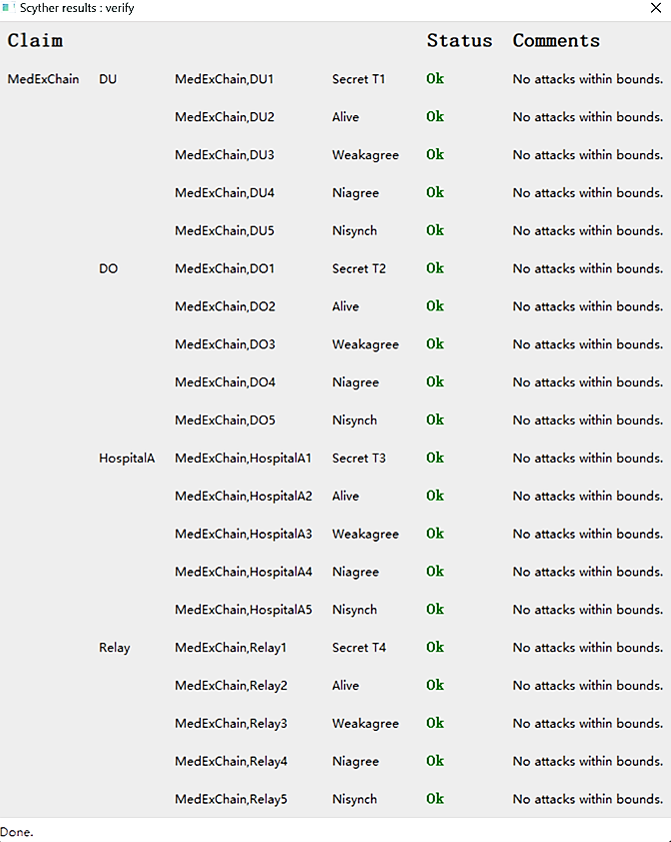
Formal verification of the MedExChain protocol was conducted utilizing the Scyther Tool, a symbolic execution and protocol analysis platform. This process involved mathematically proving the protocol’s security properties against a defined set of threats. Scyther’s capabilities were employed to model the protocol’s cryptographic assumptions and analyze potential attack vectors, including man-in-the-middle attacks, replay attacks, and denial-of-service scenarios. The verification results demonstrate that the protocol adheres to specified security goals under defined conditions and confirms its resistance to the modeled attack vectors, providing a high degree of assurance in its security posture. The Scyther Tool output includes a formal proof trace, detailing the steps taken to establish protocol correctness.
Toward a More Connected and Resilient Healthcare Ecosystem
MedExChain is engineered to deliver health information with exceptional speed and capacity, addressing a critical need within modern healthcare systems. The architecture deliberately balances low latency – minimizing the delay in accessing data – with high throughput – maximizing the volume of information processed. This dual focus ensures clinicians and researchers aren’t hampered by sluggish data retrieval or system bottlenecks when making time-sensitive decisions or conducting large-scale analyses. By prioritizing both swiftness and scalability, MedExChain facilitates real-time patient monitoring, rapid diagnosis, and efficient data sharing, ultimately supporting a more responsive and effective healthcare experience. The design isn’t merely about faster data transfer; it’s about enabling a seamless flow of information that directly impacts the quality and timeliness of care.
Rigorous theoretical analysis and experimental validation confirm that MedExChain presents a compelling advancement in healthcare data management efficiency. The system achieves computational overhead equivalent to current state-of-the-art technologies, meaning it doesn’t demand significantly more processing power. While exhibiting a marginally greater communication overhead, MedExChain demonstrably surpasses existing schemes in overall throughput – the rate at which data can be successfully processed. This combination of performance characteristics suggests that MedExChain is not simply a theoretical improvement, but a practical solution capable of handling the demanding data requirements of modern healthcare systems and enabling faster, more reliable access to critical patient information.
MedExChain demonstrates a compelling balance of efficiency and performance, achieving computational overhead comparable to current leading technologies. While its communication overhead is marginally increased, it remains demonstrably shorter than all alternative schemes, indicating a streamlined data exchange process. Critically, the system’s throughput – the rate at which it processes transactions – equals or surpasses that of existing solutions, suggesting a capacity for handling substantial volumes of health information without compromising speed or reliability. These results highlight MedExChain’s potential to facilitate rapid and secure access to vital medical data, supporting real-time clinical decision-making and advancements in healthcare delivery.
Data security within MedExChain is fundamentally assured through the implementation of established consensus mechanisms. These protocols, already proven in other distributed systems, dictate how network participants collectively agree on the validity of new health information before it is permanently recorded on the blockchain. This collaborative verification process drastically reduces the risk of fraudulent data entry or malicious alteration, as any attempt to tamper with records would require the collusion of a majority of the network. Consequently, the integrity and reliability of patient data are not reliant on a single point of failure, but are instead distributed across the network, creating a robust and trustworthy system for managing sensitive medical information and fostering confidence in the accuracy of shared records.
Supported by the National Key Research and Development Program, MedExChain represents a significant step towards reshaping healthcare delivery through enhanced connectivity and a patient-focused approach. This innovation envisions a future where secure, readily accessible medical data empowers both individuals and researchers. By fostering seamless information sharing among healthcare providers, the system facilitates more informed diagnoses and personalized treatment plans. Furthermore, the robust data infrastructure created by MedExChain unlocks new opportunities for large-scale medical research, accelerating discoveries in disease prevention and treatment, and ultimately contributing to a more proactive and preventative healthcare landscape.

The pursuit of interoperability, as demonstrated by MedExChain’s cross-chain data sharing, echoes a fundamental truth about complex systems. The architecture proposed doesn’t aim for static perfection, but rather facilitates a dynamic flow of information across disparate networks. This anticipates inevitable evolution; systems, even those built on robust foundations like blockchain, are not immune to change. As Alan Turing observed, “No one can predict the future with certainty, but we can design systems to be adaptable.” MedExChain, with its focus on secure and efficient PHR sharing across heterogeneous blockchains, embodies this adaptability, acknowledging that the longevity of a system lies not in its initial design, but in its capacity to accommodate future complexities and resource constraints.
What’s Next?
MedExChain, as presented, addresses a current friction point in data portability, yet the inevitable accrual of technical debt remains. The scheme’s reliance on proxy re-encryption, while elegantly solving immediate access control concerns, introduces a dependency on key management infrastructure-a single point of potential failure all systems eventually encounter. Future work must consider the entropy of these cryptographic foundations, not simply their initial strength. The architecture’s scalability beyond a limited network of heterogeneous blockchains is also an open question; true interoperability isn’t about connection, but about graceful degradation under stress.
The ambition to integrate with resource-constrained IoMT devices is commendable, but begs the question of longevity. These devices, by their nature, are ephemeral. The true challenge isn’t securing data on them, but ensuring its continued accessibility after their inevitable obsolescence. The system’s current focus on secure sharing implicitly assumes a stable substrate of participating nodes; a naive assumption given the pace of technological turnover.
Ultimately, MedExChain is a step toward a more fluid healthcare data ecosystem. However, it is crucial to remember that every solution introduces new vulnerabilities and dependencies. The real metric of success won’t be the initial security of the system, but its capacity to adapt-to anticipate and accommodate the errors and fixes that are inherent to all complex systems over time.
Original article: https://arxiv.org/pdf/2602.12106.pdf
Contact the author: https://www.linkedin.com/in/avetisyan/
See also:
- All Shadow Armor Locations in Crimson Desert
- Jujutsu Kaisen Season 3 Episode 12 Release Date
- Dark Marksman Armor Locations in Crimson Desert
- Sega Reveals Official Sonic Timeline: From Prehistoric to Modern Era
- How to Beat Antumbra’s Sword (Sanctum of Absolution) in Crimson Desert
- Top 5 Militaristic Civs in Civilization 7
- Genshin Impact Dev Teases New Open-World MMO With Realistic Graphics
- Sakuga: The Hidden Art Driving Anime’s Stunning Visual Revolution!
- Keeping AI Agents on Track: A New Approach to Reliable Action
- Where to Pack and Sell Trade Goods in Crimson Desert
2026-02-14 13:15