Quantum Model Privacy: Auditing the Black Box

A new framework offers a practical way to estimate privacy leakage in quantum machine learning models without needing to know their inner workings.
A new framework offers a practical way to estimate privacy leakage in quantum machine learning models without needing to know their inner workings.

Researchers have developed a new method to map the hidden flaws of quantum computers by analyzing the structure of quantum circuits.
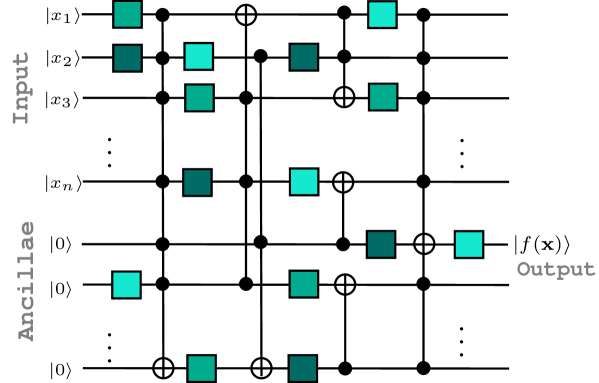
Researchers have established stronger limitations on the power of shallow quantum circuits, proving that certain fundamental functions remain computationally challenging even with quantum speedups.

Researchers have successfully cultivated and characterized ‘magic states’ on a superconducting processor, bringing fault-tolerant quantum computation a step closer to reality.

New decoders for surface codes dramatically reduce the communication overhead required for reliable quantum computation.

New research explores the practical challenges of sending more data with fewer qubits using maximally entangled states.

Researchers have uncovered a surprising vulnerability in cloud-based quantum computers that allows users to bypass billing systems by exploiting mid-circuit reset operations.

Researchers have extended a versatile runtime system to seamlessly integrate classical and quantum processing, paving the way for more complex hybrid workflows.
Researchers are applying the tools of symplectic geometry to redefine and analyze quantum error-correcting codes, uncovering connections to classical coding theory.

Researchers have developed an improved decoding algorithm for 3D color codes, pushing the boundaries of fault-tolerant quantum computation.