Taming Uncertainty: A Logic for Verifying Concurrent Probabilistic Programs
Researchers have developed a new logical framework to rigorously prove the correctness of complex programs that combine concurrency, probability, and mutable state.
Researchers have developed a new logical framework to rigorously prove the correctness of complex programs that combine concurrency, probability, and mutable state.

A new algorithm, DeMABAR, offers robust performance in multi-agent learning scenarios where agents face both malicious attacks and unreliable information.

A new analysis reveals that blending spatial and frequency domain techniques dramatically improves the resilience of digital watermarks embedded within images.

Researchers are using liquid metal printing to fabricate high-performance superconducting circuits, opening doors for more flexible and scalable cryogenic electronics.
A new architecture, Pk-IOTA, streamlines OPC UA certificate management by combining the IOTA blockchain with programmable data plane technology to bolster trust and reduce overhead in Industry 4.0 environments.
A recent analysis refines the Bai-Galbraith signature scheme, optimizing its efficiency for post-quantum cryptography applications.
New optimization techniques dramatically improve the speed and accuracy of calculating secure key rates in quantum key distribution systems.

A new approach to quantum error correction utilizes cyclic hypergraph product codes to achieve performance competitive with state-of-the-art methods.
New research demonstrates how quantum frustration can act as a protective mechanism against decoherence in a novel qubit design.
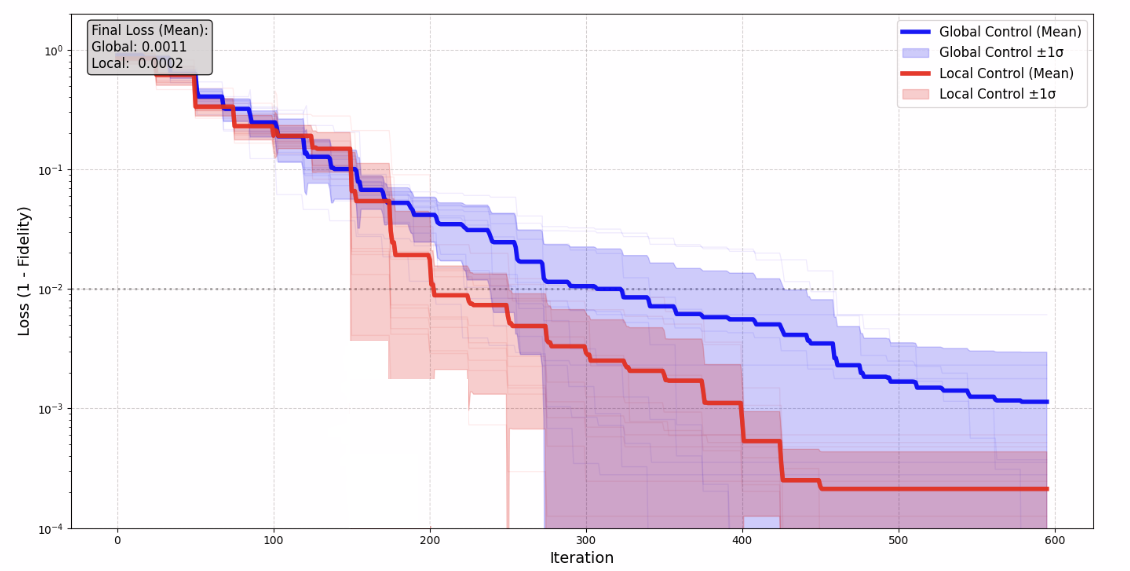
A new variational algorithm optimizes state transfer in complex spin chains, revealing fundamental limits between performance and noise resilience.