Trusting the Chain: Hunting for RPC Bugs in Ethereum Clients
![The Ethereum client’s request-response cycle operates as a layered system, where remote procedure calls [latex] RPC [/latex] facilitate communication between application logic and the blockchain, acknowledging that even decentralized systems are subject to the constraints of sequential processing and the inherent latency of network interactions.](https://arxiv.org/html/2601.21593v1/x1.png)
A new approach to fuzzing Ethereum clients uncovers hidden inconsistencies in RPC responses by intelligently simulating realistic blockchain conditions.
A new approach to fuzzing Ethereum clients uncovers hidden inconsistencies in RPC responses by intelligently simulating realistic blockchain conditions.
![The study demonstrates the relationship between block length and the decoding rate [latex]\frac{|\mathcal{A}|}{N}[/latex] for polar codes, illustrating how performance scales with increasing code size.](https://arxiv.org/html/2601.21330v1/x8.png)
A new analysis technique leveraging the structure of quantum channels promises more efficient decoding algorithms for critical error-correcting codes.
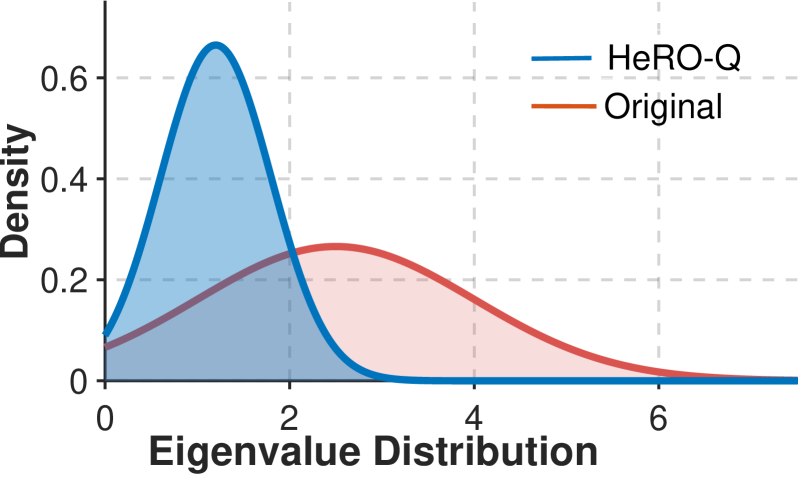
Researchers have developed a novel quantization framework that reshapes the underlying mathematical landscape of AI models to enable significantly more efficient low-bit inference.
A new study explores the delicate balance between wave behavior and stability in the face of strong nonlinear effects.
![The study investigates two cubic models-a homogeneous form, [latex]g_{3}(s)+\sigma\|s\|^{4}[/latex], and a non-homogeneous counterpart, [latex]g^{T}s+g_{3}(s)+\sigma\|s\|^{4}[/latex]-both characterized by randomly generated coefficients within the range of [0, -100], demonstrating that even with zero gradient terms, cubic terms significantly influence the resulting function’s behavior.](https://arxiv.org/html/2601.20418v1/change_from_sos.png)
Researchers have discovered conditions under which nonnegative quartic polynomials can be reliably expressed as a Sum-of-Squares, opening doors to more efficient optimization and verification techniques.
![The decay of a resonance, potentially [latex]Z_c(4430)[/latex], into both two-body states like [latex]D^{<i>+} \bar{D}_{2}^{</i>0}[/latex] and [latex]\psi(2S)\pi^{+}[/latex], and three-body combinations of [latex]D^{<i>+}D^{-}\pi^{+}[/latex], [latex]D^{</i>+}D^{<i>-}\pi^{+}[/latex], and [latex]D^{</i>+} \bar{D}^{<i>0}\pi^{0}[/latex], offers a comparative shape analysis-scaling the [latex]\psi(2S)\pi^{+}[/latex] distribution to match the peak height of the [latex]D^{</i>+} \bar{D}_{2}^{*0}[/latex] mode-to determine the coupling constant [latex]g_{\psi'}[/latex] and reveal underlying patterns in particle decay.](https://arxiv.org/html/2601.20740v1/x8.png)
New research delves into the composition and decay of the Zc(4430) and Zc(4200) states, shedding light on the fundamental forces binding these unusual particles.
A novel framework leveraging fractal transforms and Fourier analysis dramatically improves the security and efficiency of image transmission.
New protocols enable secure computation of shared elements between private datasets, even when perfect matches aren’t required.
![The Shastry-Sutherland lattice-characterized by four orbitals within each unit cell and defined by sublattice degrees of freedom [latex] (m_x, m_y) = (A,A), (B,A), (B,B), (A,B) [/latex]-can be systematically transformed towards a square lattice through the introduction of diagonal Heisenberg couplings, offering a pathway to explore the interplay between magnetic frustration and dimensionality.](https://arxiv.org/html/2601.19980v1/x1.png)
New research reveals a shared underlying mechanism governing the exotic behavior of Dirac spin liquids on both square and Shastry-Sutherland lattices.

A new mathematical approach offers a precise way to model and analyze job queuing in cloud computing environments.