Author: Denis Avetisyan
New research reveals a counterintuitive mechanism in perovskite nanocrystals where temporary emission suppression actually enhances the purity of single photons.
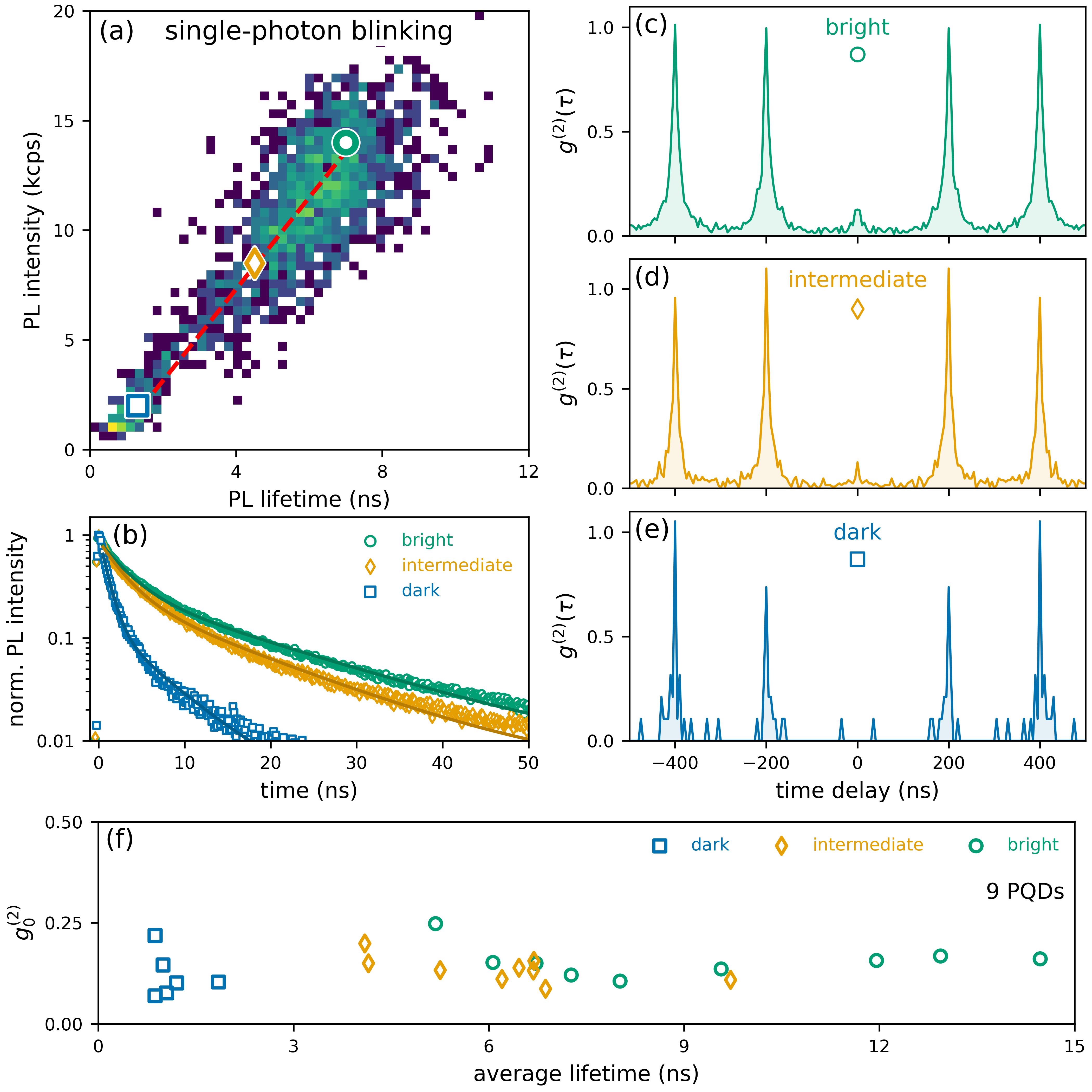
Suppressed biexciton emission via self-trapped excitons in perovskite quantum dots leads to improved single-photon characteristics.
The pursuit of bright, stable single-photon sources is often hindered by the ‘blinking’ behavior of quantum emitters. This research, titled ‘When Blinking Helps: Suppressed Biexciton Emission in Lead Halide Perovskite Quantum Dots’, investigates this phenomenon in perovskite nanocrystals, revealing a counterintuitive mechanism where certain low-emitting ‘dark’ states exhibit improved single-photon purity. Through time-resolved spectroscopy, the authors demonstrate that suppressed biexciton formation-driven by self-trapped excitons-selectively reduces multiphoton emission in these states, achieving a decrease in g^{(2)}_0 from 0.155 to 0.120. Could this lattice-driven route to controlling biexciton dynamics unlock a new generation of highly efficient and reliable perovskite-based single-photon emitters?
Illuminating the Quantum Horizon: Perovskite Nanocrystals as Single-Photon Sources
The advancement of quantum technologies hinges on the dependable generation of single photons – discrete packets of light – yet current materials often present significant obstacles. Many promising candidates exhibit low efficiency, meaning a substantial portion of energy input doesn’t translate into emitted photons, hindering practical application. Furthermore, the fabrication of these single-photon sources can be extraordinarily complex, requiring specialized equipment and meticulous procedures that increase both cost and the potential for error. This combination of low photon yield and difficult manufacturing processes has created a bottleneck in the development of quantum communication, sensing, and computing, driving research towards materials that offer both high performance and simplified production methods.
Perovskite nanocrystals are rapidly gaining attention as potential cornerstones of future quantum technologies, largely due to their exceptional optical properties. These materials exhibit remarkably high photoluminescence quantum yields (PL QY), meaning a significant proportion of absorbed photons are re-emitted as light – a crucial characteristic for efficient single-photon sources. Beyond mere brightness, perovskites offer an unprecedented degree of control over the emitted light’s color; their emission wavelengths are readily tuned simply by adjusting the nanocrystal’s size or composition. This ‘tunability’ is vital for building complex quantum circuits and allows researchers to tailor light signals to specific requirements, opening doors to a variety of applications ranging from secure quantum communication to advanced quantum sensing. The combination of high efficiency and spectral control positions perovskites as compelling alternatives to traditional quantum emitters, promising simplified fabrication and enhanced performance.
Despite the exciting potential of perovskite nanocrystals in quantum technologies, their widespread adoption is currently hindered by significant material limitations. These materials, while exhibiting exceptional brightness, suffer from an inherent instability that degrades performance over time and under operational conditions. Furthermore, a phenomenon known as ‘blinking’ – the unpredictable and random switching between bright and dark emission states – disrupts the reliable single-photon stream essential for quantum communication and computation. Researchers are actively investigating encapsulation techniques, compositional modifications, and surface passivation strategies to address these challenges, striving to create perovskite-based quantum emitters that maintain both high efficiency and long-term operational stability. Overcoming these hurdles is crucial to unlocking the full potential of perovskites as robust and dependable components in future quantum devices.

Dissecting the Darkness: Understanding the Mechanisms of Perovskite Blinking
Photoluminescence blinking in perovskite nanocrystals is not attributable to a singular cause; instead, it results from the simultaneous operation of several distinct mechanisms. Observed intensity fluctuations are a composite effect, making simple characterization and mitigation challenging. These mechanisms operate concurrently, with relative contributions varying based on nanocrystal composition, size, and surface passivation. Consequently, analysis requires differentiating between these contributing factors to accurately model and control the blinking behavior, as any single explanation will be incomplete.
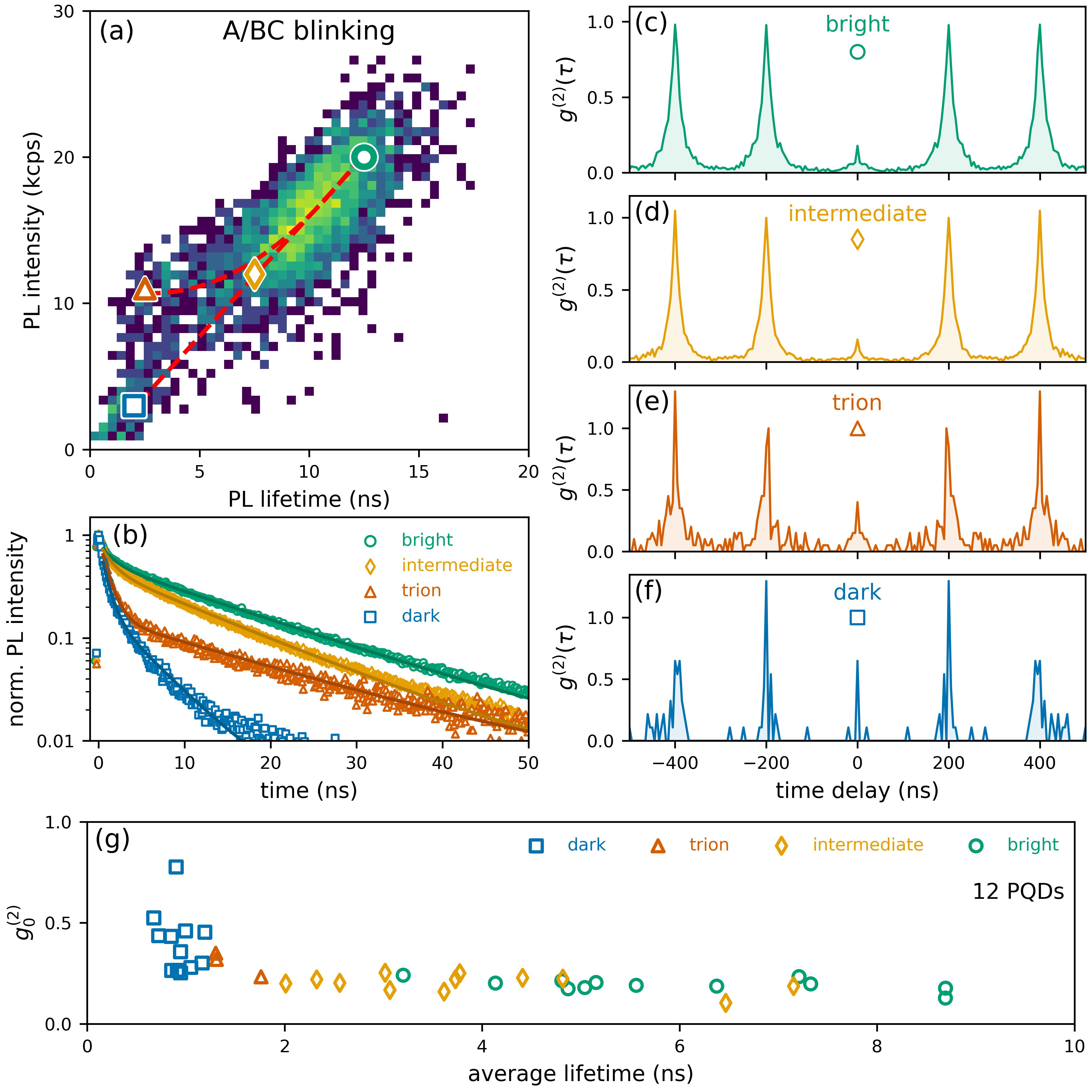
A-type blinking in perovskite nanocrystals occurs due to the temporary capture of charge carriers – electrons or holes – by defect states within the material. This trapping process leads to the formation of trions, which consist of one exciton and one additional charge carrier. The presence of trions alters the recombination dynamics, shifting the emission wavelength and reducing the probability of ideal single-photon emission. Consequently, the nanocrystal exhibits intermittent periods of brightness and darkness, manifesting as blinking, as the trion population fluctuates and eventually recombines. The rate of blinking is directly related to the density of trapping states and the carrier capture/escape rates associated with them.
BC-type blinking in perovskite nanocrystals is characterized by temporal fluctuations in luminescence intensity resulting from variations in nonradiative recombination rates. These fluctuations are directly correlated with the presence of surface defects and trap states within the nanocrystal lattice. Defects introduce energy levels within the bandgap, facilitating trap-assisted recombination pathways where electron-hole pairs recombine via these trap states without photon emission. The density and energetic distribution of these surface defects are not uniform, leading to stochastic changes in the rate of nonradiative recombination and, consequently, intermittent decreases in observed luminescence. This process differs from A-type blinking, which is primarily driven by charge carrier number fluctuations, and contributes to a broader distribution of blinking timescales.
Self-trapped excitons (STE) represent a localized electronic excitation where the electron and hole become trapped at specific lattice sites due to strong electron-phonon coupling. This localization results in a reduced radiative recombination probability and an extended exciton lifetime compared to free excitons. The stochastic formation and dissociation of STE within the perovskite nanocrystal population directly contribute to fluctuations in the emitted light intensity, manifesting as blinking behavior. The density of STE is influenced by temperature and excitation power, with higher temperatures and lower excitation densities generally favoring STE formation and, consequently, increased blinking.
Toward Ideal Single-Photon Emission: Optimizing Purity in Perovskite Nanocrystals
Single-photon purity is a critical metric for applications in quantum key distribution, quantum computing, and single-photon sources. This purity is quantitatively assessed using the second-order correlation function, denoted as g^{(2)}(0). A value of g^{(2)}(0) = 0 indicates a perfect single-photon source, meaning photons are emitted one at a time. Values greater than zero indicate the presence of multi-photon events, reducing the quality of the source and introducing errors in quantum operations. Therefore, minimizing g^{(2)}(0) is essential for reliable performance in these quantum technologies, and is a primary focus in the development of novel quantum materials.
Biexciton emission negatively impacts single-photon purity in quantum dot systems due to the generation of multi-photon events. The formation of a biexciton – an exciton bound to a hole – increases the probability of emitting two photons nearly simultaneously, rather than single, distinct photons. This is quantified by the second-order correlation function g^{(2)}(0); a value significantly above zero indicates a substantial multi-photon emission component. Consequently, the presence of biexcitons diminishes the proportion of truly single photons emitted, reducing the overall performance of the quantum dot as a single-photon source. Mitigation strategies often focus on suppressing biexciton formation or minimizing its contribution to the emitted light.
Analysis of quantum dot emission revealed that dark states, traditionally considered non-emitting, demonstrate enhanced single-photon purity compared to bright states. Specifically, the second-order correlation function g^{(2)}(0) was measured at 0.120 for dark states, a significant reduction from the 0.155 value observed in bright states. This lower g^{(2)}(0) value indicates a decreased probability of coincident photon emission, directly correlating to improved single-photon characteristics and suitability for quantum applications. This finding challenges conventional blinking models which typically associate dark states with periods of inactivity or reduced emission quality.
The transition of quantum dots from bright to dark states is accompanied by a substantial reduction in emission rates of both excitons and biexcitons. Specifically, the exciton quantum yield decreases by a factor of 8, indicating a significant suppression of single-photon emission originating from individual excitons. Simultaneously, the biexciton quantum yield is reduced by a factor of 10, demonstrating a marked decrease in the generation of two-photon events that degrade single-photon purity. These reductions in both exciton and biexciton yields contribute to the observed improvement in the g^{(2)}(0) value associated with dark states, as compared to bright states.
Temporal dynamics reveal a substantial difference in emission lifetimes between bright and dark states within the quantum dot system. Specifically, bright states exhibit a decay time of 9.13 nanoseconds, indicating a relatively prolonged emission duration. Conversely, dark states demonstrate a significantly shorter lifetime of 1.14 nanoseconds, representing a nearly eight-fold reduction in emission duration compared to bright states. This decreased lifetime suggests a faster non-radiative decay pathway within the dark state, contributing to the observed differences in single-photon purity and overall quantum yield.
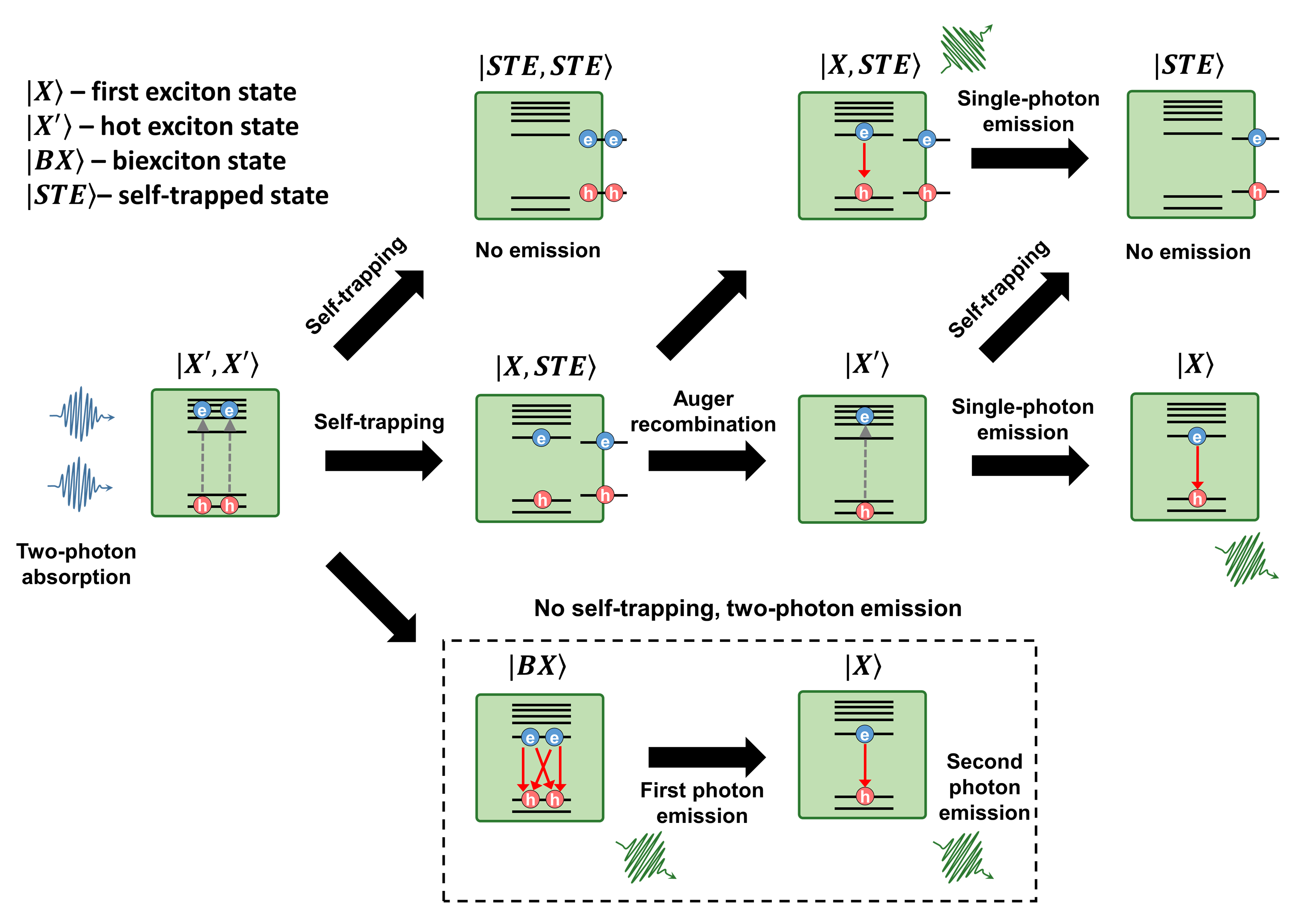
The pursuit of stable, single-photon emission sources, as demonstrated by this study of perovskite nanocrystals, echoes a fundamental principle of elegant design. Researchers discovered that suppressing biexciton emission – a complex interaction within the nanocrystal structure – enhances the purity of the emitted photons. This refinement, achieved through self-trapped excitons, reveals that true brilliance isn’t simply about maximizing output, but about minimizing internal noise. As Albert Einstein once observed, “Everything should be made as simple as possible, but no simpler.” This research embodies that sentiment; it demonstrates how understanding and controlling inherent complexities – like biexciton formation – can lead to remarkably clean and efficient light emission, proving that beauty scales, clutter does not.
The Road Ahead
The observation of suppressed biexciton emission through self-trapped excitons suggests a subtle, yet profound, principle at play: that darkness, properly understood, can enhance luminescence. This is not merely a technical refinement, but a challenge to the intuitive drive for ever-brighter signals. The field now faces the task of systematically exploring this ‘dark state engineering’ – identifying materials and conditions where this suppression isn’t an anomaly, but a predictable, controllable feature. Consistency, after all, is empathy; a reliable single-photon source demands a predictable response.
Current limitations reside in the inherent variability of nanocrystal synthesis. Achieving uniformity, not just in size, but in defect density and surface passivation, will be crucial. The pursuit of ‘perfect’ crystals, though perhaps unattainable, guides attention toward understanding the types of imperfections that contribute to unwanted biexciton formation. One suspects the answers lie not in eliminating all defects, but in sculpting them – harnessing their influence to steer excitons toward desired states.
Ultimately, the elegance of this mechanism isn’t simply that it works, but that it hints at a deeper harmony between material properties and quantum phenomena. The true test will be translating this fundamental understanding into practical devices – robust, scalable single-photon sources that unlock the potential of quantum technologies. Beauty does not distract; it guides attention, and the path forward demands a relentless focus on the underlying principles that govern light emission at the nanoscale.
Original article: https://arxiv.org/pdf/2602.11385.pdf
Contact the author: https://www.linkedin.com/in/avetisyan/
See also:
- All Shadow Armor Locations in Crimson Desert
- Jujutsu Kaisen Season 3 Episode 12 Release Date
- Dark Marksman Armor Locations in Crimson Desert
- Keeping AI Agents on Track: A New Approach to Reliable Action
- How to Beat Antumbra’s Sword (Sanctum of Absolution) in Crimson Desert
- Top 5 Militaristic Civs in Civilization 7
- Sega Reveals Official Sonic Timeline: From Prehistoric to Modern Era
- How to Get the Sunset Reed Armor Set and Hollow Visage Sword in Crimson Desert
- Sakuga: The Hidden Art Driving Anime’s Stunning Visual Revolution!
- How To Beat Ator Archon of Antumbra In Crimson Desert
2026-02-15 19:40