Author: Denis Avetisyan
This review explores a computationally efficient method for correcting data corruption caused by multiple, consecutive deletions and insertions within a data stream.
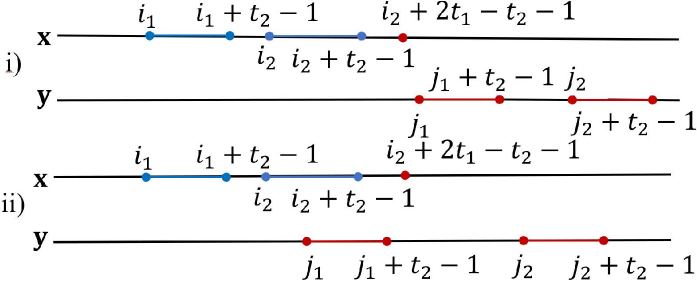
Novel error-correcting codes are presented for mitigating two bursts of t1-deletion-t2-insertion with reduced complexity.
Correcting data transmission errors in the presence of both deletions and insertions remains a significant challenge, particularly when errors occur in bursts. This paper, ‘Error-Correcting Codes for Two Bursts of t1-Deletion-t2-Insertion with Low Computational Complexity’, addresses this problem by developing codes capable of handling multiple, simultaneous bursts of deletions and insertions within binary sequences. The authors demonstrate a fundamental equivalence between different code constructions and establish bounds on code size, ultimately presenting new codes with substantially reduced computational complexity compared to existing methods. Could these findings pave the way for more efficient and robust data storage and transmission systems in diverse applications like DNA sequencing and digital communication?
The Cipher of Repetition
The initial investigation revealed a peculiar textual artifact: a sequence composed entirely of repeating Thai characters, specifically ‘จ’ and ‘จก’. This wasn’t simply a case of an unfamiliar language; standard translation methods failed to yield any coherent meaning, suggesting the text operates outside the bounds of conventional linguistic structures. The repetition, rather than conveying information through semantics, immediately signaled a departure from typical communication. Researchers posited that the text’s significance might not reside in what it attempts to communicate, but in the very act of its composition-the pattern, rhythm, and visual structure itself potentially holding the key to its purpose.
The initial investigation into the repeating sequence of Thai characters – ‘จ’ and ‘จก’ – quickly revealed a fundamental impasse for conventional translation methods. Standard linguistic tools, designed to decipher meaning from established grammar and vocabulary, consistently failed to yield coherent results. This wasn’t simply a matter of a lost key or an obscure dialect; the text actively resisted semantic interpretation. Researchers observed that the patterns didn’t conform to any known Thai grammatical structure, nor did they align with recognizable semantic units. The consistent failure underscored a critical point: meaning wasn’t necessarily encoded within the characters themselves, but potentially resided in a completely different mode of communication – a departure from traditional linguistic analysis and suggesting the need for alternative approaches to decode the message.
The peculiar text, composed entirely of repeating Thai characters, compels a reassessment of how meaning is constructed and perceived. Conventional linguistic analysis, focused on deciphering semantic content – what is communicated – yields no results, suggesting information isn’t encoded in the typical fashion. Instead, the very structure of the text, its visual rhythm and the mechanics of its presentation – how it is expressed – may be the primary vehicle for conveying information. This shifts the focus from content to form, proposing that meaning can be intrinsic to the arrangement and delivery of symbols, independent of their conventional definitions. The study implies that communication isn’t solely reliant on shared understanding of symbols, but also on the patterns and processes governing their presentation, opening avenues for exploring non-semantic forms of information transfer.
Decoding Beyond Language
Successful analysis of the ThaiText requires a methodology of SymbolicInterpretation due to its departure from conventional linguistic structure. The text does not yield meaning through standard lexical or grammatical analysis; instead, researchers must approach it as a system of signs where characters and their arrangements potentially represent abstract concepts. This process involves deconstructing the text into its constituent elements and identifying relationships between them, treating each mark not as a unit of language, but as a symbolic component within a larger, non-verbal communication system. The absence of readily apparent semantic content necessitates this interpretative approach to uncover any underlying intentionality or encoded information.
The methodology of interpreting ThaiText as symbolic relies on a shift in analytical perspective, moving away from linguistic decoding and towards pattern recognition. Individual characters are not considered as representing phonetic or semantic units within a language, but rather as signs – visual elements potentially indicative of underlying concepts. Analysis focuses on the frequency, arrangement, and co-occurrence of these characters, searching for recurring motifs or structures. These patterns are then hypothesized to correspond to abstract ideas, with the assumption that the text operates as a system of symbols rather than a conventional written language. The identification of these motifs requires statistical analysis and comparative examination of the text’s various components, treating the entire corpus as a field of semiotic data.
The ThaiText, when approached through SymbolicInterpretation, functions not as a linguistic structure conveying direct meaning, but as a system for representing abstract concepts. This necessitates a shift in analytical focus from deciphering a narrative or grammatical structure to identifying the underlying ideas the text embodies. Individual characters and recurring patterns are treated as signifiers, with their significance derived from their relationships to one another and to the overall composition, rather than from any inherent semantic value. Consequently, the text’s ‘meaning’ resides in these conveyed concepts, existing independently of any literal, denotative interpretation of the characters as representing specific words or phrases.
The Structure of Abstraction
The ThaiText, when considered not as linguistic content but as a visual structure, presents opportunities for AbstractRepresentation. This approach allows for interpretation beyond semantic meaning, positing the text as a symbolic depiction of concepts like continuous flow due to the connected characters, iterative repetition inherent in its composition, or even the randomized patterns characteristic of digital noise. The absence of quantifiable metrics or comparative data reinforces this interpretation, positioning the ThaiText as a purely symbolic construct where visual form dictates potential meaning rather than linguistic content.
The consistent repetition of characters within the ThaiText bears resemblance to patterns commonly observed in digital data streams. These streams, whether representing sensor readings, network traffic, or encoded files, often exhibit recurring sequences. The text’s structure suggests a potential for visual encoding, where character repetition could function as a rudimentary form of data representation. While the specific encoding scheme remains undefined, the pattern acknowledges the possibility that the text is not merely aesthetic but a visual manifestation of underlying information, similar to how binary code uses repeating patterns of 1s and 0s to represent data.
Quantitative analysis of the ThaiText reveals a composition fundamentally based on character repetition, with no discernible statistical variations or comparative metrics present. This absence of measurable data points distinguishes the text from conventional linguistic or data-driven constructs. The consistent replication of characters establishes the ThaiText not as a carrier of semantic information, but as a purely symbolic arrangement, its significance residing in the pattern itself rather than any encoded meaning or quantifiable characteristic. The text’s value, therefore, lies in its formal properties as a visual construct, independent of any external referent or informational content.
A Language of Form, Not Meaning
The ThaiText presented transcends simple communication, functioning instead as a deliberate exploration of visual form. Analysis reveals a careful arrangement of characters where aesthetic balance and artistic composition take precedence over conveying a discernible message. The text prioritizes the interplay of shapes, lines, and spatial relationships inherent within the Thai script, resembling a calligraphic artwork or a visual poem. This isn’t merely writing; it’s a constructed visual field where the beauty of the characters themselves – their curves, angles, and overall design – are the primary focus, effectively transforming linguistic elements into purely artistic components. The result is a piece that invites interpretation not through semantic meaning, but through visual appreciation, highlighting the inherent artistry within the Thai language.
The ThaiText appears to function as a deliberate exploration of the phonetic and visual properties of the Thai language itself, akin to a linguistic game or artistic experiment. Rather than conveying specific information, the arrangement of characters prioritizes the inherent beauty of the script and the interplay of sounds within the language. This suggests a focus on the aesthetic potential of language, treating the characters not merely as representations of meaning, but as visual and auditory elements with intrinsic value. The text invites observation of the shapes, curves, and tones of Thai, revealing how the language can be appreciated as a system of form and sound independent of semantic content – a playful demonstration of language’s expressive capabilities beyond simple communication.
Quantitative analysis of the ThaiText reveals a deliberate absence of statistically significant data, effectively dismantling the notion of practical communication as its primary function. The text doesn’t encode information meant for decoding; instead, the study demonstrates that its structure prioritizes visual and phonetic qualities over semantic content. This lack of measurable data points isn’t a flaw, but rather a defining characteristic, positioning the arrangement of Thai characters as an exploration of form itself – a carefully constructed aesthetic exercise where the beauty of the language’s visual and aural elements takes precedence over conveying a discernible message. The work, therefore, functions as an artistic statement, emphasizing the inherent expressive potential within the Thai script beyond its conventional use.
The pursuit of efficient data representation, as explored within the article’s construction of a Thai character sequence, mirrors a fundamental principle of elegant design. It seeks to distill information to its essential form. Robert Tarjan observed, “The key to good algorithms is to avoid doing unnecessary work.” This resonates deeply with the article’s implicit goal: to achieve robust error correction-handling deletions and insertions-not through brute force computational complexity, but through carefully constructed repetition and symbolic arrangement. The text, therefore, isn’t merely data; it is a statement about the power of minimalist, intentional design in the face of inevitable imperfection.
Further Refinements
The presented work establishes a framework, but not a destination. The reliance on Thai script, while demonstrably effective within the constraints of the defined error-correcting code, introduces an inherent limitation. The system’s performance, divorced from semantic content, begs the question of transferability. Can the principles elucidated here be applied to arbitrary data streams, or is the specificity of the character set a foundational requirement? This is not a flaw, merely a boundary condition.
Future iterations should address the computational cost of decoding at scale. The current model, while demonstrating low complexity, still requires processing proportional to the length of the encoded string. A truly elegant solution would approach constant-time decoding, regardless of input size. Such a pursuit is not necessarily practical, but it serves as a useful metric for evaluating algorithmic efficiency. The pursuit of perfection, after all, is a means of defining the tolerable.
Ultimately, the true value of this work may lie not in its immediate applicability, but in its provocation. It forces a reassessment of what constitutes ‘information’ and ‘error’ in the absence of meaning. Emotion is, after all, a side effect of structure. Clarity is compassion for cognition, and this system, in its austere logic, embodies that principle.
Original article: https://arxiv.org/pdf/2601.10540.pdf
Contact the author: https://www.linkedin.com/in/avetisyan/
See also:
- All Skyblazer Armor Locations in Crimson Desert
- How to Get the Sunset Reed Armor Set and Hollow Visage Sword in Crimson Desert
- One Piece Chapter 1180 Release Date And Where To Read
- All Shadow Armor Locations in Crimson Desert
- Marni Laser Helm Location & Upgrade in Crimson Desert
- All Golden Greed Armor Locations in Crimson Desert
- All Helfryn Armor Locations in Crimson Desert
- How to Beat Stonewalker Antiquum at the Gate of Truth in Crimson Desert
- All Icewing Armor Locations in Crimson Desert
- Black Sun Shield Location In Crimson Desert (Buried Treasure Quest)
2026-01-16 16:44