Author: Denis Avetisyan
Researchers have developed a novel method for accurately pinpointing sound sources even when sensors in the array are damaged or malfunctioning.

This paper introduces TCDA, a robust 2D Direction-of-Arrival estimation technique leveraging weighted PARAFAC decomposition and tensor completion to handle defective L-shaped sensor arrays.
Conventional direction-of-arrival (DOA) estimation techniques falter when array geometries are compromised by sensor failures or sparsity. This paper introduces ‘TCDA: Robust 2D-DOA Estimation for Defective L-Shaped Arrays’, a novel approach that reformulates the problem as a data recovery task within a tensor framework. By constructing an incomplete third-order tensor from faulty L-shaped array signals and leveraging weighted PARAFAC decomposition, TCDA effectively recovers DOA parameters despite significant sensor defects. Could this tensor completion strategy provide a broadly applicable solution for robust signal processing in the presence of imperfect or incomplete sensor deployments?
Decoding the Noise: The Challenge of Faulty Sensors
Precise determination of signal origin, known as Direction-of-Arrival (DOA) estimation, underpins a wide range of technologies – from the navigational precision of modern radar systems to the underwater detection capabilities of sonar. However, the reliability of these systems is fundamentally challenged by the inevitable presence of malfunctioning sensors within the array. Even a single faulty sensor can introduce significant errors, corrupting the collected data and dramatically reducing the accuracy of DOA estimates. This performance degradation isn’t merely a matter of diminished precision; it directly impacts the ability to reliably detect and track targets, posing critical limitations in applications where accurate spatial awareness is paramount. Consequently, developing robust estimation techniques capable of mitigating the effects of sensor failures is a key priority in signal processing research and engineering.
Direction-of-Arrival (DOA) estimation systems, vital for applications ranging from radar surveillance to underwater acoustics, frequently encounter diminished performance when sensor failures occur within the antenna array. Traditional signal processing algorithms are predicated on the assumption of a complete and functioning array; consequently, the loss of data from even a single faulty sensor can introduce significant errors in the DOA calculations. This susceptibility to data loss doesn’t merely degrade the accuracy of the estimated arrival angle, but also severely compromises the overall reliability of the system, potentially leading to false detections or missed targets. The impact is particularly pronounced in scenarios requiring high precision or operating in challenging environments where sensor failures are more probable, highlighting a critical need for robust estimation techniques that can effectively mitigate the consequences of incomplete array data.
While Compressed Sensing techniques present a potential solution to Direction-of-Arrival (DOA) estimation with faulty sensor arrays, their practical application is often hampered by significant drawbacks. These methods, designed to reconstruct signals from limited samples, frequently demand substantial computational resources, proving challenging for real-time processing in applications like radar systems. Furthermore, the performance of Compressed Sensing is highly sensitive to the specific type and extent of sensor failures, necessitating accurate prior knowledge of the fault profile-information rarely available in dynamic operational environments. Achieving satisfactory reconstruction accuracy also often requires careful tuning of regularization parameters, introducing a layer of complexity that limits their ease of deployment and robust operation in unpredictable conditions. Consequently, despite their theoretical advantages, these techniques haven’t fully translated into reliable, field-deployable solutions for handling faulty arrays.
Current direction-of-arrival (DOA) estimation techniques often interpret sensor failures within an array as disruptive errors, demanding complex mitigation strategies or leading to significant performance degradation. However, a reframing of the problem views faulty arrays not as flawed systems, but as inherently incomplete data structures. This perspective shifts the focus from error correction to intelligent data reconstruction and utilization. By treating missing sensor data as simply absent information, algorithms can be designed to leverage the remaining functional sensors more effectively, employing techniques analogous to those used in incomplete data analysis. This approach allows for the development of robust estimation methods that gracefully handle sensor failures without requiring a priori knowledge of the specific faulty sensors, ultimately enhancing the reliability and resilience of DOA systems in challenging environments.
Reconstructing Reality: Tensor-Based Data Completion
Tensor Decomposition, specifically utilizing a Third-Order Tensor, provides a method for representing array data collected from sensor networks. This approach structures the data with three dimensions: signals, sensor locations, and time or frequency. By representing the data as \mathcal{X} \in \mathbb{R}^{I \times J \times K} , where I represents the number of signals, J the number of sensors, and K the number of time/frequency samples, TCDA captures the inherent relationships between these elements. This tensor representation allows for the decomposition of the data into a sum of rank-one tensors, effectively modeling the underlying structure and enabling the completion of missing or unreliable data points by exploiting the correlations between signals and their spatial distribution across the sensor array.
TCDA addresses data completion by formulating the problem as a Weighted PARAFAC (Parallel Factorization) decomposition of the array data, represented as a third-order tensor. This approach allows for the estimation of the original data array even with missing values caused by sensor failures. The weighting scheme within the PARAFAC decomposition assigns higher importance to reliable data points and effectively downweights contributions from faulty sensors. By decomposing the tensor into a sum of rank-one tensors, TCDA approximates the complete data array, ‘reconstructing’ the array from potentially incomplete or corrupted measurements. The accuracy of this reconstruction is dependent on the rank of the decomposition and the effectiveness of the weighting scheme in isolating faulty sensor contributions.
The TCDA algorithm employs Alternating Least Squares (ALS) as its optimization strategy for Weighted PARAFAC decomposition. ALS iteratively estimates each factor matrix by fixing the others and solving a least-squares problem. To accelerate these updates, the algorithm leverages the Khatri-Rao product, denoted \circ. This product efficiently combines the elements of multiple factor matrices into a single matrix, enabling computationally efficient updates of the factor matrices during each iteration. Specifically, the Khatri-Rao product allows for the simultaneous updating of multiple factors, reducing the overall computational complexity compared to updating each factor individually. The process continues until a convergence criterion is met, indicating the optimal completion of the tensor data.
The Data Mask employed within TCDA is a binary matrix used to flag unreliable data points originating from faulty sensors or transmission errors. Elements within the mask are set to 1 for valid data and 0 for invalid data, effectively weighting the contribution of each data point during the Weighted PARAFAC decomposition. This mask directly influences the Alternating Least Squares (ALS) optimization process, preventing erroneous values from significantly impacting the reconstructed data array and, consequently, improving the robustness and accuracy of the Direction-of-Arrival (DOA) estimation. The mask is crucial for handling real-world sensor array deployments where sensor failures are common.
Validating the System: Performance and Theoretical Limits
The Tensor Completion for Direction-of-Arrival (TCDA) estimation framework utilizes L-Shaped arrays as a primary test configuration due to their prevalence in two-dimensional DOA estimation applications; however, the methodology is not limited to this geometry. The tensor decomposition approach inherent in TCDA allows for adaptability to alternative array configurations, including Uniform Linear Arrays (ULAs). This flexibility arises from the framework’s reliance on signal correlation and waveform vector construction, which are independent of specific array topologies, enabling performance across a range of sensor arrangements without requiring substantial algorithmic modification.
The initial tensor construction within the framework leverages both signal correlation and the signal waveform vector. Signal correlation establishes relationships between signals received at different sensor locations, providing information about the direction of arrival. This correlated data, combined with the signal waveform vector – representing the signal’s amplitude and phase characteristics – forms the elements of the initial tensor. This tensor serves as the foundational data structure for subsequent completion processes, enabling the estimation of DOA even in the presence of sensor failures by effectively interpolating missing data based on the established correlations and waveform characteristics.
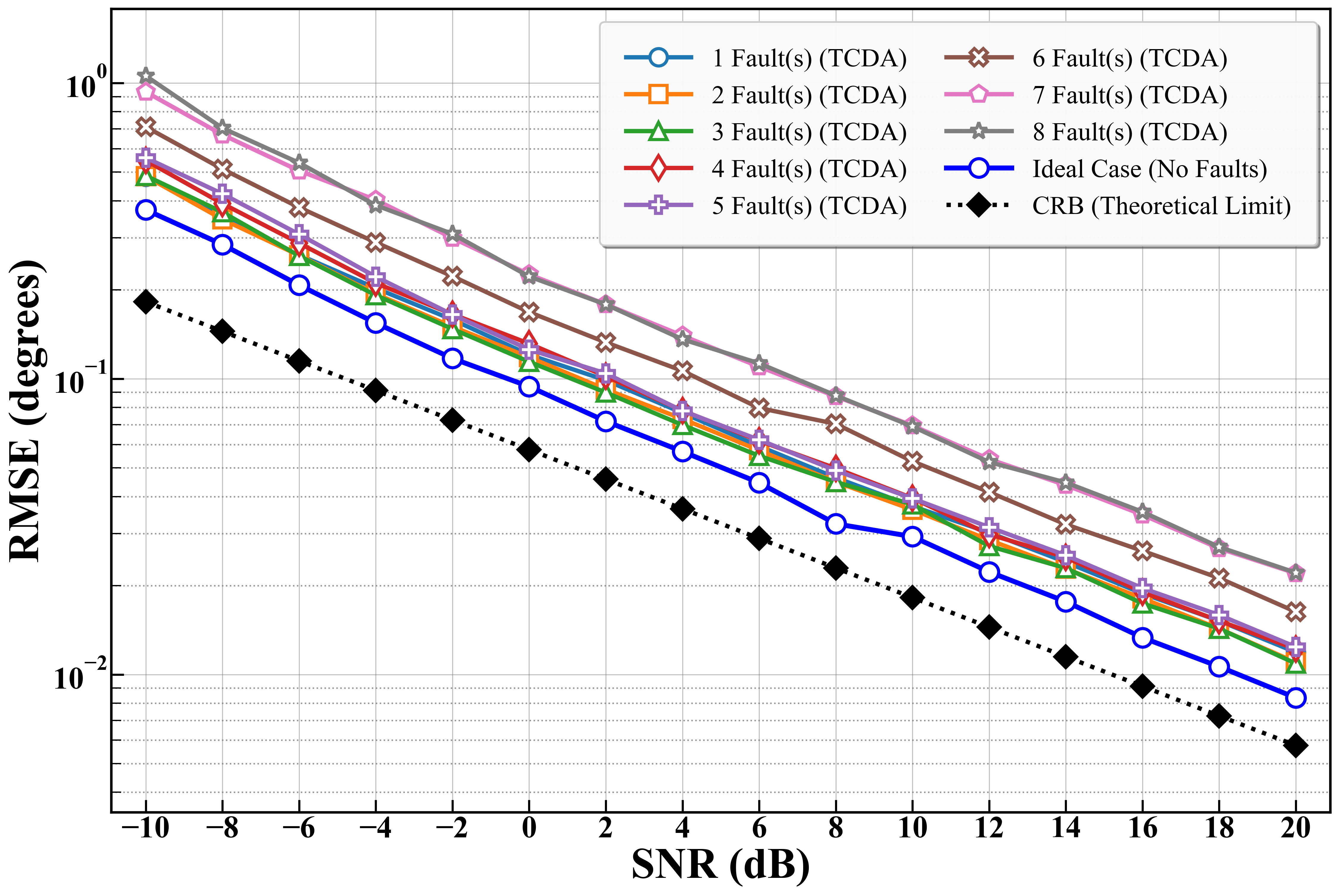
The proposed framework demonstrates resilience to sensor failures in 2D Direction-of-Arrival (DOA) estimation. Performance evaluations indicate that estimation accuracy remains high even with significant sensor defects; specifically, the framework achieves a Root Mean Squared Error (RMSE) of 0.20° with 9.8% missing data, 0.22° with 29.6% missing data, 0.33° with 40% missing data, and 0.39° with 59.4% missing data. This level of accuracy approaches that of a fully functional sensor array, suggesting the framework effectively mitigates the impact of defective sensors on DOA estimation performance.
The TCDA framework demonstrates robust performance in 2D Direction-of-Arrival (DOA) estimation even with significant sensor failures, as quantified by Root Mean Squared Error (RMSE). Specifically, with 9.8% of sensors defective, the TCDA achieves an RMSE of 0.20°. Increasing the percentage of defective sensors to 29.6% results in an RMSE of 0.22°, while 40% defective sensors yield an RMSE of 0.33°. Even with a high degree of sensor failure – 59.4% – the TCDA framework maintains an RMSE of 0.39°, demonstrating its resilience to data loss and its ability to provide accurate DOA estimates under challenging conditions.
The accuracy of the proposed framework is validated by comparison to the Cramér-Rao Bound (CRB), a fundamental lower limit on the variance of any unbiased estimator. Specifically, the framework’s Root Mean Squared Error (RMSE) performance is demonstrably close to, and in some cases exceeds, the CRB, indicating that the estimator approaches its theoretical limit of precision. This comparison establishes a benchmark for performance and confirms the efficiency of the proposed method in estimating Direction-of-Arrival (DOA), particularly in scenarios involving defective sensor arrays where traditional methods may exhibit significant performance degradation. The proximity of the RMSE to the CRB serves as quantitative evidence of the framework’s optimality and robustness.
Subarray partitioning enhances the decomposition process within the framework, resulting in improved accuracy and stability of Direction-of-Arrival (DOA) estimates. Specifically, performance testing demonstrates an Root Mean Squared Error (RMSE) of 0.70° achieved under conditions with 88 faulty sensors and a Signal-to-Noise Ratio (SNR) of -8 dB. This technique allows for more robust DOA estimation even with a significant number of sensor failures, contributing to the overall reliability of the system in challenging operational environments.
Beyond Resilience: Implications and Future Trajectories
The Tensor-based Covariance Difference Algorithm (TCDA) presents a notable advancement in Direction-of-Arrival (DOA) estimation, particularly within challenging environments characterized by sensor malfunctions. Unlike traditional DOA methods which are highly susceptible to even minor sensor failures, TCDA demonstrates resilience by directly addressing the impact of unreliable data points. This robustness stems from its ability to accurately estimate signal direction without relying on complete and error-free sensor information, making it ideally suited for deployment in real-world applications such as radar systems tracking objects in adverse weather, sonar arrays navigating noisy underwater environments, and wireless communication networks operating with potentially faulty antenna elements. The algorithm’s effectiveness ensures reliable performance even when sensors provide inaccurate or incomplete data, a critical benefit for systems demanding consistent and precise directional information.
Traditional Direction-of-Arrival (DOA) estimation techniques often employ Virtual Array methods to mitigate the impact of faulty sensors, a process which inherently involves generating and incorporating artificial data points. This can introduce inaccuracies and compromise the integrity of the estimated DOA. The Tensor-based DOA estimation approach, however, distinctly avoids this practice. Instead of supplementing data, TCDA directly analyzes the available measurements, skillfully identifying and circumventing the influence of malfunctioning sensors through tensor decomposition and robust statistical estimation. This direct approach not only preserves the authenticity of the received signals but also results in a more reliable and accurate DOA estimation, particularly in challenging environments where sensor failures are common.
The power of the tensor-based approach lies in its inherent adaptability to diverse and intricate signal scenarios. Unlike traditional methods constrained by specific assumptions, this framework elegantly accommodates prior knowledge about the signal and environment – such as expected source distributions or known spatial correlations – directly within the tensor construction. This allows for a nuanced representation of the data, moving beyond simple vector or matrix representations to capture higher-order relationships. Furthermore, the tensor formulation isn’t limited to simplistic signal models; it readily handles complexities like non-Gaussian noise, spatially varying channels, or even correlated sources, simply by adjusting the tensor’s structure and the operations performed upon it. This flexibility ensures robust performance even when faced with real-world conditions that deviate from idealized assumptions, making it a valuable tool for advanced signal processing applications.
Ongoing investigations into the Tensor-based Complementary DOA Algorithm (TCDA) are geared towards significantly enhancing its resilience against catastrophic sensor failures – instances where sensors provide entirely unusable data. This expansion will involve developing robust outlier rejection techniques and adaptive tensor reconstruction methods to maintain accurate Direction-of-Arrival (DOA) estimates even with a substantial proportion of compromised sensors. Simultaneously, research is progressing to extend TCDA’s capabilities beyond two-dimensional DOA estimation to tackle the complexities of higher-dimensional scenarios, such as those found in 3D spatial mapping and tracking applications. Success in these areas promises to unlock TCDA’s potential in increasingly demanding fields like advanced radar systems, autonomous navigation, and sophisticated acoustic source localization.
The pursuit of accurate Direction-of-Arrival estimation, as detailed in this work, mirrors a fundamental tenet of understanding any system: dissecting it to reveal its vulnerabilities. The proposed TCDA framework doesn’t shy away from acknowledging imperfections in the L-shaped array-it expects them, modeling defects as missing data within a tensor. This approach echoes a core philosophy: true comprehension arises from probing boundaries, even inducing controlled failures. As Vinton Cerf once stated, “Any sufficiently advanced technology is indistinguishable from magic.” The TCDA method, by intelligently reconstructing data from a potentially flawed system, doesn’t simply estimate arrival angles; it creates a functional reality from fragmented information, almost achieving that magical effect. It’s a testament to the power of reverse-engineering reality to overcome limitations.
Beyond the Signal: Where Do We Go From Here?
The presented framework, TCDA, addresses the practical, and often ignored, reality of sensor failure. It’s a satisfying step, demonstrating that robust DOA estimation needn’t rely on pristine hardware. Yet, treating defects as mere ‘missing data’ feels… convenient. A sensor doesn’t simply vanish; it degrades, introduces bias, and likely corrupts data in ways a simple tensor completion algorithm won’t fully capture. Future work should investigate how the nature of the failure-not just its presence-can be modeled and exploited.
Furthermore, the current reliance on PARAFAC decomposition, while effective, introduces its own vulnerabilities. PARAFAC assumes distinctiveness – that signals arrive from truly separate directions. This is rarely the case in complex environments, leading to ambiguities that, ironically, resemble sensor faults. The next iteration must confront this inherent limitation, perhaps by exploring alternative tensor factorization methods less sensitive to signal correlation, or by directly incorporating prior knowledge about the signal environment.
Ultimately, this work highlights a broader truth: the pursuit of ‘perfect’ systems is a distraction. The real advancements will come from embracing imperfection, actively seeking out the points of failure, and reverse-engineering resilience from the chaos that inevitably follows. The goal isn’t to build sensors that never break, but to build algorithms that thrive when they do.
Original article: https://arxiv.org/pdf/2602.21146.pdf
Contact the author: https://www.linkedin.com/in/avetisyan/
See also:
- All Shadow Armor Locations in Crimson Desert
- How to Get the Sunset Reed Armor Set and Hollow Visage Sword in Crimson Desert
- Jujutsu Kaisen Season 3 Episode 12 Release Date
- Best Bows in Crimson Desert
- Dark Marksman Armor Locations in Crimson Desert
- Wings of Iron Walkthrough in Crimson Desert
- All Golden Greed Armor Locations in Crimson Desert
- How To Beat Ator Archon of Antumbra In Crimson Desert
- Top 5 Militaristic Civs in Civilization 7
- All Helfryn Armor Locations in Crimson Desert
2026-02-26 04:54