Author: Denis Avetisyan
A new framework overcomes traditional constraints to embed secret images within cover images at any resolution, enabling high-fidelity recovery without prior knowledge.
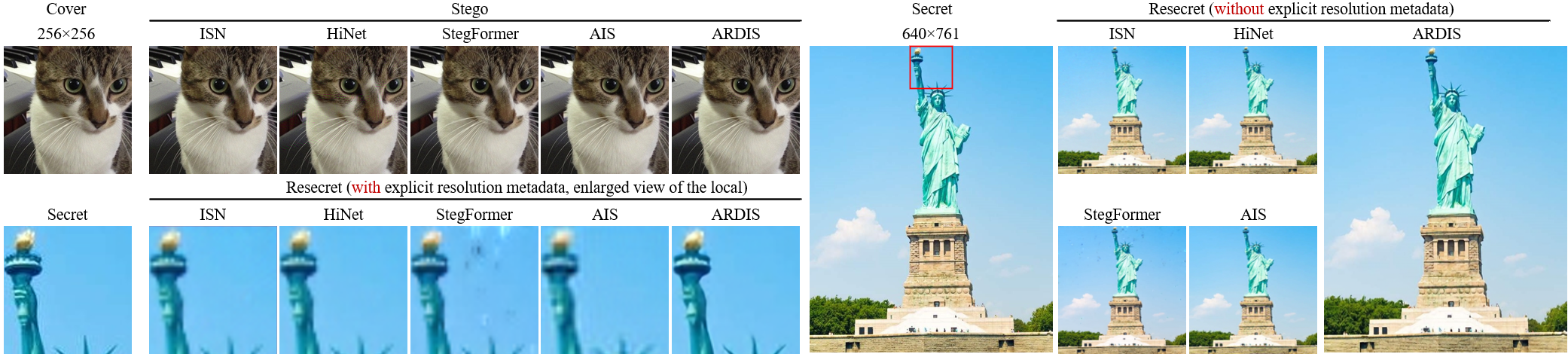
This research introduces ARDIS, a deep image steganography system leveraging frequency decoupling and latent guidance for arbitrary-resolution hiding and blind reconstruction.
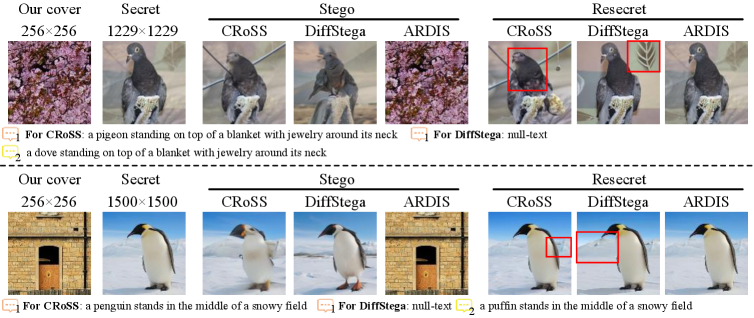
Existing deep image steganography methods typically enforce a fixed resolution between secret and cover images, limiting flexibility and potentially sacrificing detail during hiding and recovery. To address this, we present ‘Breaking the Resolution Barrier: Arbitrary-resolution Deep Image Steganography Framework’, introducing ARDIS, a novel approach that decouples frequency components and utilizes latent guidance for high-fidelity, cross-resolution secret image restoration. This framework enables blind recovery of the original resolution and significantly improves both invisibility and fidelity compared to state-of-the-art techniques. Could this paradigm shift unlock new possibilities for covert communication and robust data embedding in complex visual media?
The Inherent Limitations of Conventional Steganography
Current deep image steganography (DIS) techniques, frequently leveraging autoencoders for concealing data, exhibit a significant limitation in adapting to varying secret image resolutions. These methods typically train with a fixed resolution, creating a rigid system unable to effectively embed or retrieve information if the secret image deviates from this predefined size. This inflexibility hinders practical deployment, as real-world applications often require accommodating diverse image dimensions – from low-resolution thumbnails to high-definition photographs. Consequently, a secret image needing to be transmitted might require pre-processing, such as resizing, which can introduce artifacts and compromise both image quality and the robustness of the hidden data. Addressing this constraint is crucial for broadening the usability of DIS beyond controlled experimental settings and enabling its integration into versatile communication systems.
Conventional deep image steganography frequently employs discrete pixel mapping, a technique that fundamentally limits the recoverable resolution of the hidden message. This constraint arises because the secret image is fragmented and embedded into specific, predetermined locations within the cover image; recovering the secret requires accessing exactly those mapped pixels. Consequently, if a user attempts to retrieve the secret image at a resolution differing from the original embedding, significant distortion or data loss occurs. This inflexibility poses a practical challenge, as real-world applications often demand adaptability to varying bandwidths or display capabilities. A system capable of delivering a secret image at any desired resolution – without compromising integrity – would represent a substantial advancement over current methodologies and broaden the utility of deep image steganography.
Conventional deep image steganography techniques often embed secret images by rigidly aligning their pixels with those of the cover image, a process that severely limits adaptability. This fixed spatial correspondence means the secret image’s resolution is predetermined by the cover image, and any attempt to extract the secret at a different scale results in significant distortion or failure. Such inflexibility stems from the assumption that a direct, pixel-to-pixel mapping is essential for maintaining image quality and imperceptibility; however, this constraint hinders practical applications where varying secret image sizes or resolutions are frequently needed. Researchers are actively exploring methods to decouple the secret image from this rigid alignment, aiming to establish a more flexible embedding scheme that allows for successful recovery regardless of the initial spatial relationship between the two images.
The efficacy of contemporary deep image steganography is increasingly challenged by sophisticated steganalysis techniques, prompting a critical need for parallel advancements in both concealment and detection methodologies. While current methods can effectively embed secret images, their susceptibility to scrutiny – often exploiting statistical anomalies or subtle pixel deviations – limits practical application. Researchers are actively investigating robust hiding strategies, including adaptive embedding based on image content and the incorporation of adversarial examples to mislead detection algorithms. Simultaneously, improved steganalysis tools are being developed, leveraging machine learning to identify even the most cleverly disguised secrets. This ongoing cycle of concealment and discovery is driving innovation, pushing the boundaries of what is possible in the field and ensuring a continued arms race between those who seek to hide information and those who seek to reveal it.
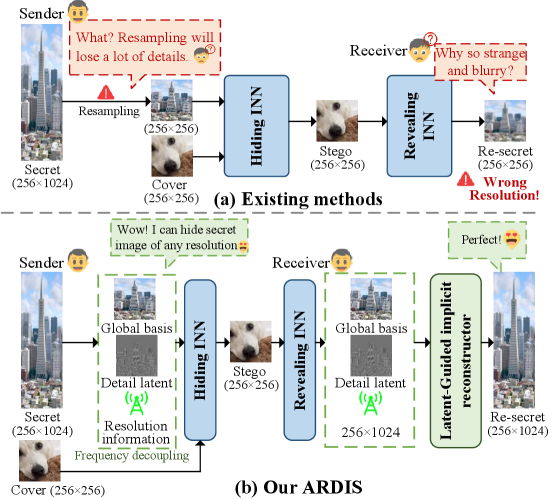
ARDIS: A Paradigm Shift Towards Resolution Independence
ARDIS departs from conventional steganographic methods reliant on predefined image resolutions by implementing a continuous signal reconstruction framework. This approach facilitates the recovery of secret images at arbitrary resolutions, effectively decoupling the decoding process from a fixed output size. Instead of storing or transmitting resolution parameters explicitly, ARDIS reconstructs the image based on the characteristics of the latent signal, allowing for scalable secret image generation without loss of fidelity. This flexibility is achieved through a novel architecture designed to synthesize image details at any desired level of granularity, offering a significant advantage over systems constrained by static resolution limitations.
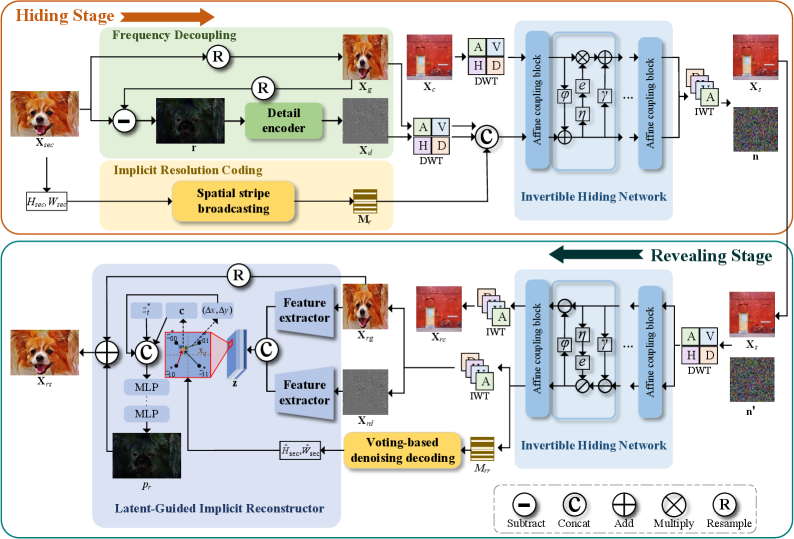
The ARDIS framework employs a frequency decoupling architecture to facilitate resolution-independent secret image recovery. This architecture decomposes the secret image into two distinct components: a low-frequency global visual basis representing the image’s core structure, and a high-frequency latent representation capturing detailed textural information. This separation is achieved through spectral analysis and feature extraction techniques, allowing each component to be encoded and processed independently. The global basis provides a coarse representation adaptable to various resolutions, while the latent information allows for the reconstruction of fine details upon decoding, regardless of the target resolution. This decoupling strategy minimizes information loss during transmission and enables high-quality image reconstruction at arbitrary resolutions.
The ARDIS framework achieves arbitrary resolution secret image creation by decoupling the secret into a global visual basis and high-frequency detail. This separation allows the global basis to define the overall structure, while the high-frequency details are modulated by a latent vector. A latent-guided implicit reconstructor then utilizes this combined information to synthesize the secret image. The implicit nature of the reconstruction process, coupled with the latent vector’s control over detail, allows for the generation of images at resolutions independent of the training data; the desired resolution is determined during the reconstruction phase rather than being a fixed parameter of the system, resulting in high-quality images at any specified size.
ARDIS employs an implicit resolution coding strategy where resolution information is not explicitly transmitted but is instead embedded directly within the feature maps of the neural network. This is achieved by modulating the feature representation based on the target resolution during encoding. Consequently, the decoder can recover the intended resolution without prior knowledge, enabling “blind” recovery. This approach avoids the need for separate resolution control signals or metadata, streamlining the secret image recovery process and offering increased flexibility in transmission and storage. The implicit coding allows the network to learn a resolution-agnostic feature representation, facilitating reconstruction at arbitrary scales.
Empirical Evidence of Robustness and Fidelity
The ARDIS system employs an implicit resolution coding strategy that utilizes spatial redundancy within feature channels to embed resolution metadata without introducing noticeable distortions. This approach capitalizes on the inherent correlations present in image data; by encoding resolution information within these redundant areas, ARDIS avoids the need for explicit, potentially artifact-inducing, metadata transmission. The system distributes resolution data across multiple spatial locations, providing robustness against localized data loss or corruption without affecting perceptual image quality. This differs from traditional methods that can suffer from visible artifacts when attempting to embed or recover resolution information, especially at higher resolutions.
ARDIS achieves fault tolerance in secret image recovery by capitalizing on the inherent redundancy present within its feature channels. This redundancy allows the system to reconstruct the secret image accurately even when portions of the transmitted data are lost or corrupted. The method distributes critical information across multiple, correlated feature channels, ensuring that the loss of data from any single channel does not critically impede the reconstruction process. This approach differs from methods reliant on single-channel transmission, which are inherently vulnerable to data loss, and provides a demonstrable improvement in robustness without requiring retransmission of lost data.
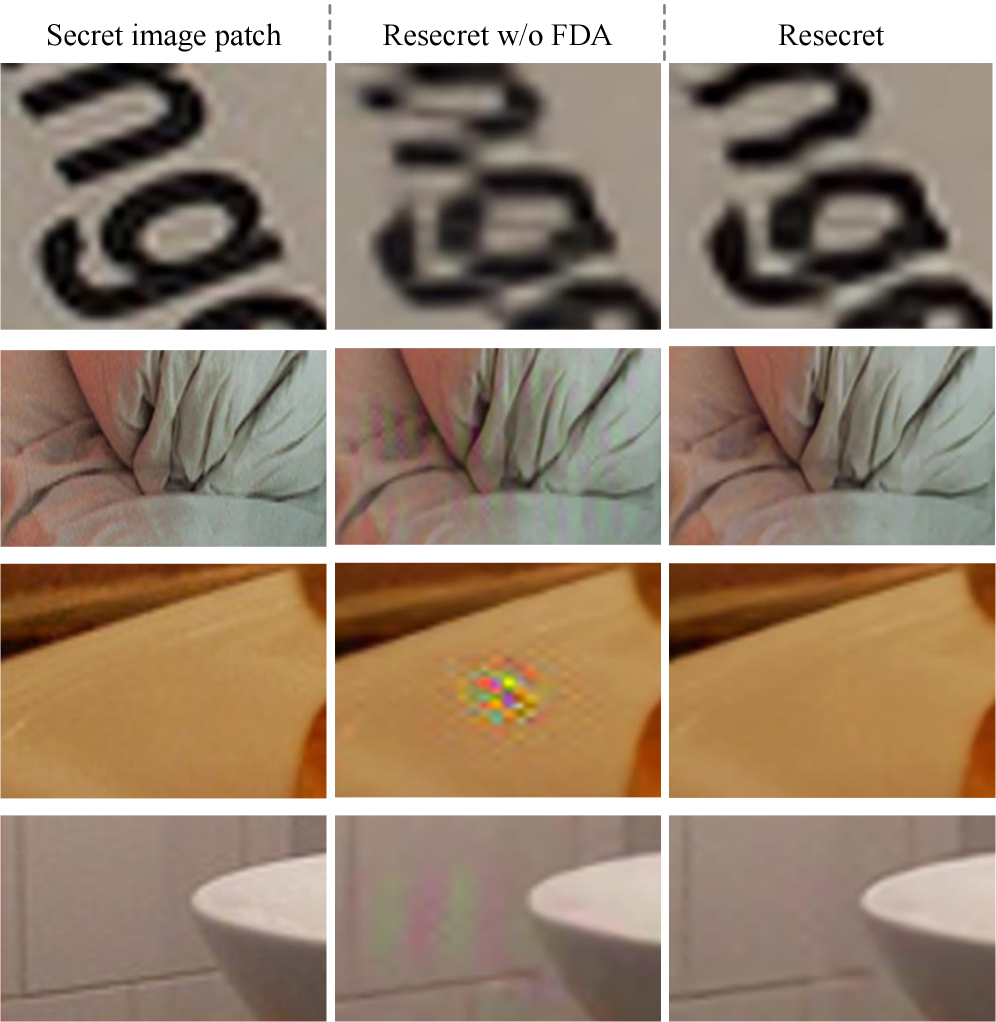
ARDIS employs a high-frequency detail latent representation to improve the fidelity of reconstructed secret images, especially at resolutions of 1024×1024 and above. This representation captures and encodes nuanced textural information that contributes to more intricate details in the recovered image. By focusing on high-frequency components, the system prioritizes the preservation of fine details often lost in traditional data hiding techniques. This approach results in a demonstrably higher peak signal-to-noise ratio (PSNR) and structural similarity index measure (SSIM) – specifically, a 1.83 dB improvement in PSNR and 0.044 in SSIM – compared to existing methods when reconstructing secret images at the aforementioned resolution.
Performance evaluations demonstrate that the ARDIS system surpasses existing methods in secret image recovery at 1024×1024 resolution, achieving a peak signal-to-noise ratio (PSNR) improvement of 1.83 dB and a structural similarity index measure (SSIM) improvement of 0.044. Critically, ARDIS attains 0% Relative Resolution Error (RRE) in blind recovery scenarios – meaning the recovered image’s resolution precisely matches the original – while comparative methods exhibit RRE values as high as 63.12%. These metrics indicate a substantial improvement in both visual fidelity and accuracy of resolution recovery using the ARDIS framework.
Future Trajectories: Towards Unbreakable Steganography
Future iterations of the ARDIS framework aim to leverage the power of diffusion models to create hidden images that are virtually indistinguishable from the cover content. These generative models excel at producing high-fidelity, natural-looking imagery, and their integration promises a significant leap in steganographic realism. By training diffusion models to embed data within image noise, the resulting hidden images are expected to evade even the most advanced steganalysis techniques. This approach moves beyond simply concealing data and instead focuses on creating plausible, natural variations within the cover image itself, effectively masking the presence of hidden information and bolstering the security of the communication channel.
To ensure the longevity and reliability of ARDIS, ongoing investigation centers on the development of advanced steganalysis methods, prominently featuring architectures like SRNet. These techniques move beyond traditional steganalysis by employing sophisticated deep learning models to detect even subtle manipulations indicative of hidden data. By proactively identifying potential vulnerabilities within the steganographic framework, researchers aim to fortify ARDIS against evolving attacks and maintain its secure communication capabilities. This iterative process of attack and defense is crucial; identifying weaknesses before malicious actors exploit them is paramount to building truly robust deep image steganography and preserving data integrity in sensitive applications.
To bolster the resilience of the ARDIS framework, ongoing research investigates adaptive resolution coding strategies tailored to the specific characteristics of the cover image. This approach moves beyond uniform resolution adjustments, instead dynamically altering the level of detail embedded within different image regions based on texture, complexity, and perceptual sensitivity. By concentrating hidden data in areas less susceptible to detection or distortion, and reducing it in visually prominent zones, the system aims to significantly improve robustness against common steganalysis techniques and image manipulations. This intelligent allocation of embedding capacity promises a more secure and imperceptible steganographic communication channel, capable of withstanding a wider range of attacks while maintaining high visual fidelity.
The advancements detailed in this study establish a foundation for markedly more secure and adaptable deep image steganography techniques, promising significant benefits for privacy-preserving communication and robust data security protocols. By leveraging innovations like the Locally-Guided Image Recovery (LGIR) method, a substantial improvement in image quality was demonstrated – specifically, a 1.84 gain in recovered Peak Signal-to-Noise Ratio (PSNR). This not only signifies a heightened ability to conceal information within images imperceptibly but also enhances the resilience of the hidden data against potential detection and degradation, offering a practical pathway toward confidential and reliable data transmission in diverse applications.
The pursuit of arbitrary resolution in image steganography, as demonstrated by ARDIS, echoes a fundamental principle of mathematical elegance. The framework’s decoupling of frequency components and implicit reconstruction aren’t merely about achieving a functional outcome; they represent a logical completeness in addressing the limitations of prior methods. As Andrew Ng aptly stated, “Simplicity doesn’t mean brevity – it means non-contradiction and logical completeness.” ARDIS embodies this – its architecture isn’t about minimizing complexity for its own sake, but about establishing a provable system for hiding and recovering information regardless of image resolution. The success isn’t solely measured by perceptual fidelity, but by the framework’s inherent correctness and robustness.
What Lies Beyond Resolution?
The framework presented here, while a notable advance in circumventing fixed-resolution limitations within deep image steganography, merely shifts the locus of difficulty. The decoupling of frequency components and implicit reconstruction, though elegant, introduce a new set of provable constraints. The fidelity of blind recovery, the core claim, remains intrinsically linked to the information capacity – a predictable trade-off. Future work must rigorously define the theoretical upper bound of this capacity, demonstrating not merely empirical performance, but mathematical certainty.
The reliance on latent guidance, a common crutch in generative models, demands further scrutiny. Is the secret image truly ‘hidden’, or simply re-encoded within the generator’s prior? A truly robust system would demonstrate independence from these priors – a verifiable guarantee of concealment, not just plausible deniability. The current approach, while effective, feels less like a solution and more like a sophisticated obfuscation.
In the chaos of data, only mathematical discipline endures. The field must move beyond assessing perceptual quality – easily manipulated – and focus on provable security. The next generation of steganographic frameworks will not be judged by what the eye cannot see, but by what mathematics cannot break.
Original article: https://arxiv.org/pdf/2601.15739.pdf
Contact the author: https://www.linkedin.com/in/avetisyan/
See also:
- All Shadow Armor Locations in Crimson Desert
- How to Get the Sunset Reed Armor Set and Hollow Visage Sword in Crimson Desert
- Jujutsu Kaisen Season 3 Episode 12 Release Date
- Best Bows in Crimson Desert
- Dark Marksman Armor Locations in Crimson Desert
- Wings of Iron Walkthrough in Crimson Desert
- All Golden Greed Armor Locations in Crimson Desert
- How To Beat Ator Archon of Antumbra In Crimson Desert
- Top 5 Militaristic Civs in Civilization 7
- All Helfryn Armor Locations in Crimson Desert
2026-01-26 04:47