
I began playing Magic: The Gathering around 21 or 22 years ago, when I was 12 or 13. I remember opening packs from the Mirrodin set and finding a powerful 11-mana Darksteel Colossus – that’s when I knew I’d really enjoy the game. I’d actually been collecting cards and learning the rules a bit before that, as I definitely remember having cards from the Onslaught set. But it was the Mirrodin block that really got me hooked. By the time the Kamigawa set came out, I was drafting whenever possible, and the Ravnica set was the most fun I ever had with Magic, even playing in tournaments and building my own decks.
I took a long break from Magic: The Gathering when I was 19, but I got back into playing and collecting a couple of years ago when the Bloomburrow set was announced. I bought all four Commander decks from Bloomburrow, plus a collector’s booster display, a regular booster box, the starter decks, and a pre-release kit. I quickly became really engaged again, and I’m already excited about the Lorwyn Eclipsed set. I’ve been involved with Magic: The Gathering for most of my life, so while I understand why Wizards of the Coast is making changes to the Ashling, the Limitless card before it’s even released, I also think it’s a sign of a larger issue with the game.
MTG’s Best Lorwyn Eclipsed Commander Explained
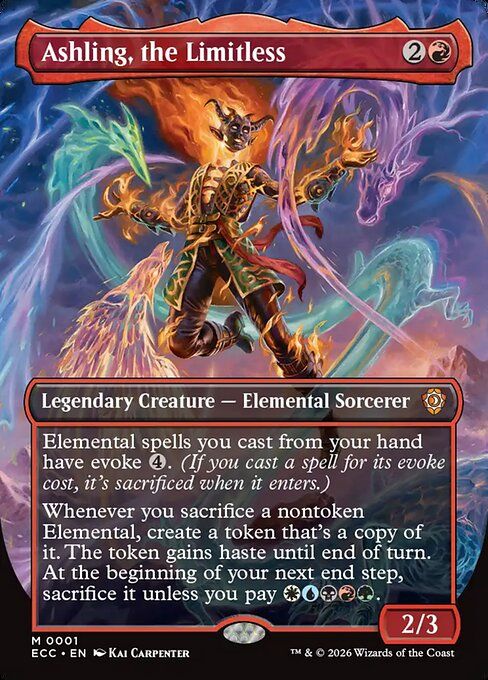
I’m so excited about Ashling, the Limitless! She’s one of the new commanders from the Lorwyn Eclipsed decks, and honestly, she’s quickly become a fan favorite – at least, she is with me and everyone I’ve talked to. Here’s what she does…
- It’s a 3-CMC 2/3 elemental creature.
- It gives evoke 4 generic to elemental spells you cast from your hand
- It creates a token copy of any elemental non-token you sacrifice, giving it haste, and giving you the option not to sacrifice it at the end of your turn if you pay WUBRG
Ashling is a remarkably powerful commander in Magic: The Gathering, currently the most played Lorwyn Eclipsed commander across all sets. It excels at repeatedly casting Impulsivity for powerful results and creates amazing combinations with cards like Yarok, the Desecrated, Shriekmaw, Risen Reef, and the classic Mulldrifter. As a WUBRG commander, it utilizes all five colors of Magic, allowing for versatile deckbuilding. You can build a strategy around overwhelming the board with many creatures, or focus on cascading into powerful spells. There’s a lot more you can do with it, but that gives you a good idea of its potential.
How MTG is Nerfing Ashling, the Limitless Commander Decks
Some players pointed out a potential issue with the card Ashling: its text says it works with “elemental spells,” but doesn’t specifically mention “permanents.” This could mean it might work with temporary spells like instants and sorceries, which normally aren’t affected by its ability to create and sacrifice elementals. Experienced Magic: The Gathering players generally assume “evoke” effects only work on permanent cards, so allowing it to work on non-permanent spells didn’t make sense. To clarify this before the card was officially released, the game’s rules team added a specific mention of “permanents” to Ashling’s text, ensuring it works as intended.
MTG’s Mechanics and Keywords Are Too Complex, Enabling Erratas
That’s okay, and honestly, it’s likely a good thing. It does highlight how much Magic: The Gathering relies on keywords, and there are simply too many of them. Some keywords even do nearly the same thing – for example, a mechanic from the Tarkir: Dragonstorm set was very similar to one from a Dungeons & Dragons set, just with a different name. Others, like ‘saddle’ and ‘crew’, are essentially the same mechanic. This also demonstrates that the game can get overly complicated, sometimes requiring official clarifications to make things easier to understand.
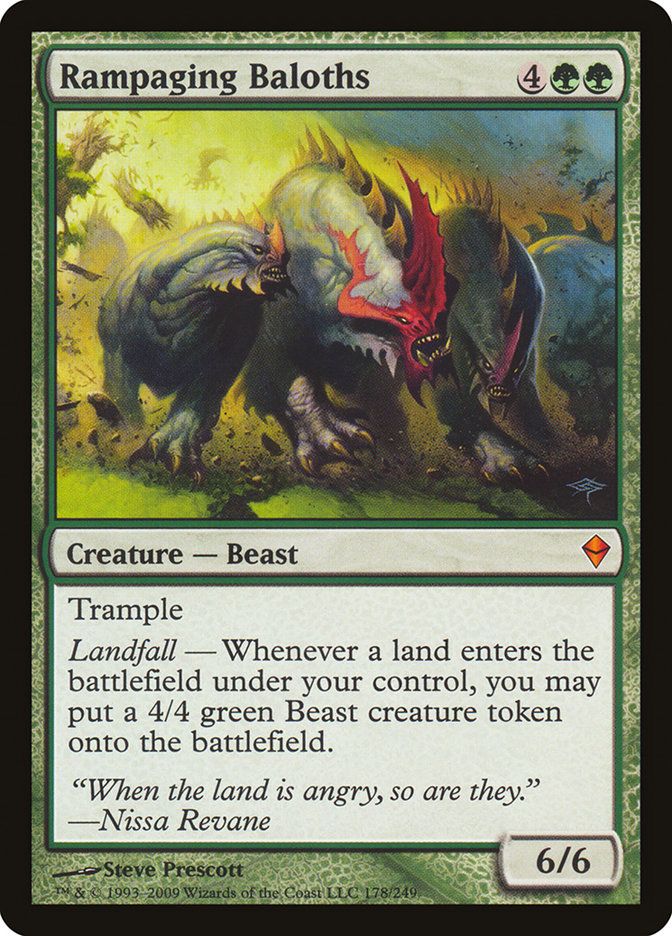
As a longtime Magic player, I thought the changes to Rampaging Baloths when it came to MTG Arena were a really interesting design choice. They basically streamlined the card, even if it meant making it slightly less versatile. The original card let you choose whether to create a 4/4 creature when a land entered the battlefield, but Arena‘s version removed that option. It means there are a few edge cases where you’d prefer not to make the token, but now you’re stuck with it. Honestly, it makes the game smoother – too much micromanaging and keeping track of everything would be a nightmare on the digital platform.
Before being removed from competitive play in Magic: The Gathering, the card Vivi Ornitier received a weakening adjustment on the MTG Arena platform. This wasn’t just a correction of how the card worked, but a deliberate reduction in its power, highlighting how easily rules and cards can be adjusted in Magic: The Gathering and how sensitive the game’s rules can be.
Look, I get why they made Ashling a permanent card, even if it’s still incredibly powerful from that old Magic: The Gathering set. But it really highlighted a bigger problem with the game: the rules can be a total mess. There are so many hidden, complicated sections – like how layers interact or the order effects permanently change cards – that even veteran players often don’t fully understand them. Fixing this isn’t going to be easy, and honestly, I expect we’ll be seeing rule clarifications – errata – for a long time to come.
Read More
- All Skyblazer Armor Locations in Crimson Desert
- One Piece Chapter 1180 Release Date And Where To Read
- How to Get the Sunset Reed Armor Set and Hollow Visage Sword in Crimson Desert
- All Shadow Armor Locations in Crimson Desert
- All Golden Greed Armor Locations in Crimson Desert
- How to Beat Stonewalker Antiquum at the Gate of Truth in Crimson Desert
- Cassius Morten Armor Set Locations in Crimson Desert
- Grime 2 Map Unlock Guide: Find Seals & Fast Travel
- Marni Laser Helm Location & Upgrade in Crimson Desert
- USD RUB PREDICTION
2026-01-18 04:04