Author: Denis Avetisyan
A new approach leverages quantum reinforcement learning to optimize reconfigurable intelligent surfaces for dramatically enhanced security and performance in multi-user wireless networks.
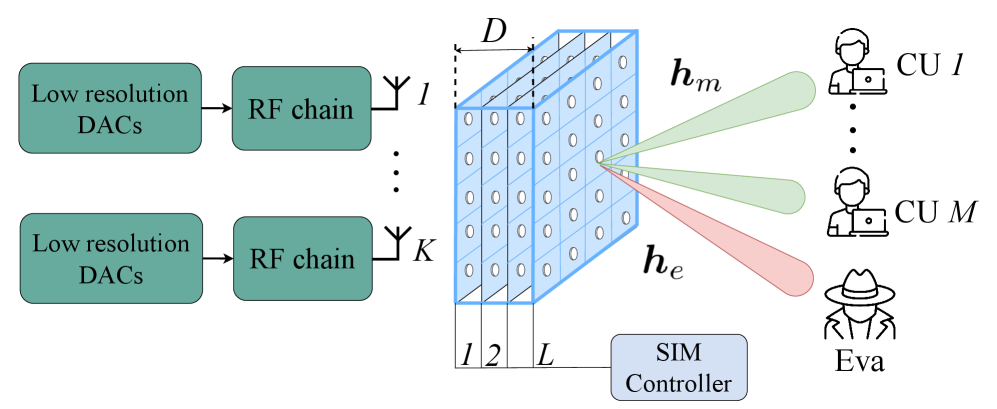
This review details a quantum-enhanced reinforcement learning algorithm for optimizing stacked intelligent metasurface configurations to maximize physical layer security and convergence speed.
Achieving robust physical-layer security in modern wireless networks is increasingly challenging due to dynamic environments and imperfect channel knowledge. This is addressed in ‘Securing SIM-Assisted Wireless Networks via Quantum Reinforcement Learning’, which proposes a novel hybrid quantum proximal policy optimization (Q-PPO) framework for optimizing stacked intelligent metasurface (SIM)-assisted secure communications. By embedding a parameterized quantum circuit into the actor network, the Q-PPO scheme enhances policy representation and accelerates convergence in high-dimensional action spaces, achieving approximately 15% higher secrecy rates than traditional deep reinforcement learning baselines. Could this quantum-enhanced approach pave the way for truly secure and adaptive wireless communication systems?
The Expanding Network: A Challenge of Density
The proliferation of connected devices – from smartphones and laptops to IoT sensors and autonomous vehicles – is placing unprecedented demands on modern wireless networks. Traditional communication methods, designed for fewer, less data-hungry users, are now struggling to cope with this exponential growth. This surge in demand isn’t simply about increased bandwidth; it’s a fundamental shift in network density and usage patterns. Consequently, networks are experiencing heightened congestion, reduced signal quality, and diminished overall performance. Addressing this challenge necessitates a move beyond conventional techniques and the adoption of innovative technologies capable of efficiently managing a vastly increased number of concurrent connections and delivering reliable, high-speed communication for all users.
Conventional beamforming techniques, while effective for single-user communication, encounter substantial challenges when extended to multi-user environments. These methods direct a concentrated signal towards a specific user, but fail to adequately account for the presence of others, leading to considerable inter-user interference. This interference manifests as unwanted signal leakage, effectively diminishing the signal-to-interference-plus-noise ratio (SINR) for all involved. Consequently, the system’s capacity – the maximum rate at which data can be reliably transmitted – is significantly reduced as users contend with degraded signal quality and increased error rates. Addressing this limitation necessitates advanced strategies that either actively mitigate interference or intelligently allocate resources to maximize overall network throughput and enhance the user experience.
Addressing the escalating demands of modern wireless networks necessitates a shift beyond conventional communication strategies. The core challenge lies in effectively serving multiple users concurrently without succumbing to debilitating interference. Innovative techniques, such as spatial multiplexing, aim to exploit the three-dimensional nature of wireless channels, transmitting independent data streams to different users on the same frequency band. However, realizing the full potential of this approach requires sophisticated interference mitigation strategies. These can range from precoding techniques – carefully shaping the transmitted signals to minimize overlap – to advanced receiver designs capable of disentangling overlapping signals. The ongoing research focuses on intelligently allocating resources and dynamically adjusting transmission parameters to maximize overall system capacity and ensure a reliable user experience, particularly in densely populated environments where interference is most acute.
Wave-Domain Beamforming: A Paradigm Shift
Conventional beamforming techniques process signals after they have been received and digitized. This signal-domain approach necessitates substantial computational effort, particularly with increasing array size and sampling rates. The core of this complexity lies in the need to perform complex weighting and summation operations on each signal sample to achieve desired beam patterns. These operations, often involving Fast Fourier Transforms (FFTs) and matrix manipulations, scale with the number of array elements and the bandwidth of the received signal. Consequently, traditional beamforming implementations can be resource-intensive, limiting their applicability in real-time or power-constrained scenarios. Furthermore, precise timing and synchronization between array elements are critical to maintain beam quality, adding to the computational burden and system complexity.
Wave-Domain Beamforming departs from conventional signal-domain beamforming by operating directly on the physical characteristics of the wave itself – specifically, amplitude and phase – prior to signal detection. This method involves manipulating the wavefront to constructively interfere in desired directions and destructively interfere in others, effectively shaping the beam pattern. Unlike traditional techniques that process received signals to identify and amplify contributions from a specific source, wave-domain beamforming proactively creates the beam by controlling the wave’s propagation characteristics, thereby reducing computational load and potentially improving beamforming accuracy and efficiency.
Wave-domain beamforming departs from conventional signal-domain techniques by directly modulating the physical characteristics of the wavefront. This approach exploits principles of wave propagation – specifically, phase and amplitude manipulation – to shape and steer the beam. By operating directly on the wave itself, rather than processing sampled signals, computational complexity is reduced, as the core operations align with the inherent physics of wave interference. Precise beam steering is achieved through controlled alterations to wave parameters, allowing for accurate targeting without the intensive calculations required for digital signal processing in the time or frequency domain. This method enables efficient beamforming, particularly in applications with limited computational resources or stringent real-time requirements.
Synergy in Action: Multi-User System Optimization
Integrating Wave-Domain Beamforming into a Multi-User Multiple-Input Single-Output (MISO) system addresses inter-user interference by manipulating the signal phase in the wave domain, enabling more focused transmission beams. This technique shapes the radiated power such that signals intended for one user experience minimal leakage to other users in the system. Traditional beamforming methods often struggle with precise control in complex multi-user scenarios, leading to residual interference. By operating in the wave domain, the system gains enhanced spatial resolution, allowing for finer control over beam direction and width, and effectively isolating user signals. This isolation directly reduces the interference experienced by unintended receivers, improving overall system performance and data rates.
Wave-domain beamforming achieves enhanced signal transmission by manipulating signals in the frequency domain, enabling precise control over both the amplitude and phase of each transmitted beam. This technique contrasts with conventional spatial-domain methods by directly addressing interference through frequency-selective beam shaping. By optimizing beam characteristics in the wave-domain, the system can focus energy specifically towards the intended receiver while minimizing signal leakage to other users. This precise beam control maximizes the signal-to-interference-plus-noise ratio (SINR) at the receiver, resulting in improved data rates and system capacity. The granularity of control afforded by wave-domain processing allows for adaptation to dynamic channel conditions and user locations, further enhancing signal strength and reliability.
Simulation data indicates that integrating Wave-Domain Beamforming with a Multi-User MISO system achieves a 15% improvement in average secrecy rate (ASR), reaching 1.67 bps/Hz, when contrasted with conventional Power-based Policy Optimization (PPO). This combination also exhibits faster convergence during training, attaining optimal ASR after 20,000 steps, compared to the 30,000 steps required by PPO. Furthermore, the system demonstrates equitable resource allocation, with Jain’s Fairness Index exceeding 0.7, representing a performance advantage over alternative methodologies.
The pursuit of secure communication, as detailed in this study of SIM-assisted wireless networks, often leads to layers of increasing complexity. However, this work subtly champions a different path. It elegantly demonstrates how intelligent optimization, particularly through quantum reinforcement learning, can distill security enhancements from seemingly intricate systems. This resonates with Donald Davies’ observation that, “Simplicity is the key to reliability.” The paper doesn’t advocate for abandoning advanced technologies like reconfigurable intelligent surfaces or multi-user MIMO; rather, it suggests a mindful reduction of unnecessary elements, revealing a more robust and efficient foundation for physical layer security. The convergence speed achieved through quantum methods underscores the power of focused design.
Where Do We Go From Here?
The presented work, while demonstrating a functional convergence of quantum reinforcement learning and reconfigurable intelligent surface optimization, merely sketches the periphery of a larger challenge. The true limitation isn’t algorithmic speed, but the fundamental assumption of a quantifiable, optimizable security landscape. To believe perfect security is achievable through iterative waveform shaping is, at best, naive. The signal, ultimately, is information, and information, by definition, leaks.
Future efforts should not concentrate on increasingly complex algorithms – the current trajectory risks diminishing returns. Instead, the field would benefit from a deliberate reduction in scope. Focusing on provably secure, albeit limited, communication regimes-accepting inherent vulnerabilities rather than chasing illusory perfection-offers a more pragmatic path. Exploration of energy-efficient channel estimation techniques, alongside realistic modeling of hardware imperfections in stacked intelligent metasurfaces, represents a necessary, if unglamorous, progression.
The most pressing question remains unspoken: what constitutes ‘security’ in a post-quantum world? Simply outperforming classical algorithms addresses a tactical concern, not a strategic one. True advancement demands a reassessment of the underlying assumptions, a willingness to discard the notion of absolute protection, and an embrace of resilient, adaptable communication systems. The aim shouldn’t be to prevent compromise, but to tolerate it.
Original article: https://arxiv.org/pdf/2602.13238.pdf
Contact the author: https://www.linkedin.com/in/avetisyan/
See also:
- All Shadow Armor Locations in Crimson Desert
- Dark Marksman Armor Locations in Crimson Desert
- Jujutsu Kaisen Season 3 Episode 12 Release Date
- How to Get the Sunset Reed Armor Set and Hollow Visage Sword in Crimson Desert
- Best Bows in Crimson Desert
- Wings of Iron Walkthrough in Crimson Desert
- All Golden Greed Armor Locations in Crimson Desert
- How To Beat Ator Archon of Antumbra In Crimson Desert
- Keeping AI Agents on Track: A New Approach to Reliable Action
- Top 5 Militaristic Civs in Civilization 7
2026-02-17 23:54