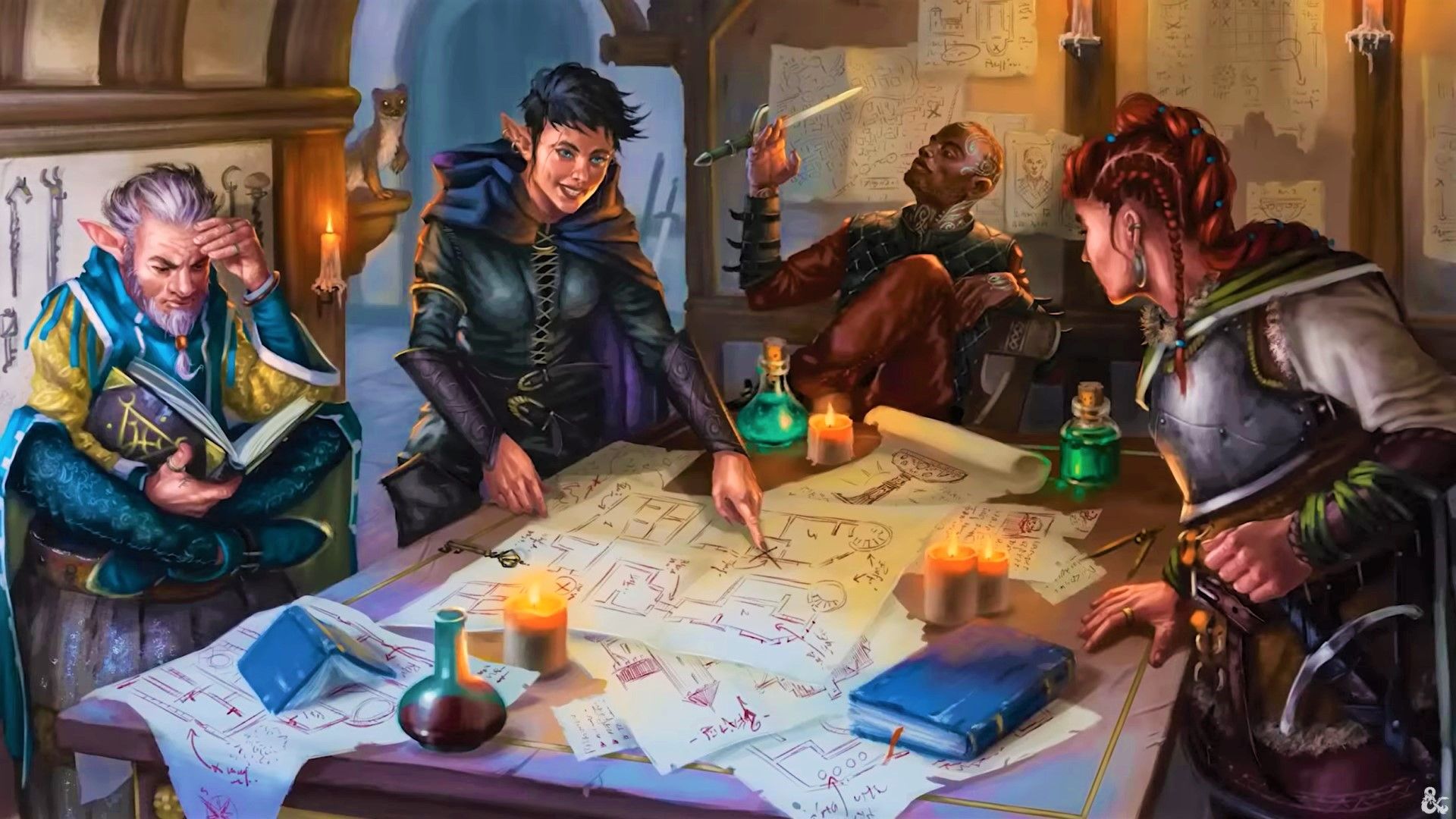
Despite having extensive rulebooks, Dungeons & Dragons often sparks disagreements at the gaming table. These arguments aren’t usually about complicated situations, but rather misunderstandings of core rules. Over time, home-brewed rules, online interpretations, different editions of the game, and video game versions have created confusion about what the official rules actually say versus how people commonly play. While Dungeon Masters have the final say on how things work in their campaigns, it’s best to generally follow the guidelines in the core rulebooks.
One challenge with Dungeons & Dragons is that players want the rules to match the exciting stories they’re trying to tell. When dice are rolled, people often prioritize a thrilling outcome over strict logic – a roll of 20 feels amazing even though the rules aren’t always that generous. The game’s rules are also designed to keep things moving quickly and allow for flexibility, rather than perfectly mimicking reality, which can sometimes leave players wanting more. Ultimately, each group needs to decide if it’s worth stopping to clarify a rule, or if it’s better to keep the game flowing and adjust the rules to fit their preferred play style.
Fit the 9 games into the grid.
Results
Pick a game
Nat 20s
Not A Guaranteed Success Every Time
Details:
- Auto-success only applies to attack rolls
- Ability checks still respect feasibility
Rolling a natural 20 on a twenty-sided die (d20) is considered the best possible outcome, but this often leads to confusion. Players frequently believe a natural 20 automatically ensures success, no matter how difficult the task – whether it’s convincing an enemy or attempting something physically impossible. This expectation is what makes actually rolling a natural 20 feel so special and dramatic when it happens.
The problem is that these game rules don’t always lead to the exciting results players might expect. In the game, rolling a natural 20 only guarantees success when attacking – it ensures a hit and a critical effect. However, when attempting other actions like skill checks or saving against something, a 20 is just a good roll, and it won’t overcome an impossible situation. This design choice keeps the story believable, preventing random luck from overriding common sense, even if it means missing out on those dramatic, last-minute saves that can be so memorable.
Armor Class
More Than Just Basic Protection
Details:
- AC has complexity below the surface
- Misses can still strike the target
As a movie buff, I’ve always thought of Armor Class as how easily someone dodges attacks – basically, how hard they are to hit. That makes perfect sense for characters in light clothes, moving quickly. But when you start thinking about characters in full plate armor, it doesn’t really hold up. It’s weird to imagine a knight dodging arrows, right? It starts to feel less realistic the more armor someone wears, and it makes me question how combat is usually portrayed.
Armor Class (AC) isn’t just about dodging attacks. It represents how well a character avoids, deflects, or simply absorbs damage. So, a failed attack doesn’t always mean someone missed completely – it could mean the blow was blocked by armor or a shield, or didn’t hit with full force. Seeing AC this way explains why being surprised doesn’t cancel out armor’s protection, why heavily armored characters are hard to hurt, and why a high AC doesn’t automatically mean someone is nimble or acrobatic.
Grappling
Restricting Movement But Not Actions
Details:
- Does not prevent the character from acting
- Still powerful if a bit less overbearing
Many players struggle with the ‘grappling’ mechanic because they approach it as if it were real-life wrestling. They often assume that successfully grappling an enemy will pin them, stopping them from attacking or using spells. This seems powerful, even against less challenging opponents, but it doesn’t quite work that way in the game.
While grappling completely stops a creature’s movement, that’s all it does on its own. A grappled creature can still fight, cast spells, and generally act as normal, unless other effects are in play. This is designed to keep the game balanced – if grappling completely shut down opponents, most fights would become too easy. Grappling remains a strong way to control a creature’s position, particularly when combined with teamwork or the surrounding environment, but it’s not as powerful as some players expect.
Two Spells, One Turn
The Bonus Action Trap
Details:
- Casting limits are stricter than they look
- Specific text on spells matters
The rules for bonus actions in spellcasting are often misunderstood, causing more problems than almost any other part of combat. Many players mistakenly believe they can cast two spells each turn if they have both an action and a bonus action. While powerful, this isn’t how it works, and the misunderstanding often leads to arguments at the table, leaving players frustrated or the Dungeon Master feeling pressured to concede.
If you cast a spell using a bonus action, the only other spell you can cast that turn is a cantrip that takes a full action to cast. This rule applies to spells of any power level, allowing for combinations of spells as long as they follow this restriction. For example, casting a quick bonus action spell like Healing Word prevents you from then casting a more powerful spell with a full action. Understanding these rules is key to playing magic effectively. This restriction is in place to balance gameplay and prevent spellcasters from dominating encounters with too many effects at once. Dungeon Masters should explain this rule to new players early on.
Holding Actions
Readying Anything Comes With A Cost
Details:
- Consequences of the delay
- Readied spells can be lost
Many players think of holding an action as simply waiting for the right time, without any drawbacks. However, setting up an action is actually a conscious decision with a cost, and shouldn’t be used as a free way to delay things without facing some sort of penalty.
As a longtime cinema devotee, I see this mechanic as a way to keep things moving! Basically, if a character is setting up a special move, they have to clearly state when it happens – a specific trigger. They use their reaction for it, but if that ‘when’ never comes, the move is wasted. It’s a trade-off, because using your reaction like this means you can’t use it for things like attacks of opportunity or quick defenses. And with spells, if you lose focus, that prepared spell goes down the drain too. I love it because it stops players from endlessly stalling or planning some huge, game-winning move that never actually happens. It encourages quick thinking and keeps the action flowing, preventing those frustrating moments where someone just waits for the ‘perfect’ moment that never arrives.
Read More
- All Skyblazer Armor Locations in Crimson Desert
- One Piece Chapter 1180 Release Date And Where To Read
- All Shadow Armor Locations in Crimson Desert
- How to Get the Sunset Reed Armor Set and Hollow Visage Sword in Crimson Desert
- Cassius Morten Armor Set Locations in Crimson Desert
- Grime 2 Map Unlock Guide: Find Seals & Fast Travel
- How to Beat Stonewalker Antiquum at the Gate of Truth in Crimson Desert
- All Golden Greed Armor Locations in Crimson Desert
- Euphoria Season 3 Release Date, Episode 1 Time, & Weekly Schedule
- Amber Alert Secrets & CDs In Crime Scene Cleaner Act 2
2026-02-09 14:38