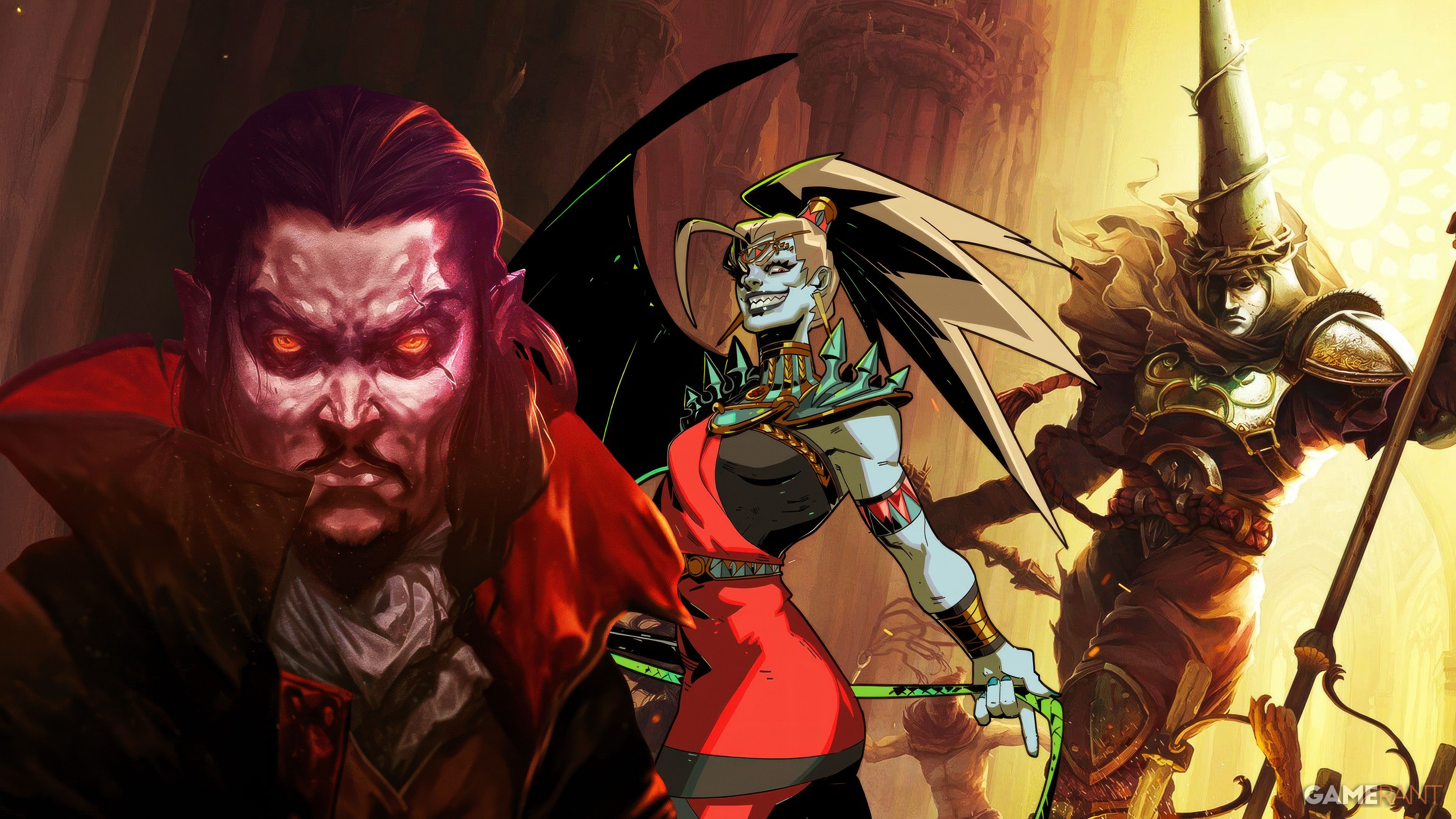
Games similar to Vampire Survivors are becoming increasingly popular, and Ember and Blade aims to join the ranks of these addictive titles. The upcoming indie game takes inspiration from Vampire Survivors, blending it with the dark, religious atmosphere of Blasphemous. It also incorporates elements of storytelling and roguelike gameplay reminiscent of Hades, creating a unique and engaging experience.
One of the first things you’ll likely notice about Ember and Blade is its beautiful art style. It uses a fixed, angled perspective similar to Hades, but with a vibrant 3D look and glowing visual effects that call to mind Furi. This bright and dynamic design makes facing large groups of enemies much more visually appealing than in many other similar games, where chaotic battles can become messy and hard to follow. The game also features gorgeous, hand-drawn character portraits, giving it a similar aesthetic feel to Hades. Ember and Blade isn’t just visually stunning, though – it also has solid gameplay to match its looks.
There is currently an Ember and Blade demo available on Steam.
Ember and Blade Channels Vampire Survivors’ Chaotic Combat
Battle through overwhelming waves of enemies, face challenging boss fights inspired by the Souls series, and gain divine powers that change how you play with each new attempt.
At first glance, Ember and Blade plays a lot like Vampire Survivors. You succeed more by carefully moving your character and choosing the right upgrades than by skillfully pressing buttons. You start each game with a character, Fenrix Haven, who automatically attacks with a weapon. Most upgrades add more automatic attacks that happen on a timer. Because Fenrix doesn’t have much health, moving strategically is key to surviving.
Fenrix begins each playthrough equipped with a melee weapon that you control directly. These weapons have simple attack combos and a stronger, charged-up move. This adds depth to the usual fast-paced combat of *Survivorslike games, and certain upgrades can make these manual weapons work even better with your automatic attacks. For example, you might find an item that speeds up your automatic attacks every time you use a manual attack.
Beyond the core gameplay, Ember and Blade offers some smart twists on the usual *Survivorsstyle formula. Fenrix, for example, has a shield that gradually refills, letting players withstand a hit or two before taking damage. This makes the game both easier to pick up and more strategic, encouraging players to take risks even when their health is low. Plus, Fenrix can dodge roll on command, making it easier to avoid attacks with skill instead of relying on luck.
How Ember and Blade Shakes Up the Classic Hades Gameplay Loop
Similar to how Ember and Blade builds upon the gameplay of Vampire Survivors, it also takes inspiration from the core ideas of Hades. Players control Fenrix and receive “boons” from angelic spirits, but these boons typically manifest as automatic attacks – like meteor showers or projectiles fired when dodging. These boons are simple to upgrade repeatedly, potentially allowing for greater power than in other games similar to Hades.
While the game borrows some progression ideas from Hades, what really sets Ember and Blades apart is its arena-based structure. Each run takes place in a large arena that gradually fills with stronger enemies – it’s a lot like Risk of Rain in that regard. Instead of getting power-ups after completing areas, you level up by defeating enemies and collecting the experience points they leave behind. This encourages players to be aggressive and take risks. Additionally, the main character, Fenrix, can become significantly stronger over time through a traditional skill tree, adding a familiar RPG element to the gameplay.
Like Blasphemous, Ember and Blade Creates a New Mythology
The Blasphemous series and Ember and Blade both feature unique and compelling religious or mythological backgrounds. While Blasphemous draws inspiration from religions like Christianity, it doesn’t simply retell those stories. Ember and Blade similarly takes cues from Greek and Norse myths – presented in a similar style to Hades – but creates a completely original pantheon of gods. This approach offers exciting possibilities because the game isn’t bound by existing stories, characters, or established rules.
While Ember and Blade is generally upbeat, there’s a hint of something darker brewing beneath the surface. The story feels a bit familiar and relies on some common tropes, which will be interesting to see how the developers address as the game develops. Personally, I didn’t love the somewhat silly and immature dialogue, though others might enjoy it. That said, I did laugh a few times during the demo, even though I’m not usually a fan of this type of writing.
There’s no doubt that Ember and Blade is a thrilling game to play. It’s fast-paced, challenging, and offers a lot of strategic depth through its well-designed systems. While the story’s full quality is still unfolding, the game is currently looking like a fantastic entry in the action-roguelike genre.
Ember and Blade is set to release in Q3 2026.
Read More
- All Shadow Armor Locations in Crimson Desert
- Best Bows in Crimson Desert
- How to Get the Sunset Reed Armor Set and Hollow Visage Sword in Crimson Desert
- All Golden Greed Armor Locations in Crimson Desert
- Wings of Iron Walkthrough in Crimson Desert
- How to Craft the Elegant Carmine Armor in Crimson Desert
- All Helfryn Armor Locations in Crimson Desert
- How To Beat Ator Archon of Antumbra In Crimson Desert
- All Skyblazer Armor Locations in Crimson Desert
- Keeping Large AI Models Connected Through Network Chaos
2026-01-05 16:19