Beyond the Usual Rules: Factorization at High Energies
![The study reveals how factorization-a cornerstone of theoretical calculations in particle physics-breaks down at specific energy scales, demonstrated by collinear splittings connecting soft modes via Glauber-gluon exchange, and signaled by measurements indicated by colored blobs on lines representing these interactions-a phenomenon ultimately challenging the completeness of any perturbative approach to understanding high-energy collisions as expressed by the hard scattering amplitude [latex]\mathcal{M}_{N}[/latex].](https://arxiv.org/html/2603.12383v1/x2.png)
New research reveals that standard methods for predicting particle collisions break down when subtle quantum effects become dominant.
![The study reveals how factorization-a cornerstone of theoretical calculations in particle physics-breaks down at specific energy scales, demonstrated by collinear splittings connecting soft modes via Glauber-gluon exchange, and signaled by measurements indicated by colored blobs on lines representing these interactions-a phenomenon ultimately challenging the completeness of any perturbative approach to understanding high-energy collisions as expressed by the hard scattering amplitude [latex]\mathcal{M}_{N}[/latex].](https://arxiv.org/html/2603.12383v1/x2.png)
New research reveals that standard methods for predicting particle collisions break down when subtle quantum effects become dominant.
BTC traded above $75,000 as of 1:30 am UTC, up 3% over 24 hours. The asset has now rallied roughly 25% from its February low near $60,000, set when the Iran conflict triggered a broad selloff-proof that geopolitical drama is the ultimate catalyst for market euphoria.
A new framework, LLP-FW, streamlines the development of parallel solvers for complex combinatorial problems by decoupling problem definition from implementation.

New research details a rapid testing methodology for pinpointing the limits of data reliability in modern DRAM chips, revealing significant performance gains with targeted error mitigation.
The shares perked up briefly during CEO Jensen Huang’s keynote, like someone pretending to be interested in a boring Zoom call, but then slid back down, ending the day with a shrug and a modest grin.

Look, I’m not saying I spend my evenings staring at candlestick charts like some sort of digital monk, but if I did, this is exactly the kind of thing that would make me physically excited in a way that’s frankly embarrassing to admit in public.
![Under adversarial attack utilizing HiSPA, the Mamba-130M model experiences a precipitous decline in information retention-falling from [latex]\rho(\bar{A}) = 0.98[/latex] to [latex]0.32[/latex]-resulting in a [latex]52.5[/latex] percentage-point accuracy collapse, manifested as a contraction of hidden-state trajectories toward the origin, though this collapse can be mitigated by SpectralGuard intervention.](https://arxiv.org/html/2603.12414v1/figures/hidden_state_trajectories_3d.png)
Researchers have discovered a vulnerability in State Space Models where adversarial attacks can cause a ‘spectral radius collapse’, leading to performance degradation, and propose a novel monitoring system to detect and mitigate these attacks.

In March, the spot prices of lithium, that fickle lover, took a brief bow, retreating from their recent heights. Yet, the longer-term signals, like a stubborn sunrise, remained steadfast. The grand narrative? Lithium’s reign endures, though the stage is set for both triumph and tragedy.

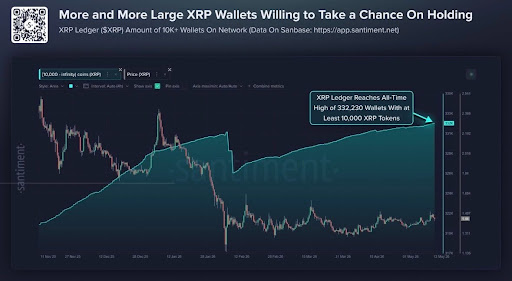
Though the price of XRP has languished below the $2 threshold for nigh on months, the intrepid investors’ sentiment and demand for this altcoin have displayed a resilience as robust as a well-stocked larder. The quantity of this digital elixir in crypto exchanges’ reserves has been vanishing at a rate that would make a magician weep, heralding a most curious accumulation trend.
![The system demonstrates effective tail packing within the cipher of [latex]r\_0^\widehat{\bm{r}\_{0}}[/latex], achieved through strategic management of in-queue inputs.](https://arxiv.org/html/2603.12946v1/x5.png)
A new framework significantly reduces the performance overhead of prioritizing inference requests when using privacy-preserving machine learning techniques.