Building Trust in a Quantum Future: Secure Multi-Agent Systems
![The system proposes an agentic artificial intelligence architecture fundamentally secured against quantum attacks through its very design, bypassing the need for post-hoc cryptographic defenses often vulnerable to future computation advances [latex] \implies [/latex] a proactive approach to long-term security in increasingly complex AI systems.](https://arxiv.org/html/2603.15668v1/HighLevelArchwithagentblock.png)
A new framework integrates post-quantum cryptography and quantum communication to establish resilient and trustworthy interactions between distributed AI agents.
A new framework integrates post-quantum cryptography and quantum communication to establish resilient and trustworthy interactions between distributed AI agents.
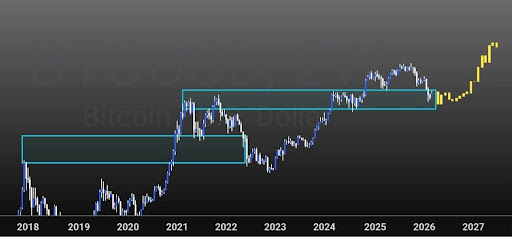
According to a sagacious observer known as DorkChicken, Bitcoin’s current trajectory diverges sharply from the cataclysmic descent of 2022. The analyst’s diagram, a tapestry of historical support levels, suggests a market now fortified by layers of resilience, as if the cryptocurrency had finally mastered the art of self-preservation. Yet, one cannot help but chuckle at the irony: a market that once collapsed under its own weight now boasts a structure so robust it might rival the Kremlin’s walls-though perhaps not quite as enduring.
A new protocol leverages the often-overlooked data within git commit messages to provide AI coding assistants with valuable context and preserve institutional knowledge.

New research reveals fundamental obstructions to consistent compactifications of F-theory, showing how quantum effects invalidate standard perturbative expansions.
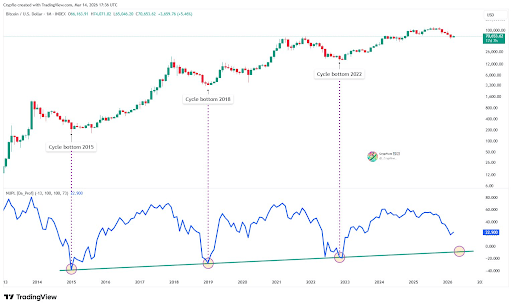
This spectral guide, known as the NUPL, charts the soul of the market-whether its denizens bask in illusory gain or writhe in the throes of loss. In each of the last three bearish tragedies, it stumbled into the same abyssal depths, brushing against a trendline ascending like a willow weeping over forgotten graves.
New research delves into the structure and decay of tetraquark particles containing hidden strangeness, potentially revealing new insights into the strong force.

I absolutely love using bows in this game! What’s so cool about them is that every time you fire, they build up power, but you can also add different coatings to your arrows for extra effects without losing that charge. Seriously, it’s the best of both worlds if you know how to use them, and I’ve been checking out some of the top-rated bows to share!
On March 17, the Securities and Exchange Commission (SEC) and the Commodity Futures Trading Commission (CFTC), two regulatory giants with the dexterity of sleep-deprived tortoises, issued a joint-agency interpretive guidance. This document, penned in the densest legalese since the Treaty of Tordesillas, attempts to explain how federal securities laws apply to crypto assets and network transactions. One suspects the SEC’s legal team may have consulted a thesaurus written in hieroglyphs.

If you’re curious about which monsters are endangered in Monster Hunter Stories 3, here’s a full list.

First, you’ll need to find and befriend a Mizutsune, a rare and endangered monstie. You’ll have to defeat a Shogun Cenataur to even reach its den. Here’s a guide on how to unlock the Soulseer Mizutsune.