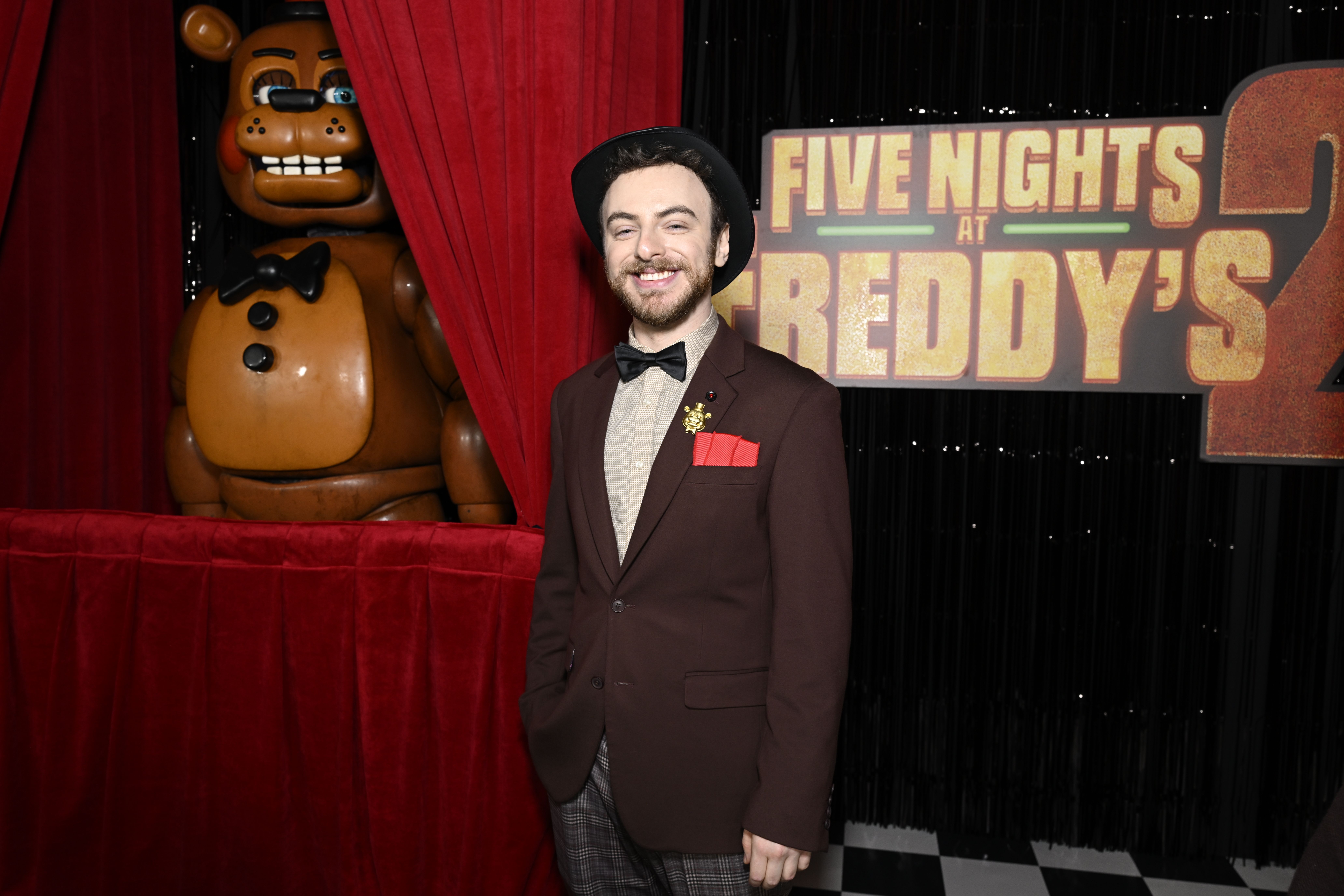
You’ve almost certainly heard Kellen Goff’s work, even if you don’t know his name. He’s a hugely successful voice actor who’s lent his talents to popular video games like Five Nights at Freddy’s, The Last of Us, and Fire Emblem, as well as hit anime series such as JoJo’s Bizarre Adventure, My Hero Academia, and Demon Slayer. He’s also voiced characters in films like Wicked, Elio, and Pokémon. With a career like that, it’s clear Kellen Goff will continue to be a major voice in the industry.
Joe Goff is an incredibly talented voice actor, having even trained with the renowned Bob Bergen. Last year, before the release of Five Nights at Freddy’s 2, I spoke with him about his work in voice acting, his experience with various media, his collaboration with Scott Cawthon on the FNAF series, and specifically, his portrayal of Toy Freddy in FNAF2.
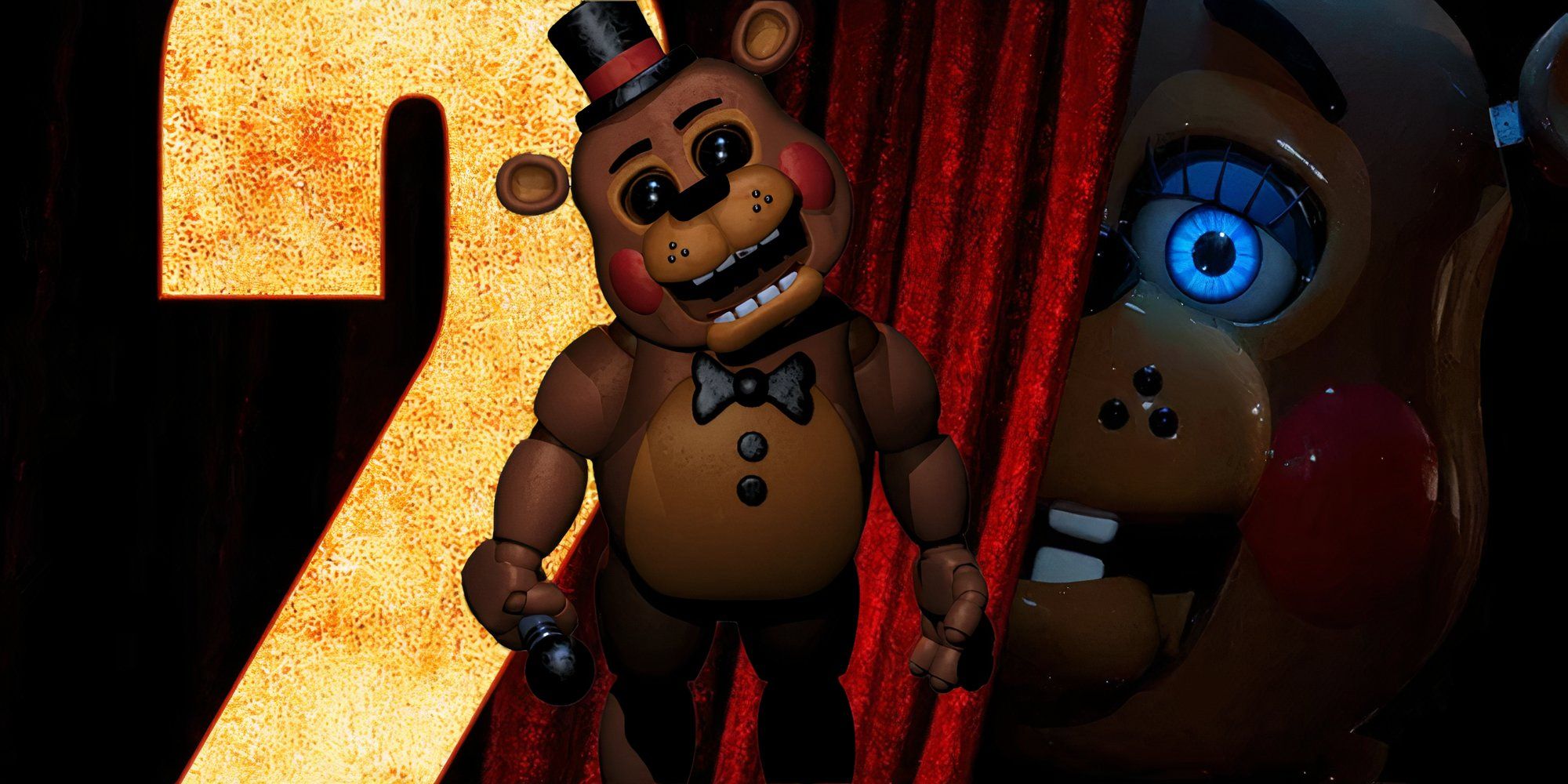
TopMob: Did anything about Toy Freddy’s role or the film’s approach to the lore strike you as something fans will debate or latch onto before details go public?
When I was first cast as Toy Freddy, I thought the creators—Scott and the team—wanted me to sound as much like Darren Roebuck’s iconic performance in Ultimate Custom Night as possible. It was a real honor to be asked to do that.
Over time, I learned more about Toy Freddy’s part in the movie, and things started to make sense. Both what I was told and the scenes themselves revealed that his intentionally silly, Barney-like voice might have confused viewers, since those scenes actually required a more serious tone.
We really focused on matching the original character portrayal from Ultimate Custom Night. We then experimented with a very frightening, deep, and growling voice, and also a more moderate option. After a preview screening in Florida with Scott Cawthon, it turned out the most terrifying version was the one selected.
I’m a little worried about what dedicated Toy Freddy fans will think, as they’ve often said they want to see the character done right. The movies really cater to fans of FNaF, and almost everything in them is exactly as people remember it – a way to show appreciation for their loyalty to the series.
I accept the decision, and I’m actually quite happy with how things ultimately played out. I really hope longtime fans will also appreciate the choices made, considering the larger narrative.
As far as FNaF is concerned, what were the major differences between voicing characters for the games versus voicing Toy Freddy in the film?
When I started working on the project back in 2016, the voiceover sessions were very relaxed. The director simply gave me a document with my lines and asked me to record them in a few different ways, letting him choose the best takes. This lack of direction was both unsettling and liberating, much like the game itself. I had complete creative freedom to interpret the lines as I saw fit, as long as he had options to choose from. I felt a lot of trust from him then, and I still do. My working relationship with Scott is much more personal than what I’d typically have with a larger company like WB or AdRiot. It’s a direct connection with the sole creator, producer, game designer, and writer all rolled into one.
I’ve found that feeling trusted really helps my performance, especially when it comes to the game itself. To answer your question about recording alone, it can be a bit lonely, but it does give me a lot of freedom. As we moved towards Security Breach, we started working with directors Jason Toplovsky and Brian Friarmouth from Steel Wolf Studios. Both are incredibly talented, open to new ideas, and really supportive – they’re just great people to work with.
It felt like a close, enjoyable team effort, and that wasn’t different from how the films felt either. The first movie especially reminded me of how I started working with Scott: he’d just send me raw audio clips without much explanation, and I’d record multiple versions on my phone – it was all I had back then! Luckily, it worked out great thanks to the skills of the Hollywood sound editors.
The second version was more conventional, which is typical for movie ADR. Luckily, I had experience with that from projects like Kingdom of the Planet of the Apes, Elio, and Minions 2, plus some theatrical dubbing, so I wasn’t unprepared. It felt like a natural progression after the initial, somewhat rushed work we did – we really handled everything ourselves, working hard and independently. Moving into a professional studio environment felt like a step forward, both for my career and for the future of this franchise.
You’ve studied under some incredibly prolific voice actors in your career. What was it like training under Bob Bergen in particular?
It was a really defining experience. Looking back, it changed my life, especially since I was only sixteen. My dad convinced the teacher, Bob, to let me join—Bob hadn’t had a student that young before. But Bob actually said I reminded him of himself, which I still consider a huge compliment.
I used to think voice acting was just about doing impressions and funny voices, especially since I had some acting experience. But Bob cleared up that misunderstanding. He explained that it’s about acting – using your voice as an instrument, but with the same skills as stage performance. He really connected my previous acting training with the vocal techniques needed for voice acting, showing me how they worked together and explaining everything about the industry.
He walked us through the audition process, even running practice sessions. We all recorded together for a Fraggle Rock script – something I’ve never replicated in any other class, and I really wish we could do more of that. Sadly, it feels like those collaborative recording sessions are becoming less common now that it’s easier to record actors individually. Still, he taught me so much about the professional side of acting, sharing techniques and insights I continue to use today.
Building off your career a little bit more, your voice acting career spans several forms of media, as you’ve appeared in numerous video games, TV shows, films. Do you find there to be any unique challenges when approaching these different mediums and roles?
Dubbing and localization are definitely the most challenging parts of the process. It’s not just about delivering a believable performance; you also have to stay true to the original actor’s intent and adapt the content for an American audience, making it feel natural and relatable. There’s a lot to consider in a short amount of time – usually just a few seconds – like matching lip movements, conveying the right emotions through your voice, and making sure the performance works even when the character’s facial expressions aren’t visible.
It’s common for voice actors to build on previous work, but it’s especially tricky when you have limited time. Despite the challenge, it’s really satisfying to do. Listening to the original actor’s performance actually provides a helpful foundation. I think it’s either something I learned in acting classes or a result of being on the autism spectrum, but hearing the previous actor’s take helps me figure out my own approach. I express anger differently than Kenjiro Suda, and we both explore a wide range of emotions when portraying it.
Dubbing is definitely the most complex part of the process. Once you move past that, into more open-ended animation or video game work, things become much more flexible. While you still have the skills you used under time constraints, you now have the freedom to really explore and experiment. This allows for more improvisation, which requires a different kind of mental focus – it really engages the analytical side of your brain. Dubbing actually uses both sides of the brain working together, but freeform work relies much more on that analytical, left-brain thinking. I hope that makes sense!
Traveling back in time to 2016, what was the casting process like for the Five Nights at Freddy’s games? What got you involved in this franchise to begin with?
Honestly, the story behind how I got my hands on those original FNaF: Sister Location lines is pretty simple. Back when I was first getting into online voice acting, a bunch of us formed a little club. We were all trying to break into the scene and really believed in supporting each other. So, we’d share audition opportunities – always with the casting director’s permission, of course – making sure the right person got a chance to try out for roles. A friend was super generous and sent me the original audition script, or ‘sides,’ for Fun Time Freddy all the way back in 2016.
The project had a very secretive codename because we weren’t sure if Scott Cawthon would create another Five Nights at Freddy’s game. He’d mentioned feeling tired after making the first four games so close together, so we didn’t know if he’d return for a fifth installment. Still, I was a big fan of Five Nights at Freddy’s even before I started working on it. I’ve always loved animatronics, so the chance to collaborate with Scott Cawthon felt incredibly exciting.
Initially, the character was codenamed “Costumed Entertainer.” The only direction I received was to create someone children would adore, but who would make parents uneasy leaving their kids unsupervised. I explored two different approaches. One was the version you see now – a wildly energetic, slightly unsettling clown, like a mix of Krusty the Clown and Hannibal Lecter. The other was inspired by the Medic from Team Fortress 2, complete with a German accent.
Much later, I was finally able to share the alternate version of my Game Theory Live performance with MatPat. Fans still lovingly call it ‘German Fun Time Freddie’ or ‘the Freddy that never officially happened,’ and they often ask me about it at conventions. It’s a funny little hidden detail that’s out there for people to find. Ultimately, Scott chose the final version with Freddy, and I’m really grateful he did. Those auditions were exhausting – I was running on no sleep and completely drained. Getting the email saying I’d been selected while waking up was an incredible feeling, and it hasn’t happened to me since.
That must have felt amazing.
Looking back, it really was something special. Scott and I have shared so many ‘firsts’ – experiences that would feel totally unbelievable with anyone else. He just has a way of making the impossible happen, whether he means to or not.
Still talking in the casting sphere, did you have to audition for Toy Freddy in the movies, or were you approached?
Scott Cawthon had me in mind for Toy Freddy very early in the development process, and he’s just really direct, which is great. All he asked in an email was if I wanted to voice the character, and I immediately said yes! He simply replied ‘cool’ and connected me with the team. Scott has been incredibly kind to me, consistently including me in almost every Five Nights at Freddy’s game since Sister Location. I enjoy being his running joke, and I’m thankful the fans embraced me so quickly.
I always try to understand what fans enjoy most about the series – especially the funny memes they share online – and bring that same spirit into my work whenever possible. I also make a point of giving each character a unique voice, and it seems fans really appreciate that, as they’re able to do lots of different impressions. It’s incredibly flattering to hear them doing those impressions – I love it!
You’ve voiced several characters since first joining the franchise in 2016. What’s the most challenging asset of bringing their unsettling personalities and the diverse range of voices you do to life?
What’s interesting is that the unsettling feeling often comes from the writing itself. As an actor, I’m given great material that lets me turn ordinary conversations into something much creepier beneath the surface – it’s a really enjoyable challenge. I approach each role, especially in ongoing series, by trying to make every character sound as different as possible. I think that helps the audience get more lost in the story. While some shows, like South Park and Smiling Friends, can get away with using the same voice actor for multiple characters, it doesn’t always work, so I prioritize distinct voices.
I really focus on giving each character a unique voice so listeners aren’t pulled out of the story. I’m glad I spent so much time as a kid practicing and expanding my vocal range – it definitely helps me achieve that, and thankfully I have a voice that allows for it.
Maybe this is like picking a favorite child, but who’s your favorite character to voice in FNaF?
You know, that’s always my response – it feels impossible to choose! I wish I could give you a straight answer, Renan, but honestly, I think picking a favorite would be unfair to the others. I truly appreciate something unique about each one.
I’ve definitely connected with some characters more than others, and a few have really grown on me. Glam Rock Freddy took the longest to record – around 10 hours, I think – which gave us a lot of time to develop his personality. We really explored his slightly awkward, fatherly side, his kindness, and his strong desire to protect others. What’s interesting is how different he is from the other animatronics; he wants to help and protect, rather than cause harm.
I love playing kind characters. While I really enjoy being a villain – it’s always fun and dramatic – it’s incredibly rewarding when fans tell me a positive character I’ve played had a real impact on their lives. They’ve shared stories about those characters helping loved ones open up, providing comfort during tough times, or even being a source of hope. Those roles feel more accessible, and I’m truly thankful for the opportunity to play them.
I was also able to include aspects of my own autism in the characters of Sun and Moon. I hope this helped increase awareness and showed that autism doesn’t hold people back—it actually makes us stronger.
Speaking about your history voicing villains, you voiced some of the biggest anime villains of the past decade. I mean, you’re Overhaul. What type of hero would you want to voice if given the opportunity? Is there a particular character you’d like to voice who’s not a straight-up villain? Overhaul is a bit of an anti-villain, depending on your stance there.
Overhaul isn’t simply a villain; deep down, he believes he’s actually trying to save the world, even if his methods are really messed up and disturbing. I’d love to play a hero, and I think the most interesting ones are often reluctant or unexpected. Someone like Denji from Chainsaw Man – a down-on-his-luck guy who gets powers and uses them to help others, eventually earning the acceptance and love of people. That’s the kind of character I’d find really rewarding to play.
Building off what you said about Overhaul, sometimes villains do have a redeemable side we can relate to, but many of the characters you’ve voiced do tend to be pretty monstrous or have a dark side to them. How do you get in the mindset to relate to those characters? What headspace do you have to put yourself in to really get those performances, performances down?
Someone like Overhaul is truly awful, and what he did is inexcusable. However, understanding his background – being an orphan taken in and supported by a father figure – reveals his motivation. He simply wanted to repay that kindness and honor the sacrifices made for him. Ultimately, every villain believes they’re doing the right thing, justifying their actions if they think it will improve the world. Experiencing hardship and living on the streets can deeply affect a person’s perspective.
I’ve met many people experiencing homelessness and learned about the lengths they go to just to survive. That experience really shaped the character of Overhaul. He takes that raw, instinctive need to survive and redirects it – instead of taking, he gives back. But his methods are flawed. It’s a strange combination. With a different upbringing, Overhaul could have been a huge force for good. His ability to disassemble and perfectly reconstruct someone without any harm could have revolutionized healthcare. Sadly, his past led him down a different path. I believe he’s capable of change, but it will require a significant effort on his part.
Is there any character you’ve played that you personally relate to or empathize with in particular?
Playing Sasaki in ‘Sasaki and Mino’ has been a dream role for me. It’s a perfect contrast to everything I’ve done previously in my career. Sasaki is incredibly sweet, kind, and openly gay – a genuinely good person. He’s gentle, respectful, and always ensures he has consent. He embodies the qualities I strive for in similar situations. Developing the character was a wonderful collaboration with director Emily Fajardo. Many of Sasaki’s lines and how I delivered them, including a lot of improvisation, came directly from how I, Kellen, would naturally react and speak in the same circumstances – it really reflects my own voice and personality.
It’s hard to capture in writing, but he often speaks with a sweet, playful tone – it reminds me of how my mom and I used to talk. Bringing that connection to my mom into this role and performance has been a true honor. He also helped me explore and become more comfortable with my own bisexuality. Seeing him live authentically helped me overcome my fears and realize I could do the same, and that there was nothing to be afraid of.
You’re part of one of the most prolific horror franchises of the 21st century, but are there any other horror franchises you still dream of being a part of?
I really love the world of BioShock and would be thrilled to work on a project set in that universe. I was fortunate enough to be involved in the Dead Space remake – that game was a huge favorite of mine growing up, and I’m very thankful for the opportunity. Beyond that, if another Alan Wake game were ever made, I’d love to contribute. I’m also a big fan of franchises like Scream and Chucky. If we’re talking about movies, working on a Universal Monsters project would be amazing – I’d love to be a part of those classic worlds.
So you voice a lot of scary characters. How do you describe the sliding scale of scariness when it comes to voice acting, if that’s even a thing we can quantify?
As a movie fan, trying to pinpoint what makes something scary is tricky. It’s not a simple scale, but more like one of those alignment charts, you know? Like the one in Pokémon with all the stats – HP, attack, special attack, and all that. It’s got lots of different elements working together. Basically, there are tons of ways to create unease. Something can be subtly creepy, or jump-out-of-your-seat terrifying, or even quiet and still be frightening. There’s a whole spectrum of methods to make something truly unsettling.
When creating a traditionally scary villain, a great approach is to vary their behavior. They could be quiet and unsettling at first, raising suspicion, and then gradually become more erratic and unhinged as the story progresses. I think starting subtle and building tension is most effective. The key is to give the character depth – like a real person, they should have a range of emotions and actions to feel believable and truly frightening.
Sticking to the horror genre for a little bit longer, are there any played-out horror tropes that you’re just ready to see die off in the industry?
Please don’t be mad, but I’m really getting tired of zombie stories. It’s been a while now. While some, like The Last of Us and Left 4 Dead, do it brilliantly, there are just so many of them now. You can come up with different origins for the outbreak, but it always ends up being the same thing: you’re stuck hiding in a gloomy space with a gun, hoping the zombies – who used to be people you knew – don’t find you.
At this point, it’s more depressing than scary. I’m really tired of the constant theme of everything being hopeless and the only solution being to escape and start over somewhere else. I’ve had enough of apocalyptic stories for a while. I think horror can be done in a way that offers hope—a way to solve the problem or overcome the threat. Zombie stories, at least, sometimes allow for that possibility, and I appreciate that.
While some zombie stories end with a cure, most are just relentlessly bleak, offering only small moments of relief – like finding food – before returning to the grim reality of characters dying and turning into the monsters they’re fighting. So, when it comes to what kind of stories I prefer, it’s not zombies. I enjoy playing as zombies, but I’m not really drawn to those kinds of narratives anymore.
What’s your absolute favorite Five Nights at Freddy’s game?
I’d definitely say FNaF World. As we’ve discussed, I enjoy gaming, especially RPGs like Pokémon, Earthbound, and Super Mario RPG. So, seeing FNaF evolve into that kind of game was unexpected, but in a really cool way!
You know, what I love about Scott is that he always seems to zig when you think he’ll zag. It’s like he actively tries to surprise us, and looking back at his work, he really does seem to enjoy throwing curveballs. It’s almost like he wants to create a little mystery around his decisions, so no one can quite predict what he’ll do next!
As 2025 draws to a close, what are some of your favorite video games and movies of the year?
I’m terrible with remembering things! I really enjoyed my time with Dispatch, and I absolutely loved Pokémon Legends Z-A. It finally gave me a lot of what I’ve wanted in a Pokémon game for ages. I especially appreciated how they changed up the turn-based combat. The ability to dodge attacks and the way Protect works now – with a substitute doll you can move around – is really clever and funny.
Have you seen Frankenstein?
I haven’t seen it yet, but I’ve been wanting to. I thought Sinners was really well done. I’m excited to see what the creators do next. I still really enjoy the Marvel Cinematic Universe, and Superman was fantastic. Especially when things feel bleak, that movie just brought so much hope and positivity – not just to me, but to everyone I know who’s seen it. It just made things feel good again. I love seeing stories about someone who does good simply because it’s the right thing to do. I also really enjoyed Fantastic Four; they nailed the family dynamic, and it was great to finally see a comic book-accurate Galactus on screen. Those are probably my favorite movies, I think.
Read More
- All Skyblazer Armor Locations in Crimson Desert
- One Piece Chapter 1180 Release Date And Where To Read
- How to Get the Sunset Reed Armor Set and Hollow Visage Sword in Crimson Desert
- All Shadow Armor Locations in Crimson Desert
- All Golden Greed Armor Locations in Crimson Desert
- How to Beat Stonewalker Antiquum at the Gate of Truth in Crimson Desert
- Cassius Morten Armor Set Locations in Crimson Desert
- Grime 2 Map Unlock Guide: Find Seals & Fast Travel
- USD RUB PREDICTION
- Marni Laser Helm Location & Upgrade in Crimson Desert
2026-01-18 21:12