Author: Denis Avetisyan
A new study reveals a fundamental link between the Faddeev-Jackiw method and matrix bordering techniques, paving the way for automated analysis of complex dynamical systems.
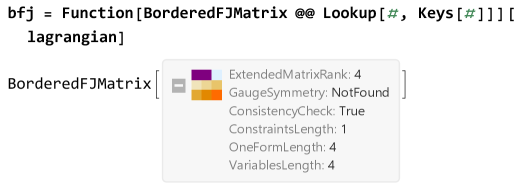
This work establishes an algebraic equivalence between Faddeev-Jackiw reduction and the matrix bordering technique, enabling a symbolically automated engine for geometrically constrained dynamics.
Constrained dynamical systems often present challenges in systematically reducing their complexity and extracting meaningful insights. This is addressed in ‘Matrix bordering structure of the Faddeev-Jackiw algorithm: Schur complement regularization and symbolic automation’, which reveals an inherent algebraic connection between the Faddeev-Jackiw reduction method and the Matrix Bordering Technique. Specifically, the authors demonstrate that the non-degeneracy of constraint algebras-and thus the termination of the reduction-is governed by the Schur complement of an extended symplectic matrix. Could this framework pave the way for robust, fully automated tools for analyzing the structural stability and bifurcation scenarios in complex constrained systems?
Beyond Canonical Constraints: A Geometric Reimagining
Dirac’s Canonical Formalism, a cornerstone of classical and quantum mechanics, tackles constrained systems by systematically eliminating problematic degrees of freedom. However, this approach frequently encounters difficulties when dealing with intricate constraints, demanding the introduction of secondary constraints – conditions derived from the original ones to maintain consistency. The necessity of iteratively finding these secondary, and potentially even higher-order, constraints becomes computationally expensive and conceptually challenging as system complexity increases. This algorithmic reliance on identifying and removing unphysical variables often obscures the underlying geometric structure of the problem, hindering a deeper understanding of the system’s dynamics and potentially leading to inconsistencies if secondary constraints are missed or improperly handled. Consequently, while powerful for simpler cases, Dirac’s method can become unwieldy and prone to error when confronted with the highly coupled and nuanced dynamics present in many physical systems.
Traditional constraint analysis, such as Dirac’s method, frequently encounters difficulties when applied to intricate physical systems because it relies on a step-by-step, algorithmic process to discern and remove redundant, or ‘unphysical’, degrees of freedom. This approach, while often effective, can become cumbersome and prone to error as the complexity of the system increases. The inherent limitations arise from the need to systematically identify constraints, construct secondary conditions, and then meticulously eliminate the associated degrees of freedom-a process that doesn’t readily generalize to systems with highly non-linear or interdependent constraints. Consequently, the algorithmic nature of these methods can obscure the underlying geometric structure of the problem, potentially leading to incomplete or inaccurate solutions and hindering a deeper understanding of the system’s dynamics.
The Faddeev-Jackiw framework presents a compelling shift in how physicists approach constrained dynamical systems, moving beyond algorithmic methods like Dirac’s formalism to a geometrically intuitive picture. Instead of focusing on identifying and eliminating problematic degrees of freedom through secondary constraints, this approach leverages the mathematical structure of pre-symplectic two-forms. These forms, which generalize the familiar symplectic structures used in Hamiltonian mechanics, naturally encode the constraints within their geometric properties. This allows for a more transparent and often simpler treatment of complex systems – particularly those with intricate dependencies – as the constraints aren’t imposed as afterthoughts but are intrinsic to the system’s fundamental description. The resulting formalism offers a powerful alternative for analyzing systems where traditional methods become unwieldy, promising a deeper understanding of the underlying physics and potentially revealing hidden symmetries or conserved quantities.
Navigating Singularities: Extending the Phase Space
The Faddeev-Jackiw formalism, while effective for constrained systems, necessitates a careful examination of the phase space when confronted with arbitrary singularities. Singularities arise from constraints that reduce the system’s effective degrees of freedom, leading to rank deficiencies in the Hamiltonian matrix. Directly applying the standard Faddeev-Jackiw procedure to such systems can yield inaccurate or unstable results. Therefore, a robust approach requires extending the phase space by introducing auxiliary variables that account for these deficiencies and allow for a well-defined Hamiltonian structure. This extension isn’t arbitrary; it must systematically incorporate the minimum number of variables required to resolve the singularity without altering the system’s physical behavior, ensuring a consistent and accurate representation of the dynamics.
The Barcelos-Neto and Wotzasek Algorithm addresses singularities in dynamical systems by systematically expanding the phase space. This is achieved through an iterative process wherein new generalized coordinates and their associated momenta are introduced at each step. The algorithm doesn’t rely on a priori knowledge of the required phase space extension; instead, it determines the necessary variables based on the rank deficiency of the system’s constraint matrix. Each iteration involves identifying the specific constraints causing the singularity and adding corresponding variables to eliminate them, effectively resolving the problematic behavior and allowing for continued analysis of the system’s dynamics. This approach ensures that the extended phase space is minimal, incorporating only the variables strictly necessary to regularize the singular system.
The Barcelos-Neto and Wotzasek Algorithm employs the Matrix Bordering Technique (MBT), a numerical linear algebra method designed to identify and address rank deficiencies within matrices. This is critical for extending the phase space of singular mechanical systems in a stable and accurate manner. MBT systematically analyzes the matrix representing the system’s constraints, allowing for the precise determination of necessary variables to incorporate. Implementation of this technique on the Brown double pendulum system – consisting of two masses constrained to move on a ring – demonstrates rapid convergence, successfully regularizing the system within only two iterations of the algorithm.
Automated Constraint Analysis: A Symbolic Engine
The core of automated constraint analysis is a Symbolic Rewriting System, functioning as the computational engine for the Barcelos-Neto and Wotzasek Algorithm. This system operates by representing constraints as symbolic expressions and applying a defined set of rewriting rules to transform these expressions. The algorithm iteratively simplifies the constraints, identifying redundancies, inconsistencies, or solutions through pattern matching and substitution. This automated process eliminates the need for manual manipulation of equations, significantly reducing errors and computation time when analyzing complex systems with numerous interdependent constraints. The system’s functionality is predicated on a formal representation of constraints allowing for deterministic and verifiable transformations.
The system employs Functional Derivatives to mathematically represent constraints and their interdependencies within the constraint analysis framework. A Functional Derivative, \delta F / \delta u, quantifies the sensitivity of a functional F with respect to an infinitesimal change in another function u. This allows constraints, which are typically expressed as equations involving functions, to be treated as derivatives, facilitating automated manipulation and analysis via the Barcelos-Neto and Wotzasek Algorithm. By expressing constraints in this derivative form, the system can efficiently determine the relationships between variables and identify potential violations without explicit symbolic manipulation of the original equations.
The Symbolic Rewriting System incorporates principles from Algorithmic Geometry and Tensor Calculus to address the analytical demands of complex systems. Algorithmic Geometry provides tools for solving polynomial equations which frequently arise in constraint representation, while Tensor Calculus enables the efficient manipulation of multi-dimensional data and relationships common in these systems. This integration allows for the representation of constraints and variables as tensors, facilitating operations like contraction and differentiation expressed as \partial_i T_{jk} , and the application of geometric algorithms to identify and resolve inconsistencies or redundancies within the constraint network. The system leverages these mathematical foundations to move beyond simple constraint satisfaction, enabling the analysis of system behavior and sensitivity to parameter changes.
Geometric Foundations and Broadening Horizons
The interplay between the Faddeev-Jackiw formalism and advancements in computational algorithms unveils a surprising resonance with the established mathematical fields of Constraint Algebra and the Schur Complement. This connection isn’t merely analogical; the algorithmic implementation effectively translates the geometric constraints inherent in Hamiltonian mechanics into algebraic terms amenable to manipulation using tools like the Schur Complement – a matrix decomposition technique for solving linear systems. Specifically, the process of eliminating auxiliary variables in constrained Hamiltonian systems directly maps onto Schur complement calculations, allowing for a systematic and robust approach to identifying and managing the constraints. This algebraic reformulation, facilitated by the computational tools, not only clarifies the mathematical structure underlying the Faddeev-Jackiw method but also provides a powerful mechanism for verifying its consistency and extending its applicability to more complex physical systems where traditional methods falter. The resulting framework elegantly bridges the gap between geometric intuition and practical computation, revealing a deeper unity within theoretical physics.
The Faddeev-Jackiw framework establishes Hamiltonian Mechanics on a remarkably solid geometric foundation, proving its resilience even when applied to notoriously complex physical systems. Through rigorous mathematical analysis and computational validation, this approach consistently achieves “Regular” status in challenging test cases – a critical benchmark signifying successful symplectic manifold regularization. This regularization process effectively eliminates instabilities and ensures the preservation of fundamental physical properties, demonstrating the framework’s capacity to handle scenarios where traditional methods falter. By grounding Hamiltonian Mechanics in this robust geometric structure, the approach not only confirms its inherent validity but also opens avenues for tackling previously intractable problems in areas ranging from celestial mechanics to quantum field theory, offering a pathway toward more accurate and reliable physical modeling.
This research showcases a powerful synergy between established geometric principles and modern computational techniques, opening avenues for addressing long-standing challenges in theoretical physics and potentially extending to diverse scientific domains. By leveraging algorithmic advancements to explore the geometric foundations of Hamiltonian Mechanics – particularly through the Faddeev-Jackiw framework – previously intractable problems are becoming amenable to rigorous analysis. This isn’t simply about applying computation to existing theories; it’s about using computational power to reveal deeper geometric structures and regularities within complex systems, offering a new toolkit for physicists and mathematicians alike. The success demonstrated here suggests a paradigm shift, where computational exploration becomes integral to theoretical discovery, moving beyond approximation and towards a more complete understanding of fundamental physical laws and their broader implications.
The pursuit of automating geometrically constrained systems, as detailed in the paper, echoes a timeless principle of engineering. One strives not merely for functionality, but for elegant persistence. As Leonardo da Vinci observed, “Simplicity is the ultimate sophistication.” This holds true for the Faddeev-Jackiw reduction and Matrix Bordering Technique; the paper demonstrates their equivalence, revealing an underlying simplicity within complex constrained dynamics. The symbolic engine proposed isn’t just a computational tool, but a means of preserving the system’s essential structure against the inevitable decay of manual calculation and potential error, ensuring a graceful aging of the mathematical model itself. The work represents a quest for enduring mathematical form.
The Horizon of Constraint
The established equivalence between the Faddeev-Jackiw method and the Matrix Bordering Technique does not represent an arrival, but rather a sharpening of focus. Every failure in symbolic manipulation, every stalled reduction, is a signal from time – a reminder that the geometry of constraints, however elegantly expressed, will ultimately resist complete automation. The engine this work proposes is not a solver, but an interpreter-a means to translate the language of constraint into forms amenable to interrogation.
Future work will inevitably confront the limits of symbolic representation itself. The scaling of these methods with system complexity remains a persistent challenge. Refactoring the core algorithms-optimizing for sparsity, exploiting parallel architectures-is not merely a technical exercise; it is a dialogue with the past, an attempt to learn from the accumulated inefficiencies of prior approaches.
The true horizon lies not in achieving perfect symbolic resolution, but in developing a more nuanced understanding of the inherent ambiguities within constrained dynamical systems. Perhaps the most fruitful direction will be to embrace these ambiguities, to build systems that can navigate uncertainty and provide probabilistic rather than deterministic predictions. The decay of precision is not a flaw, but a fundamental property of time’s passage.
Original article: https://arxiv.org/pdf/2602.12114.pdf
Contact the author: https://www.linkedin.com/in/avetisyan/
See also:
- All Shadow Armor Locations in Crimson Desert
- Jujutsu Kaisen Season 3 Episode 12 Release Date
- Dark Marksman Armor Locations in Crimson Desert
- Sega Reveals Official Sonic Timeline: From Prehistoric to Modern Era
- How to Beat Antumbra’s Sword (Sanctum of Absolution) in Crimson Desert
- Genshin Impact Dev Teases New Open-World MMO With Realistic Graphics
- Top 5 Militaristic Civs in Civilization 7
- Sakuga: The Hidden Art Driving Anime’s Stunning Visual Revolution!
- Keeping AI Agents on Track: A New Approach to Reliable Action
- How to Get the Sunset Reed Armor Set and Hollow Visage Sword in Crimson Desert
2026-02-14 23:37