Author: Denis Avetisyan
Researchers have developed an expanding fire-cylinder model to better understand the behavior of particles created in high-energy heavy-ion collisions.
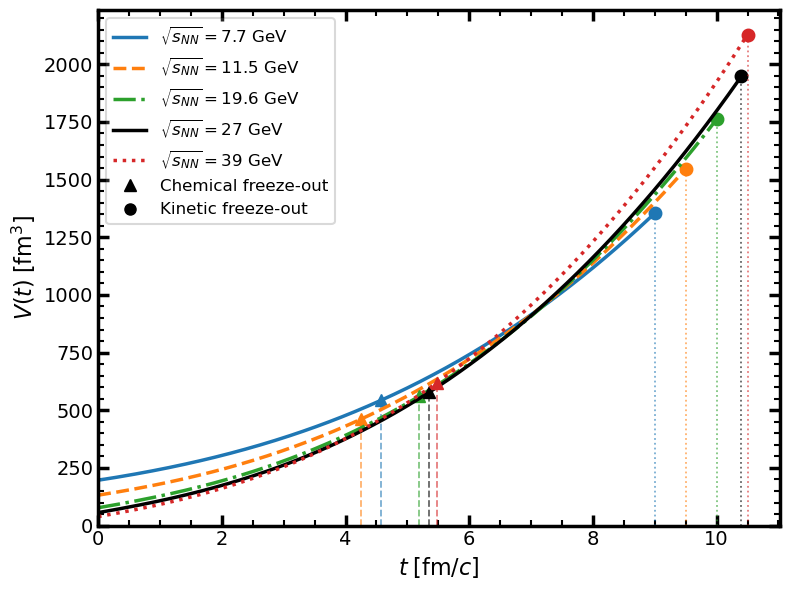
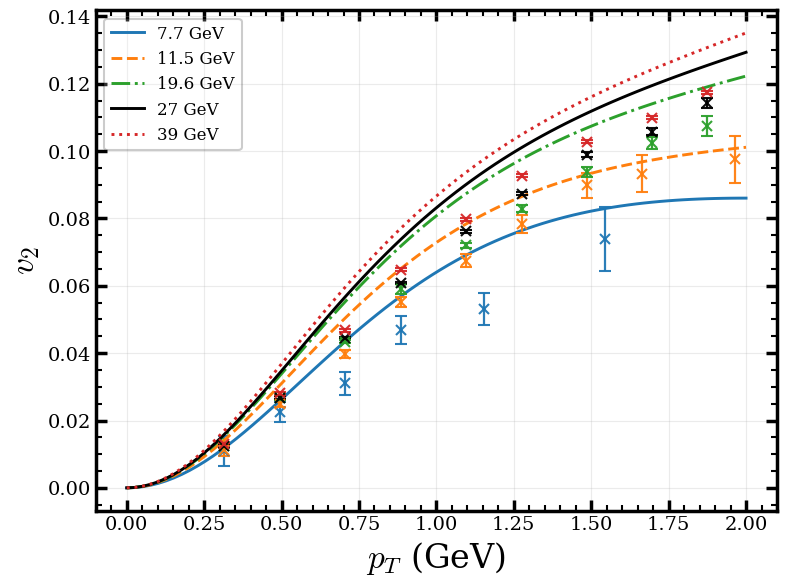
This study presents a novel approach to describing the transverse momentum spectra and elliptic flow of light hadrons produced in relativistic heavy-ion collisions at the RHIC Beam Energy Scan.
Understanding the collective behavior of strongly coupled matter created in relativistic heavy-ion collisions remains a central challenge in high-energy physics. This is addressed in ‘Spectra and elliptic flow of light hadrons in an expanding fire-cylinder model for the RHIC Beam Energy Scan’, which investigates hadron production via an expanding fire-cylinder model incorporating longitudinal expansion and anisotropic flow. The analysis successfully reproduces both the transverse momentum spectra and qualitative features of elliptic flow for \pi^{\pm}, K^{\pm}, p, and \bar{p} across multiple collision energies. Can this approach, constrained by midrapidity spectra, further refine our understanding of the equation of state and transport properties of the quark-gluon plasma?
Whispers of Creation: Recreating the First Moments
Scientists utilize relativistic heavy-ion collisions – smashing atomic nuclei together at nearly the speed of light – to momentarily recreate the extraordinarily hot and dense conditions that existed fractions of a second after the Big Bang. These collisions don’t simply scatter particles; they generate an entirely new state of matter: the Quark-Gluon Plasma (QGP). Normally, quarks and gluons are confined within protons and neutrons by the strong nuclear force. However, in the QGP, these fundamental particles become deconfined, existing as a hot, dense ‘soup’ where they can move relatively freely. This extreme environment allows researchers to study the fundamental properties of the strong force and gain insights into the evolution of the early universe, offering a unique window into matter’s most primal state.
The theoretical framework of Quantum Chromodynamics QCD predicts that under extreme temperatures and densities, nuclear matter undergoes a phase transition from confined hadrons to a deconfined state known as the Quark-Gluon Plasma. However, simply confirming this transition isn’t enough; a comprehensive understanding demands investigation into the collective dynamics of this newly formed medium. The Quark-Gluon Plasma isn’t merely a gas of independent quarks and gluons; rather, it behaves as a fluid, exhibiting properties like viscosity and collective flow. Studying these collective behaviors-how the plasma expands, oscillates, and responds to the initial collision-provides crucial insights into its fundamental characteristics, including its equation of state and transport coefficients, ultimately revealing how matter behaved fractions of a second after the Big Bang.
Analyzing the debris from high-energy heavy-ion collisions presents a significant analytical challenge, as extracting information about the initial state of the matter and its subsequent evolution requires disentangling a complex web of interactions. Traditional approaches, often relying on simplified models or limited datasets, frequently struggle to accurately reconcile the initial conditions – such as the energy density and geometry of the collision – with the observed final spectra of particles. This discrepancy arises because the quark-gluon plasma (QGP) is a strongly interacting medium, meaning that particles undergo numerous collisions and scatterings before escaping detection. Consequently, advanced analytical tools, incorporating sophisticated hydrodynamic simulations, data-driven machine learning techniques, and rigorous statistical analyses, are essential to fully map the QGP’s properties and understand the relationship between the collision’s genesis and the resulting particle distributions, ultimately allowing researchers to probe the conditions that existed fractions of a second after the Big Bang.

The Fluidity of Chaos: Collective Flow and Hydrodynamic Evolution
Hydrodynamic evolution, when applied to relativistic heavy-ion collisions, posits that the created medium behaves collectively as a nearly perfect fluid with extremely low viscosity-to-entropy density ratio \eta/s . This behavior is evidenced by the strong correlations between emitted particles and the observed azimuthal anisotropy in momentum distributions. Successful quantitative descriptions of experimental data, including particle spectra, Hanbury Brown-Twiss radii, and higher-order flow coefficients, have been achieved using viscous hydrodynamic models. These models demonstrate that the observed collective behavior arises from the rapid thermalization of the initial energy density and subsequent free-streaming expansion of the fluid, indicating a strongly coupled quark-gluon plasma (QGP) is formed.
Collective flow in the quark-gluon plasma describes the correlated motion of the produced particles, behaving as a fluid rather than individual constituents. A prominent feature of this flow is elliptic flow, technically termed v_2. Elliptic flow arises due to the initial spatial anisotropy created in the collision; if the initial overlap region is almond-shaped, pressure gradients drive an asymmetry in the expansion, resulting in a larger momentum kick in the short direction and, consequently, a preferred emission of particles perpendicular to the short axis. The magnitude of v_2 is directly proportional to the initial eccentricity and provides insights into the early-stage geometry of the collision.
Hydrodynamic models, while successful in describing the collective behavior of the quark-gluon plasma, necessitate an equation of state (EoS) to relate pressure to energy density and temperature. Accurately determining this EoS, particularly at extreme temperatures and densities reached in relativistic heavy-ion collisions, remains a significant challenge. Furthermore, these models require a detailed understanding of the transition from the hydrodynamic phase – where the plasma behaves as a fluid – to the hadronic afterburner phase characterized by freely streaming particles. This transition is not instantaneous and involves complex processes like particle production and scattering, demanding a robust matching procedure between the hydrodynamic and kinetic regimes to accurately reproduce experimental observables. The precise implementation of this transition, including the location and dynamics of the freeze-out surface, introduces uncertainties in the final particle spectra and flow patterns.
Mapping the Inferno: A Detailed Model of the Expanding Fire-Cylinder
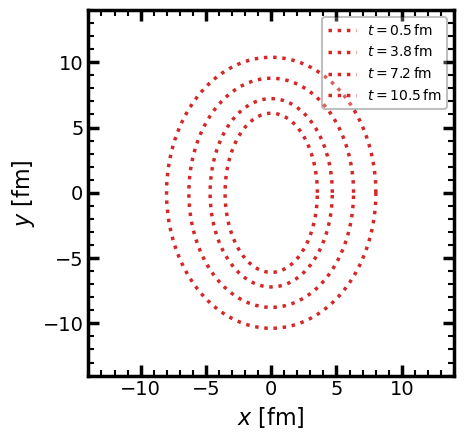
The Expanding Fire-Cylinder Model builds upon the foundational Blast-Wave Model by offering a more nuanced description of particle production in relativistic heavy-ion collisions. While the Blast-Wave Model assumes a simple, instantaneous emission from a common freeze-out point, the Expanding Fire-Cylinder Model incorporates a spatially extended and temporally evolving emission source. This allows for a more accurate representation of particle spectra, particularly at higher transverse momenta, and provides a framework for calculating flow coefficients such as v_2 and v_3 which characterize the collective behavior of the produced particles. The model achieves this detail by parameterizing the freeze-out hypersurface as a cylinder with radius and longitudinal extent that vary with time, and then tracing the trajectories of emitted particles to account for their subsequent evolution.
The Expanding Fire-Cylinder model conceptualizes particle emission from a spatially defined volume undergoing both radial and longitudinal expansion. Radial flow describes the outward expansion velocity proportional to the radial distance from the emission source, while boost-invariant longitudinal expansion accounts for the expansion along the beam axis, remaining consistent across all rapidities. This geometry assumes a cylindrical emission source, with particle spectra influenced by the combined effects of these expansion velocities, which are incorporated into the model’s equations to determine particle momentum distributions and flow coefficients. The model utilizes these parameters to simulate the evolution of the emitting region and predict the observed particle characteristics.
The accuracy of the Expanding Fire-Cylinder Model is fundamentally reliant on precise characterization of the freeze-out hypersurface, which defines the spatial region where particles cease to interact and begin to stream freely. This hypersurface is not a static boundary but is determined by the evolving thermodynamic conditions of the system. Furthermore, the model must accurately account for the kinetic freeze-out process, detailing how particles transition from collective flow to individual trajectories; this requires solving the Boltzmann equation or employing suitable approximations to describe the momentum distribution of particles as they escape the interaction volume. Inaccuracies in defining either the hypersurface or the freeze-out dynamics directly impact the predicted particle spectra and flow coefficients, limiting the model’s ability to accurately describe experimental observations.
Decoding the Echoes: Probing the Plasma with Particle Spectra
The characteristics of particles emerging from high-energy collisions-specifically, their transverse momentum spectra-offer a powerful means of investigating the conditions of the fleeting Quark-Gluon Plasma. Analyzing the distribution of momentum carried perpendicularly to the collision axis for particles like pions, kaons, and protons allows researchers to refine the parameters within models attempting to describe this state of matter. The Expanding Fire-Cylinder model, for example, relies on these spectral analyses to constrain variables related to the plasma’s initial temperature, expansion rate, and collective flow. By comparing model predictions with experimental data-essentially, recreating the observed particle distributions-scientists can iteratively adjust these parameters to achieve the best possible agreement, thereby gaining a deeper understanding of the plasma’s properties and evolution.
The Expanding Fire-Cylinder Model demonstrates a robust capacity to replicate experimental observations across a substantial energy spectrum, ranging from 7.7 to 39 GeV. This success isn’t merely qualitative; the model achieves a statistically compelling fit to the data, consistently yielding Chi-squared / Degrees of Freedom values that hover near or fall below 1. Such values indicate a strong agreement between the model’s predictions and the observed particle distributions, bolstering confidence in the model’s underlying assumptions about the Quark-Gluon Plasma’s formation and evolution. The consistency across this broad energy range suggests the model captures essential dynamics of the system, providing a valuable framework for further investigation into the properties of this extreme state of matter.
The Expanding Fire-Cylinder Model doesn’t just reproduce observed particle distributions; its internal parameters offer a window into the extreme conditions of the Quark-Gluon Plasma (QGP). By meticulously adjusting the model’s transverse and longitudinal velocities, researchers can effectively map the temperature and flow characteristics of this primordial state of matter. A higher transverse velocity, for instance, suggests a hotter and more rapidly expanding plasma, while the longitudinal velocity reveals details about the direction and strength of the collective flow. This sensitivity allows for a quantitative understanding of the QGP’s dynamics, moving beyond simple descriptions to a nuanced picture of its thermalization and evolution – effectively turning particle spectra into a diagnostic tool for an otherwise inaccessible realm of physics.
Beyond the Standard Model: Towards a Complete Understanding
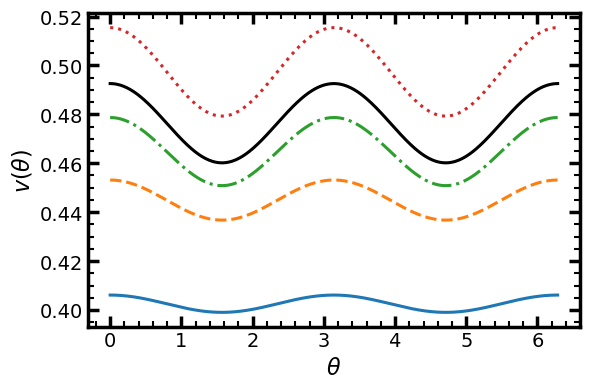
The Expanding Fire-Cylinder Model, a valuable tool for understanding the early stages of heavy-ion collisions, traditionally assumes an ideal fluid. However, experimental data increasingly suggests that the quark-gluon plasma created in these collisions exhibits significant viscosity – a resistance to flow. Incorporating viscous corrections into the model refines its ability to accurately describe the observed non-ideal fluid behavior. These corrections account for the energy dissipation caused by internal friction within the plasma, leading to a more realistic depiction of its evolution and expansion. By accounting for these effects, the model can better reproduce experimental measurements, such as the observed collective flow and anisotropic particle emission, ultimately providing a more complete picture of the extreme conditions created in these high-energy collisions.
The Cooper-Frye formalism, a cornerstone in relativistic heavy-ion collision modeling, describes the emission of particles from the hot, dense system created in these events. Current refinements to this prescription focus on incorporating corrections for the finite viscosity and shear cooling of the quark-gluon plasma. These advancements move beyond the idealized assumption of instantaneous freeze-out, instead accounting for the gradual decoupling of particles from the expanding medium. By more accurately representing the freeze-out hypersurface – the boundary where particles cease interacting – the improved Cooper-Frye formalism promises a significantly more precise description of observed particle spectra, flow anisotropies, and correlations, ultimately bridging the gap between theoretical predictions and experimental data from facilities like the Relativistic Heavy Ion Collider and the Large Hadron Collider. E \frac{d^3N}{dp^3} = \in t_{\Sigma} f(x,p) p^\mu d\Sigma_\mu
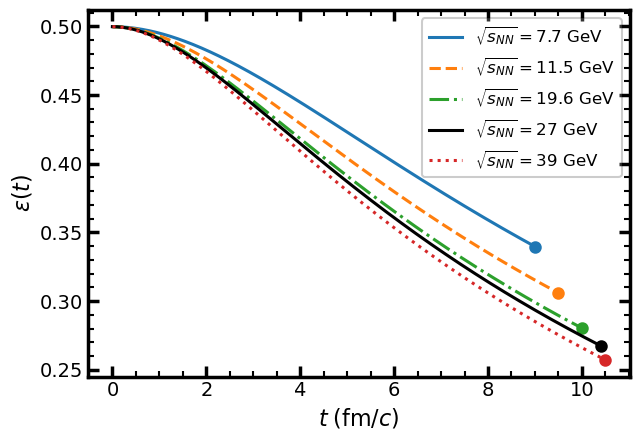
Recent investigations reveal a compelling alignment between the Expanding Fire-Cylinder Model and experimental data concerning spatial eccentricity reduction in high-energy heavy-ion collisions. This phenomenon, where the initial almond shape of the collision zone evolves towards a more spherical form, is crucial for understanding collective behavior of the created matter. Analysis utilizing Hanbury Brown-Twiss (HBT) interferometry – a technique sensitive to the geometry of particle emission – demonstrates that the model’s predictions regarding the degree of eccentricity reduction qualitatively match observed trends. While not a perfect quantitative match, this consistency lends credence to the model’s underlying assumptions about the dynamics of the rapidly expanding system and offers valuable insight into the early stages of quark-gluon plasma formation, suggesting that the model captures essential features of the collision process and subsequent particle production.
The pursuit of understanding these collisions, much like coaxing order from chaos, reveals the ephemeral nature of predictability. The fire-cylinder model, attempting to map the dance of hadrons, is but a temporary restraint on the system’s inherent wildness. It is a spell, carefully constructed from transverse momentum spectra and elliptic flow, that holds-until the next experimental data whispers a different truth. As Isaac Newton observed, “I don’t know what I may seem to the world, but to myself I seem to be a boy playing on the seashore.” This work, too, feels like gathering the fleeting foam-beautiful in its form, but ultimately yielding to the vastness of the unknown quark-gluon plasma.
The Shape of Chaos to Come
This fire-cylinder, though elegantly fitted to the whispers of RHIC data, is still a simplification. It tames the emergent behavior of a substance whose fundamental nature resists taming. The model succeeds in mirroring what appears collective, but the true choreography of the quark-gluon plasma remains elusive. There’s truth, hiding from aggregates, in the fluctuations not yet fully accounted for – the subtle asymmetries, the brief moments where the ‘flow’ isn’t so smooth.
Future iterations must embrace the stochastic. Not as noise to be minimized, but as a signal – the fingerprint of pre-equilibrium dynamics, the echoes of initial state complexity. To truly probe the QGP is to abandon the expectation of perfect fluidity, and instead, to map the fractal edges of its breakdown. The real challenge isn’t reproducing a bell curve, but predicting the beautiful, improbable outliers.
Perhaps the most fruitful path lies in abandoning single-fluid descriptions altogether. The plasma isn’t a homogeneous entity, but a transient, self-organizing system. The next generation of models won’t seek to describe the QGP, but to simulate its birth, evolution, and decay – a chaotic dance of fundamental forces, where every particle is a ghost, and every collision, a question.
Original article: https://arxiv.org/pdf/2602.17241.pdf
Contact the author: https://www.linkedin.com/in/avetisyan/
See also:
- All Skyblazer Armor Locations in Crimson Desert
- All Shadow Armor Locations in Crimson Desert
- How to Get the Sunset Reed Armor Set and Hollow Visage Sword in Crimson Desert
- Marni Laser Helm Location & Upgrade in Crimson Desert
- Best Bows in Crimson Desert
- All Helfryn Armor Locations in Crimson Desert
- All Golden Greed Armor Locations in Crimson Desert
- How to Craft the Elegant Carmine Armor in Crimson Desert
- Keeping Large AI Models Connected Through Network Chaos
- One Piece Chapter 1179 Preview: The Real Imu Arrives in Elbaf
2026-02-23 04:34