Ah, MicroStrategy (Strategy, if you will), that audacious tightrope walker of the financial circus, has finally deigned to reveal its Q4 2025 earnings report. And what a spectacle it is! Alongside the usual numbers, the company has unveiled a scenario so dire, so extravagantly catastrophic, that one might mistake it for a Nabokovian satire-a 90% plunge in Bitcoin’s price, leaving the firm’s treasury model teetering on the edge of absurdity.
The CEO, one Phong Le, with a gravitas that borders on the comical, has provided a rare glimpse into the abyss. How far, one wonders, must the market plummet before this corporate leviathan’s capital structure begins to creak and groan under the weight of its own ambition?
MicroStrategy’s Breaking Point: A Farce in Three Acts
During the latest earnings charade, Le proclaimed that a 90% decline in Bitcoin’s price to a mere $8,000 would mark the moment when the firm’s Bitcoin reserves and net debt engage in a macabre waltz. At this juncture, the company, with a flourish of dramatic irony, would find itself unable to repay its convertible debt using its BTC holdings alone. Restructuring? New equity? Additional debt? Oh, the choices are as endless as they are unappetizing.
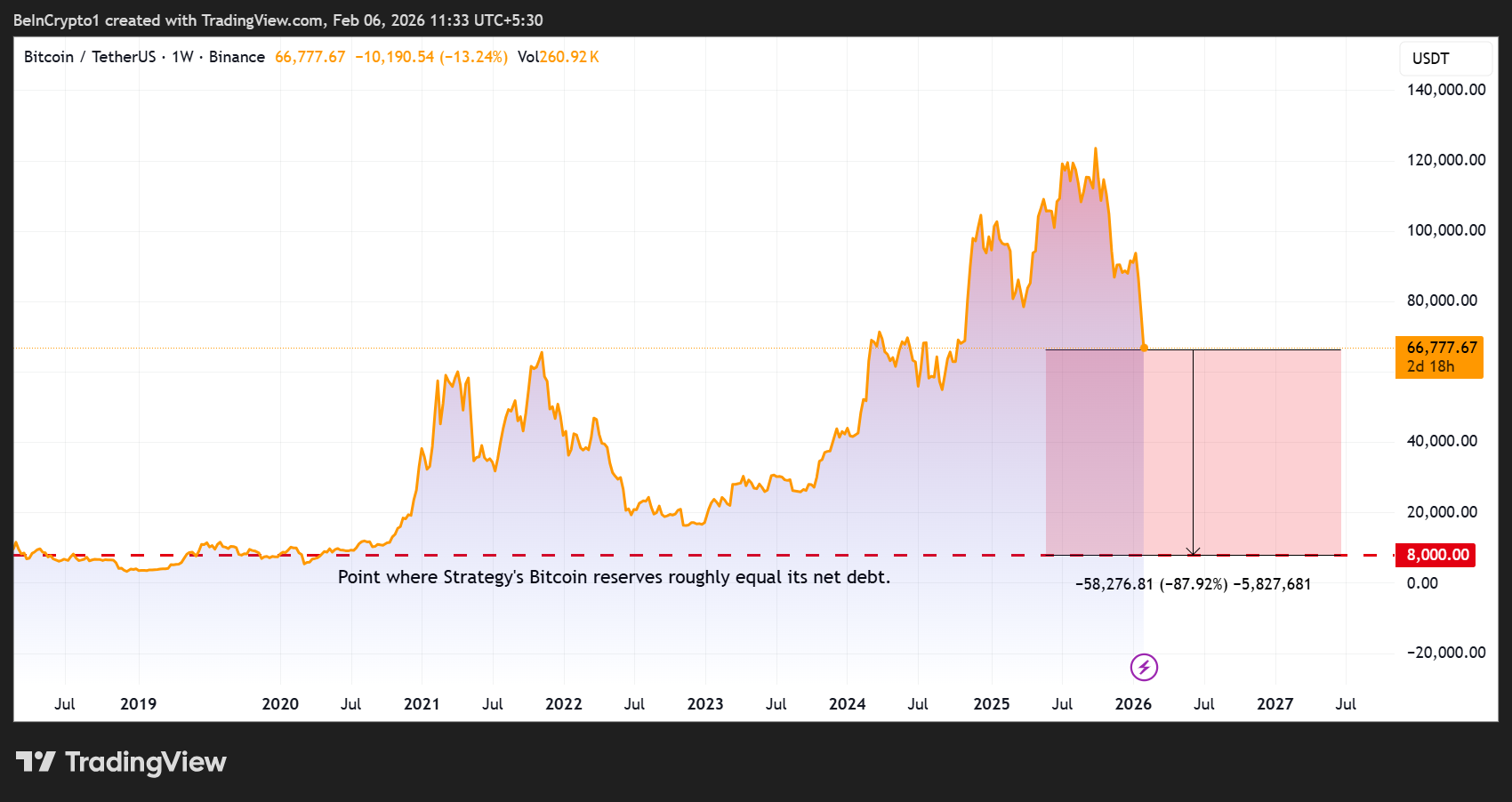
Yet, Le assures us, with a straight face no less, that such a scenario is “highly improbable” and would unfold over several years. One can almost hear the faint tinkling of a piano in the background, accompanying this financial ballet.
“In the extreme downside, if we were to have a 90% decline in Bitcoin price to $8,000, which is pretty hard to imagine, that is the point at which our BTC reserve equals our net debt and we’ll not be able to then pay off of our convertibles using our Bitcoin reserve and we’d either look at restructuring, issuing additional equity, issuing an additional debt. And let me remind you: this is over the next five years. Right, So I’m not really worried at this point in time, even with Bitcoin drops,” said Le, with the nonchalance of a man who has clearly never read Lolita.
It is worth noting, with a touch of schadenfreude, that Le’s remarks come mere months after he admitted a scenario that would compel the firm to sell Bitcoin. As BeInCrypto reported, Le cited a Bitcoin sale trigger tied to mNAV and liquidity stress. A trigger, one might add, as precise as it is precarious.
Speaking on What Bitcoin Did, Le outlined the conditions under which the firm would be forced to part with its precious BTC:
- First, the company’s stock must trade below 1x mNAV, a condition as likely as a snowstorm in July.
- Second, MicroStrategy must be unable to raise new capital through equity or debt issuance, a scenario as dire as it is delightful for those who relish financial schadenfreude.
Thus, the latest statement does not contradict Le’s earlier position but adds another layer of risk, like a matryoshka doll of financial folly. Previously, a Bitcoin sale depended on stock trading below mNAV and capital markets’ closing. Now, he clarifies that in an extreme 90% crash, the immediate issue would be debt servicing, likely addressed first through restructuring or new financing-not necessarily selling Bitcoin. How quaint.
The Grand Exposure: A Tragedy in Bitcoin
Strategy, that indefatigable accumulator of Bitcoin, remains the world’s largest corporate holder of the cryptocurrency, boasting 713,502 BTC as of early February 2026. The company acquired these holdings at a total cost of about $54.26 billion, a sum so vast it boggles the mind. Yet, Bitcoin’s decline during the final months of 2025 significantly impacted the balance sheet, resulting in $17.4 billion in unrealized digital-asset losses and a net loss of $12.4 billion. A tragedy, indeed, but one that highlights the sensitivity of its financial performance to market swings.
At the same time, Strategy continued to raise substantial capital, $25.3 billion in 2025 alone, making it one of the largest equity issuers in the US. A $2.25 billion USD reserve was also built, designed to cover roughly two and a half years of dividend and interest obligations. Executives, with a straight face, argue that these measures strengthen liquidity and provide flexibility, even during periods of market stress. One can almost hear the audience tittering.
Volatility’s Vaudeville: The Risk in Focus
The disclosure comes amid heightened volatility in crypto markets. Bitcoin, that fickle prima donna, traded near $70,000 in early February before plummeting to an intraday low of $60,000 on February 6. This shows how quickly price movements can reshape the outlook for highly leveraged treasury strategies. Strategy’s capital structure, a labyrinthine construct of debt, preferred equity, and convertible instruments, has amplified gains during bull markets but also magnifies losses during downturns, drawing increasing scrutiny from investors and analysts.
Yet, the company’s leadership maintains that the long-dated nature of much of its debt provides time to manage through cycles. This, they say, reduces the risk of forced liquidations in the near term. A comforting thought, no doubt, for those who enjoy living on the edge.
Saylor’s Sermon: HODL and Hope
Elsewhere, executive chair Michael Saylor, that indefatigable apostle of Bitcoin, reiterated his conviction in the cryptocurrency despite recent losses. Describing it as the “digital transformation of capital,” he urged investors to “HODL,” a mantra as simplistic as it is sacrosanct.
HODL
– Michael Saylor (@saylor) February 5, 2026
Saylor and his acolytes argue that Bitcoin remains the hardest form of money and that the company’s long-term strategy is built around holding the asset indefinitely, rather than attempting to time market cycles. The firm has also expanded its financial engineering efforts, including scaling its Digital Credit instruments and preferred equity offerings. According to management, these are designed to reduce volatility and diversify funding sources while continuing to accumulate Bitcoin. A plan as ambitious as it is audacious.
Investors’ Interlude: A Divided Audience
Market reaction to the earnings disclosures and downside scenario has been as mixed as a Nabokov novel. Supporters argue that Strategy’s massive Bitcoin reserves, ability to issue equity, and multi-year debt maturities provide sufficient flexibility to navigate even severe downturns. Critics, however, warn that a prolonged bear market could still force difficult choices. Potential risks cited by investors include shareholder dilution, pressure on the capital structure, or the possibility of selling Bitcoin if funding conditions tighten.
“The company is currently facing a whopping -$7.3 billion loss on their Bitcoin investments,” said Jacob King, with the air of a man who has just discovered the punchline to a very long joke.
For now, Strategy appears committed to its high-conviction approach. However, by acknowledging that its Bitcoin reserves would merely match its debt, the company has made clear that even the most aggressive corporate Bitcoin strategy still has a theoretical breaking point, one defined not just by market prices but by the limits of leverage itself. A lesson, perhaps, in the dangers of hubris.
Read More
- All Skyblazer Armor Locations in Crimson Desert
- How to Get the Sunset Reed Armor Set and Hollow Visage Sword in Crimson Desert
- All Shadow Armor Locations in Crimson Desert
- Marni Laser Helm Location & Upgrade in Crimson Desert
- One Piece Chapter 1180 Release Date And Where To Read
- All Helfryn Armor Locations in Crimson Desert
- All Golden Greed Armor Locations in Crimson Desert
- All Icewing Armor Locations in Crimson Desert
- How to Beat Stonewalker Antiquum at the Gate of Truth in Crimson Desert
- Legendary White Lion Necklace Location in Crimson Desert
2026-02-06 11:11