Author: Denis Avetisyan
New research explores the resilience of topological order in the toric code when subjected to realistic magnetic interactions.

This study utilizes neural network quantum states and Schrieffer-Wolff transformations to analyze the impact of isotropic Heisenberg interactions on the toric code’s topological phase and potential quantum phase transitions.
The robustness of topological order-a hallmark of exotic quantum phases-is often challenged by even weak, local perturbations. This is explored in ‘The toric code under antiferromagnetic isotropic Heisenberg interactions’, which investigates the impact of realistic interactions on a promising platform for quantum computation. Through a combination of neural network quantum states and Schrieffer-Wolff transformations, we demonstrate that while weak Heisenberg interactions initially renormalize the toric code’s properties, they ultimately drive a quantum phase transition to an antiferromagnetic Néel phase. Can these techniques be extended to predict and mitigate the effects of more complex perturbations on other topologically ordered states, paving the way for robust quantum technologies?
Unveiling Fragility: The Dance of Order and Disruption
The toric code stands as a cornerstone in the pursuit of topological quantum computation, distinguished by its capacity to safeguard quantum information against localized disturbances. This resilience stems from the encoding of quantum data not in individual qubits, but in the global properties of entangled qubits arranged on a lattice – specifically, the pattern of magnetic flux excitations. Unlike conventional quantum codes vulnerable to bit-flip or phase-flip errors, the toric code’s information is distributed across these collective excitations, meaning a single qubit error doesn’t necessarily corrupt the encoded data. Instead, errors manifest as localized defects that can be detected and corrected without directly measuring the fragile quantum state itself. This inherent robustness represents a significant advantage in building practical quantum computers, where maintaining coherence is a constant challenge, and is why the toric code continues to serve as a vital theoretical model and benchmark for more complex quantum error correction schemes.
The promise of topological quantum computation hinges on the inherent stability of systems like the toric code, but this robustness isn’t absolute. Introducing even seemingly minor disturbances – such as the Heisenberg interaction, which favors alignment of neighboring spins – can subtly erode the topological order that protects quantum information. This interaction introduces local correlations that compete with the long-range entanglement essential for topological protection, potentially leading to a breakdown of the system’s error-correcting capabilities. Consequently, a detailed analysis of these perturbations is vital; researchers must precisely characterize how the ground state of the toric code responds to these interactions to determine the threshold beyond which topological order is lost and to develop strategies for mitigating their effects. Understanding this delicate balance between order and disruption is therefore paramount to realizing practical, fault-tolerant quantum devices.
The promise of fault-tolerant quantum computation hinges on the stability of a quantum system’s ground state, and even subtle perturbations can jeopardize this stability. Topological quantum computation, leveraging exotic states of matter, aims to encode information in a way that is intrinsically protected from local disturbances; however, interactions like the Heisenberg interaction introduce vulnerabilities. A thorough understanding of how these perturbations alter the ground state-its energy, degeneracy, and response to external fields-is therefore paramount. Precisely characterizing these changes allows researchers to develop strategies for mitigating their effects, such as error correction schemes or tailored hardware designs, ultimately paving the way for robust and reliable quantum devices capable of performing complex calculations without succumbing to noise and decoherence.
Investigating the effects of perturbations on topologically ordered systems, like the toric code, presents a significant challenge for conventional computational techniques. Standard approaches, such as mean-field theory or perturbative expansions, often fail to accurately capture the subtle, correlated behavior that emerges in these perturbed phases. This is because the low-energy physics is governed by emergent degrees of freedom – quasiparticles with unusual statistics – and their interactions, which are not readily accessible through these simplified methods. Consequently, these techniques can misrepresent the true ground state, predict incorrect excitation spectra, and ultimately fail to reveal the extent to which topological order has been compromised. More sophisticated numerical methods, like Density Matrix Renormalization Group (DMRG) or Monte Carlo simulations, are frequently required to reliably characterize the resulting low-energy behavior and determine the stability of topological phases against even weak disturbances.
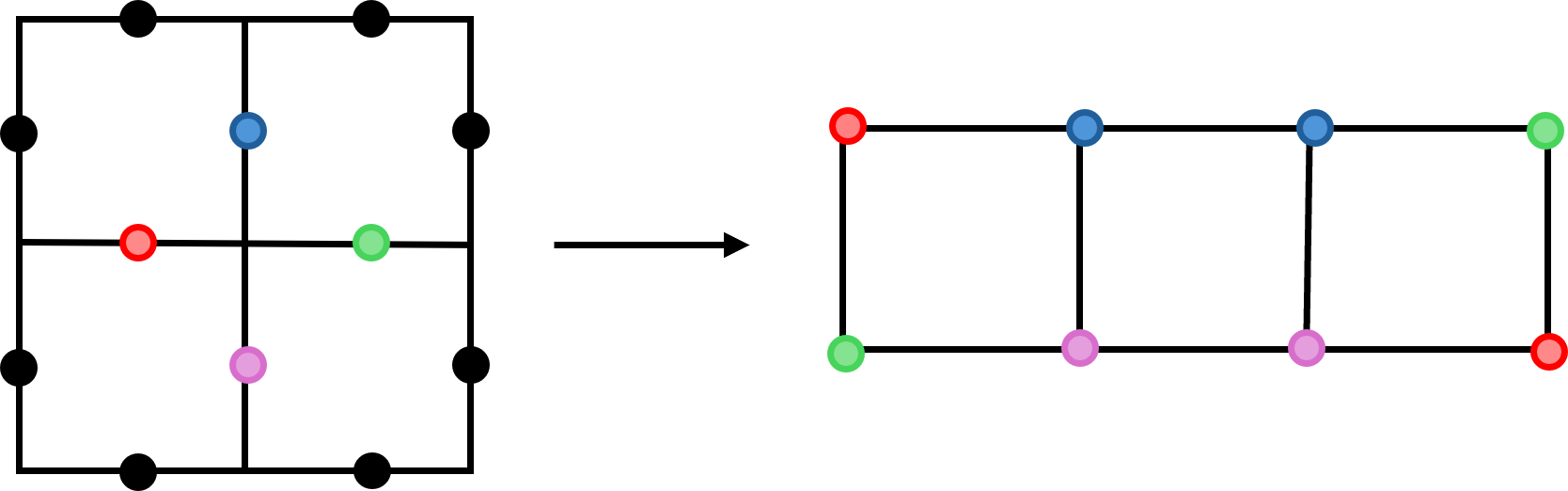
Deconstructing Complexity: A Transformative Approach
The Schrieffer-Wolff transformation is a perturbative method used to eliminate high-energy degrees of freedom from a Hamiltonian, thereby deriving an effective Hamiltonian that accurately represents the system’s low-energy physics. This is achieved by applying a unitary transformation U = exp(S) to the original Hamiltonian H_0, where the generator S is constructed to couple high- and low-energy states. By carefully choosing S, virtual processes involving these high-energy states are effectively decoupled in the transformed Hamiltonian H_{eff} = UHU^{-1}, leaving a simplified description focused on the relevant low-energy subspace. The resulting H_{eff} retains the essential physics at lower energies, facilitating analysis and providing a more tractable model for understanding the system’s behavior.
The Schrieffer-Wolff transformation effectively reduces the complexity of analyzing a perturbed Hamiltonian by systematically eliminating high-energy, virtual processes. This is achieved through a unitary transformation that decouples the low-energy subspace from the high-energy subspace, allowing researchers to concentrate solely on the relevant degrees of freedom defining the system’s low-energy behavior. By projecting the Hamiltonian into this reduced subspace, the resulting effective Hamiltonian describes only the interactions pertinent to the ground state and low-lying excitations, thereby simplifying calculations and providing a more tractable model for understanding the system’s properties. This simplification is crucial for systems where direct calculation of the full Hamiltonian is computationally prohibitive or analytically intractable.
The second-order Schrieffer-Wolff transformation yields an effective Hamiltonian that accurately represents the low-energy physics of the system by isolating the dominant interactions. This effective Hamiltonian provides a modified ground state energy, differing from the original by a correction term proportional to the interaction strength J. Specifically, the second-order correction to the energy per spin is calculated as -9J²/4. This correction arises from the virtual processes eliminated during the transformation and quantifies the change in the system’s energy due to these interactions, allowing for a precise determination of the low-energy ground state properties.
Stoquastic Hamiltonians, those possessing only real-valued matrix elements in a suitably chosen basis, are essential for the reliable application of certain quantum many-body optimization techniques, such as quantum Monte Carlo. Non-stoquastic Hamiltonians introduce the ‘sign problem’, leading to exponentially increasing computational cost and hindering accurate simulations. The Marshall gauge transformation is a unitary transformation specifically designed to preserve the physics of the original Hamiltonian while enforcing stoquasticity. This transformation achieves stoquasticity by strategically modifying the phases of hopping terms, effectively altering the basis without changing the energy eigenvalues or the physical properties of the system, thereby enabling the use of these optimization methods.

Mapping the Quantum Landscape: Neural Networks as Guides
A neural network quantum state (NNQS) represents a parameterized quantum state designed to approximate the ground state of a given Hamiltonian. This approach employs a neural network to map a set of input parameters to the amplitudes of a quantum state vector. The network’s weights and biases function as variational parameters, allowing the NNQS to explore a vast Hilbert space. By adjusting these parameters, the NNQS aims to minimize the energy expectation value ⟨Ψ(θ)|H|Ψ(θ)⟩, where Ψ(θ) is the NNQS and H is the Hamiltonian. This minimization process effectively searches for the ground state within the space of states representable by the chosen neural network architecture, providing an approximation to the true ground state.
Employing a ConvolutionalNeuralNetwork (CNN) as the variational ansatz offers computational advantages and leverages inherent symmetries within the system. CNNs are specifically designed to process data with a grid-like topology, making them well-suited for representing spatial correlations in quantum many-body problems. This architecture reduces the number of trainable parameters compared to fully connected networks, improving computational efficiency. Furthermore, the convolutional filters within the CNN are translationally equivariant, meaning they respond identically to the same local configuration regardless of its position in the system; this directly exploits translational symmetries present in the Hamiltonian, reducing the need to learn these symmetries during the optimization process and leading to more robust and generalizable results.
Incorporating GlobalParity symmetry as a constraint within the neural network ansatz restricts the solution space to only those states exhibiting the specified symmetry. This is achieved by enforcing a condition on the network’s output such that the wavefunction changes sign upon inversion through the center of the system. By design, this constraint reduces the number of variational parameters needed to accurately represent the ground state, leading to a more efficient optimization process and a more robust solution. The implementation directly biases the network towards solutions that satisfy the GlobalParity requirement, effectively preventing the exploration of energetically unfavorable, symmetry-violating states.
Variational Monte Carlo (VMC) is employed as the optimization algorithm to determine the ground state energy of the system. VMC functions by stochastically evaluating the expectation value of the Hamiltonian with respect to a trial wave function – in this case, the neural network quantum state. This expectation value represents the energy of the system for a given set of neural network weights. The algorithm then adjusts these weights iteratively, utilizing Monte Carlo integration to estimate the energy gradient and minimize the energy via methods such as stochastic gradient descent. This minimization process continues until convergence is achieved, yielding an approximation of the ground state energy and corresponding wave function parameters.

Decoding the Signature: Probing Topological Order
Fidelity susceptibility serves as a powerful tool for characterizing quantum phase transitions and assessing the stability of a system’s ground state. This quantity effectively measures how much the ground state wavefunction changes under a small perturbation to the Hamiltonian; a sharp peak in fidelity susceptibility signals a phase transition, indicating a dramatic shift in the system’s properties. By calculating this susceptibility, researchers can not only pinpoint the critical parameters at which transitions occur, but also quantify the system’s vulnerability to external disturbances-a crucial factor in understanding the robustness of quantum phases like the ℤ2 topological phase. Essentially, a higher fidelity susceptibility implies a greater sensitivity to perturbations, potentially jeopardizing the preservation of the desired quantum state and its associated properties, while a lower value suggests a more stable and resilient phase.
The NonContractibleWilsonLoop offers a powerful diagnostic for identifying and quantifying topological order within a quantum system. This observable directly probes the presence of loop operators that are non-trivial due to the system’s topology-in essence, loops that cannot be continuously shrunk to a point without breaking the underlying quantum state. Crucially, the magnitude of the NonContractibleWilsonLoop is sensitive to any disturbance that disrupts this topological protection, particularly interactions like the Heisenberg interaction which can introduce local fluctuations. A significant decay in the WilsonLoop’s value signals a degradation of the topological phase, indicating the emergence of local order and a loss of the long-range entanglement characteristic of topologically ordered states. By precisely measuring this loop, researchers gain insight into the stability of the topological phase and can pinpoint the conditions under which it breaks down, providing a critical tool for understanding and controlling exotic quantum matter.
Topological entanglement entropy serves as a crucial diagnostic for identifying and characterizing topological order, going beyond simple local measurements. Unlike conventional entanglement, which typically decays with distance, topological entanglement persists over long ranges due to the global properties of the system’s quantum state; it isn’t merely a measure of how much two regions are correlated, but rather a quantification of the hidden, non-local correlations arising from the topology of the quantum phase. Specifically, this entropy-calculated as the von Neumann entropy of the reduced density matrix-reveals a non-zero value characteristic of topologically ordered states, distinguishing them from conventional phases where it would be zero or approach zero with increasing system size. The magnitude of this topological entanglement entropy is directly linked to the quantum dimension D of the anyons-the exotic quasiparticles-that emerge as excitations within the topological phase; a value of ln(2) for the toric code, for example, signals the presence of fundamentally different excitations compared to conventional systems, and confirms the robustness of long-range quantum correlations defining the topological state.
Investigations into the ℤ2 topological phase reveal a surprising degree of stability against increasing interactions, persisting up to a critical coupling strength of approximately Jc ≈ 0.164 as determined by fidelity susceptibility and non-contractible Wilson loop analyses. Beyond this threshold, the system transitions from a topologically ordered state to one characterized by magnetic order, signifying a loss of the exotic properties associated with topological phases. Crucially, calculations also pinpoint the energy gap of the toric code – a prominent example of a ℤ2 topological phase – to be \ln(2), providing a quantitative measure of the energy required to excite the system and further validating these findings. This precise determination of both the critical coupling and the energy gap offers valuable benchmarks for future explorations into more complex topological systems and their potential applications.

The study meticulously dissects the toric code, subjecting its topological order to the stress of Heisenberg interactions. This approach echoes a fundamental tenet of understanding any system: to truly grasp its limits, one must push it to the point of failure. As Jean-Paul Sartre noted, “Existence precedes essence.” Similarly, this research doesn’t simply observe the toric code; it actively defines its properties through controlled disruption, revealing how the topological phase renormalizes or collapses under pressure. The Schrieffer-Wolff transformation serves as a crucial tool in this deconstruction, allowing researchers to map the effective Hamiltonian and pinpoint the precise conditions for the loss of topological order – a deliberate breaking to understand the whole.
Where Do We Go From Here?
The exploration detailed within reveals a predictable truth: order, even when topologically protected, is ultimately a local phenomenon. The toric code, subjected to the insistent nudge of Heisenberg interactions, does not so much transition as reveal its inherent fragility. The Schrieffer-Wolff transformation, employed as a scalpel, dissects the effective Hamiltonian, exposing the bare bones of the topological phase and its susceptibility to perturbation. One is left to wonder if the pursuit of robust topological order is, fundamentally, an exercise in identifying systems that confess their design sins most slowly.
Future work must address the limitations inherent in approximating strong correlations. Neural network quantum states, while powerful, offer a parameterized landscape; the true ground state may lie beyond the reach of the chosen ansatz. A critical direction involves probing the fate of topological order beyond the perturbative regime, potentially through explorations of dynamical mean-field theory or quantum Monte Carlo simulations – methods that may expose unforeseen instabilities.
The question isn’t simply whether the toric code survives Heisenberg interactions, but what constitutes “survival” in a strongly correlated system. Is a renormalized topological phase, barely distinguishable from a trivial state, a victory or merely a delayed collapse? The answer, predictably, lies not in the preservation of order, but in the precise characterization of its decay.
Original article: https://arxiv.org/pdf/2603.05707.pdf
Contact the author: https://www.linkedin.com/in/avetisyan/
See also:
- NTE Drift Guide (& Best Car Mods for Drifting)
- How to Get the Wunderbarrage in Totenreich (BO7 Zombies)
- Change Your Perspective Anomaly Commission Guide In NTE (Neverness to Everness)
- How to Beat Turbines in ARC Raiders
- NTE Fan Shows Off Mint Cosplay
- Deltarune Chapter 1 100% Walkthrough: Complete Guide to Secrets and Bosses
- Diablo 4 Best Loot Filter Codes
- All Nameless Hospital Endings Full Guide In NTE
- How to Unlock the Mines in Cookie Run: Kingdom
- Beware! Phishing Emails Are Deceiving Robinhood Users in a Sneaky Plot!
2026-03-09 13:45