Ah, mesdames et messieurs! Gather ’round, for six illustrious contributors from the grand world of Bitcoin (BTC) quantum security, including the ever-illuminating Casa co-founder Jameson Lopp, have unveiled a delightful little proposition known as BIP-361. This charming proposal seeks to bid adieu to the antiquated ECDSA/Schnorr signatures.
This draft, whimsically titled “Post Quantum Migration and Legacy Signature Sunset,” lays out a three-phase timeline that promises to transform quantum security into a private incentive, as if by some alchemical magic!
What on Earth is BIP-361, and What Mischief Does it Propose?
BIP-361 builds upon the previous mischief of BIP-360, which introduced the rather clever quantum-resistant output type called Pay-to-Merkle-Root (P2MR). This proposal addresses a rather alarming vulnerability in the hallowed halls of Bitcoin’s security model.
Recent estimations, likely delivered with a flourish, suggest that a staggering 34% of all Bitcoin is ensconced in addresses that are oh-so-exposed to quantum risk. Imagine! Their public keys, like scandalous secrets, have already been laid bare on-chain, leaving these UTXOs ripe for the picking by an attacker wielding a sufficiently powerful quantum computer-truly, a stroke of genius!
Among the treasures at risk are the approximately 1 million BTC attributed to the enigmatic Satoshi Nakamoto, who, it appears, may soon be whispering “oops” from beyond the cryptographic grave.
Do not forget to subscribe to our YouTube channel, where leaders and journalists will regale you with their expert insights!
Yet, dear reader, the plot thickens! The authors caution that Q-Day may only reveal its ghastly face long after the deed is done if an attacker elects to hold back their nefarious transactions, concealing their dastardly capabilities.
“Prior to a quantum attack, it is impossible to know the motivations of the attacker. An economically motivated attacker will try to remain undetected for as long as possible, while a malicious attacker will attempt to destroy as much value as possible,” the authors lamented.
Recent scholarly pursuits have only added urgency to this fine tale. A March 2026 paper from Google Quantum AI suggests that shattering elliptic curve cryptography could require far fewer resources than we once dared to dream.
Moreover, a study by the brilliant minds at Caltech and Oratomic demonstrated that Shor’s algorithm can indeed be executed at a cryptographically relevant scale with a mere 10,000 qubits. Such findings have potentially left the timeline for a credible quantum threat in tatters!
Follow us on X to receive the latest gossip as it unfolds!
Cypherpunk @lopp and five other Bitcoin developers have just published BIP-361: ‘Post Quantum Migration and Legacy Signature Sunset.’
It’s basically a plan to gradually phase out the old, quantum-vulnerable $BTC addresses, including those early Satoshi-linked treasures.
▸ Phase A : No more…
– BeInCrypto (@beincrypto) April 15, 2026
The Three Phases of the Quantum Migration: A Comedy of Errors
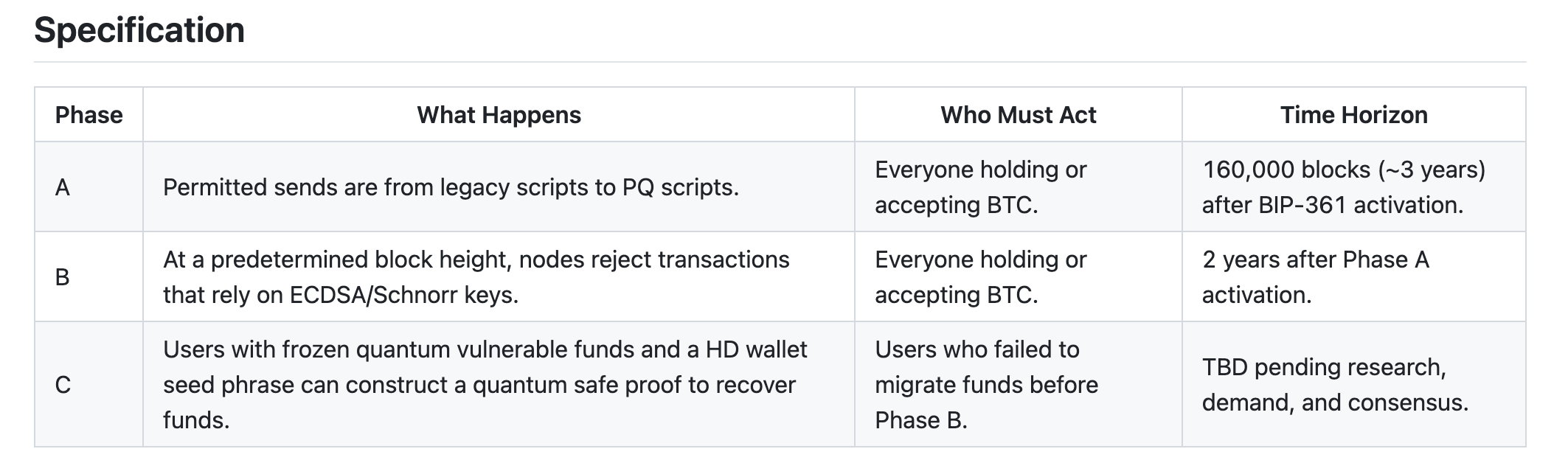
The proposal cleverly divides the transition into three acts. Phase A, which shall be triggered 160,000 blocks (or roughly three years, give or take a few dramatic pauses) after activation, would block all daring sends to those quantum-vulnerable addresses. Thus, users will be pushed to embrace post-quantum-safe address types during this well-defined migration window.
Phase B, arriving approximately two years after the grand curtain of Phase A rises, would see nodes rejecting all transactions relying on ECDSA and Schnorr signatures, rendering the funds trapped in those addresses as useful as yesterday’s newspaper.
A potential Phase C, still pending further research and community consensus-as unpredictable as a cat in a room full of rocking chairs-might allow users to recover their frozen funds through a whimsical zero-knowledge proof tied to their BIP-39 seed phrase. But alas, no timeline is fixed for this phase of dreams.
The authors frame their approach as a private incentive for holders to act, as if they were offering a sweetened morsel to a reluctant child.
“Fail to upgrade and you will encounter additional friction to access your funds, creating a certainty where none previously existed,” they quipped with a touch of sarcasm.
Finally, the authors present their proposal as a noble defense against potential quantum-enabled threats, invoking the ever-wise words of Satoshi Nakamoto, who once mused that lost coins effectively increase the value of remaining holdings, likening it to “a donation to everyone.” Extending that delightful logic, the authors contend that coins recovered through quantum means would yield quite the opposite effect. How droll!
Read More
- All Skyblazer Armor Locations in Crimson Desert
- One Piece Chapter 1180 Release Date And Where To Read
- New Avatar: The Last Airbender Movie Leaked Online
- All Shadow Armor Locations in Crimson Desert
- How to Get the Sunset Reed Armor Set and Hollow Visage Sword in Crimson Desert
- Cassius Morten Armor Set Locations in Crimson Desert
- Red Dead Redemption 3 Lead Protagonists Who Would Fulfill Every Gamer’s Wish List
- Grime 2 Map Unlock Guide: Find Seals & Fast Travel
- Euphoria Season 3 Release Date, Episode 1 Time, & Weekly Schedule
- USD RUB PREDICTION
2026-04-15 12:56