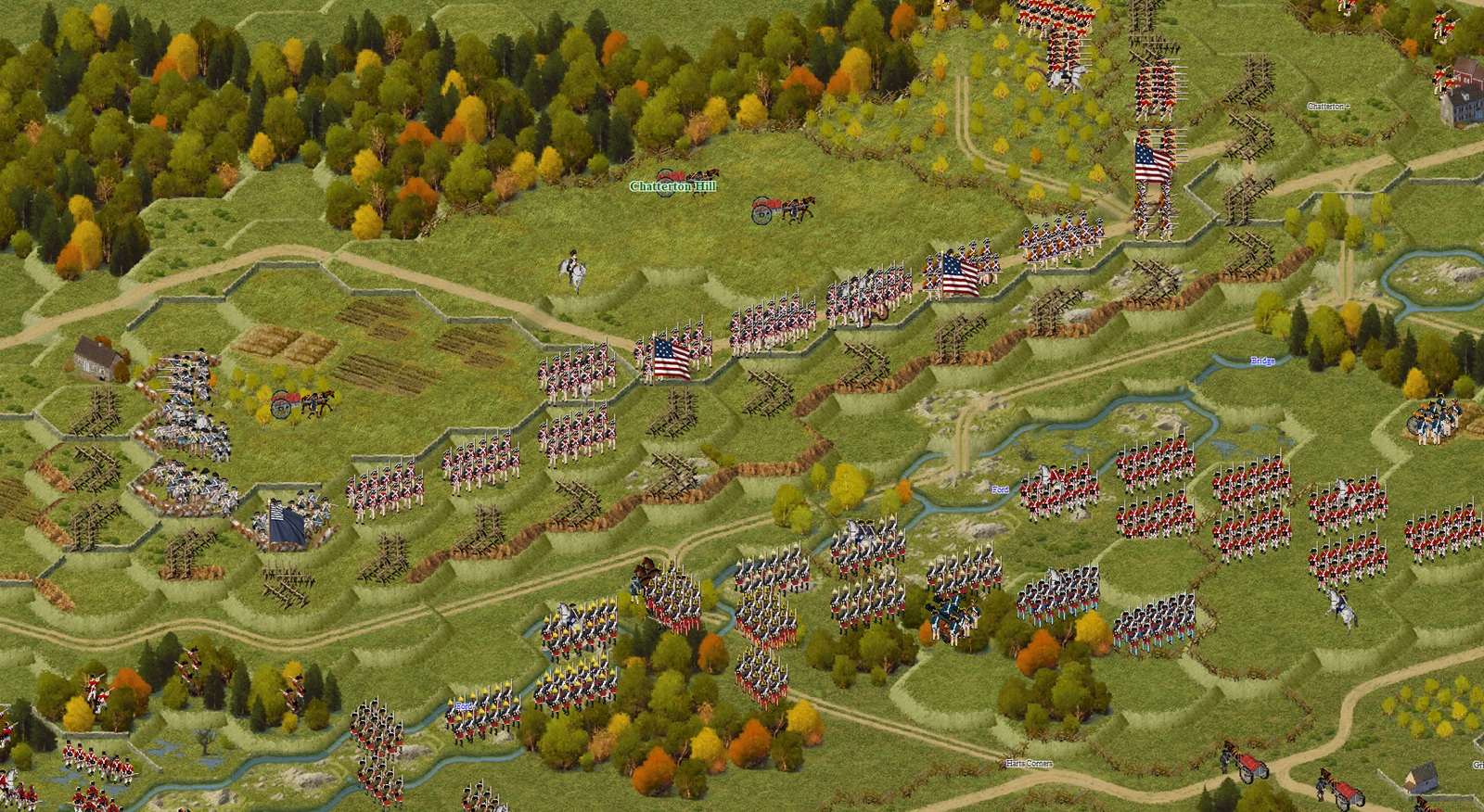
For the past six months, I’ve been immersed in the American Revolution, researching it through books and gameplay. I’ve been playing the older Campaign 1776 game and thoroughly testing this new one. As you might have seen in my interview with the designer, I’ve studied works like Matthew Spring’s With Zeal and with Bayonets Only and Robert Middlekauff’s The Glorious Cause. I really wanted to understand the details of 18th-century warfare – things like the standard Brown Bess musket, how British Grenadiers functioned as a kind of early armored force (similar to Space Marines in Warhammer), and the role of light infantry as a forerunner to modern mobile infantry tactics.
Talking with the game designer helped me understand why he made certain choices about how the game works and how players win, giving me a detailed look at its inner workings. I learned he thoroughly researched the game’s locations, even visiting South Carolina and Manhattan to study the real-world terrain. He clearly left no detail unexplored in his pursuit of accuracy. But it’s also important to consider whether the game is easy to learn and enjoyable. Ultimately, people play wargames for both realism and fun.
Gameplay
The game is designed to be immediately accessible, staying true to the familiar John Tiller style. It streamlines the experience by reducing the amount of clicking needed – you can now simply right-click on a location instead of manually moving units across the screen.
How does this differ from Campaign 1776? The key lies in the formations used, which were typical of 18th-century warfare. Players can utilize different formations – open order for moving through woods, column march for quick travel, and extended lines for larger units – compared to the tighter formations in the previous campaign. The game also realistically reflects how unit mobility varied depending on the type of unit and the year/location of the conflict; for example, units fighting in the South during the 1780s would generally be more mobile than those fighting in Manhattan in 1776.

This game addresses a problem from earlier versions where a few units could quickly defeat everyone else in a single turn – a tactic we’ve nicknamed “blitzkrieg.” We’ve redesigned combat to include closer-range engagements, which prevents this from happening. This change also simplifies the game’s structure, making it better suited for online, turn-based play. And, unlike Campaign 1776, this game allows you to command forces at different levels, from companies to battalions, making it a significantly expanded experience.
Scenarios and Campaigns
I counted roughly 147 scenarios and 4 campaigns, though the exact number might be a little off. It’s still a huge amount of content, and I doubt I’ll be able to finish it all within the next ten years—it’s an incredible value! The designer said if the game does well, they plan to create more content soon. You won’t find another game out there with this many Revolutionary War scenarios and such careful attention to historical accuracy.

The game features several historical campaigns, including the Philadelphia and Saratoga campaigns, as well as the Battle of Brandywine Creek. You can play as either side in each campaign. You can choose to control every single unit yourself, or use a helpful AI system called ‘Commander Control’ that manages some units for you, letting you focus on overall strategy – like a general giving orders. Certain scenarios also let you make big-picture decisions, like choosing between a strong, focused defense or a wider, more spread-out one.
AI In The Game
Historically, John Tiller/HPS games weren’t known for having strong artificial intelligence. However, WDS has been actively working to improve AI in their games. Does this new title reflect that effort? I’ve spoken with the company’s leadership and the game designer about this very issue.
The Battle of Cowpens is a great illustration of how well-designed this game is. The designer, Mike, actually visited the battlefield, and he captured the intensity of this small but fierce fight. I started a game as the British around 6:00 AM, shrouded in mist. Visibility was extremely limited. I used my cavalry to scout ahead, and when I neared the objective, I found Revolutionary skirmishers in my path. Surprisingly, they didn’t just stand and fight; they skillfully retreated, drawing me in. As the fog cleared and dawn broke, the Revolutionaries unleashed a devastating attack, putting me in a similar situation to the historical commander, LTC Tarleton.

The Battle of Cowpens provides a good opportunity to evaluate both artificial intelligence and how well a game represents history. The original 1776 game depicted Tarleton’s soldiers as strong and well-rested. However, the updated version by Mike portrays them as tired and easily defeated by Daniel Morgan’s determined, though somewhat disorganized, troops. These changes demonstrate Mike’s commitment to historical accuracy, even if it means sacrificing perfect game balance.
Like in a real battle, you can sometimes overwhelm the AI. During a simulation of Long Island, I tried slowing down the British advance by positioning militia units as obstacles in front of their elite Grenadier troops and Henry Clinton’s best soldiers. I managed to harass and disrupt them for a while, but they still inflicted heavy losses on my forces. They skillfully used flanking attacks and captured my artillery, quickly overrunning Bedford and Flatbush passes by turn 12. After 15 turns, only one of my units – the 11th Continental, despite being low quality – was still performing effectively. While I could occasionally inflict some damage, their Grenadiers consistently broke through my lines. So, although my tactics were sound, I ultimately lost the battle strategically.
The ‘Savage’s Old Fields – First Siege of Ninety Six’ scenario really highlights how powerful the AI can be. When I played as the Revolutionary forces led by Major Andrew Williamson, the AI completely outsmarted and overpowered me. I eventually conceded defeat about halfway through. While some players might not enjoy such a difficult challenge, others will find it incredibly appealing.
I tested the AI with James L. Nelson’s With Fire and Sword after playing Bunker Hill. The original Campaign 1776 focused only on the Charlestown Peninsula, but American Revolution expands the map to show the outskirts of Boston and the British preparing for an attack. This new version also includes a lot more British support ships, which weren’t in the original. I did miss the supply carts from the first game, which created a sense of urgency, but this version makes you manage your ammunition, especially for cannons, much more carefully.
Howe barely managed to win, and the AI played smartly. It took advantage of a mistake I made – leaving my rear undefended – to capture an important point. I then attempted to retake it with 800 untrained militiamen against just 100 light infantry. While we killed eight of the enemy and lost two men, my militia completely fell apart afterward, which felt realistic for such troops. Ultimately, I held Bunker Hill, causing 600 enemy casualties while suffering 200 losses. It was a tough fight; the Grenadiers were relentless and wouldn’t retreat until they were all eliminated.
Graphics and Sound
This game stands out from similar titles like HexWar’s Saratoga and Hold the Line: The American Revolution/Rebels and Redcoats, as well as the demo of The Glorious Cause and the newer Musket and Pike games. It offers a unique experience that none of those others quite match.
The game’s visual style perfectly captures the look and feel of the 18th century. The character portraits, featuring figures like Daniel Morgan and Burgoyne, are like miniature works of art. Honestly, a lot of the appeal of 18th and 19th-century warfare comes down to the elegance of the uniforms and the music of the time. The sight of armies lined up for battle is almost like watching a historical fashion show, showcasing their discipline, style, and grandeur – qualities they believed set them apart from their enemies.

Honestly, if you think the Founding Fathers weren’t stylish and enjoyed life, you should really check out how Douglas Southall Freeman talks about young George Washington and his love of dancing. And it’s amazing to learn that even generals like Burgoyne put on plays – I was surprised to find out about his show, The Maid of the Oaks! It really shows they were more than just soldiers.

The game accurately depicts the American revolutionaries, much like earlier rebellions, as a force of ordinary people with a strong folk culture. Popular songs like “God Save Our Thirteen States” and “Revolutionary Tea” energize the rebel troops as they clash with the more formal British army. The game’s artwork portrays these American militiamen as rugged frontiersmen – a look often associated with figures like Daniel Boone – which is particularly fitting for the Southern Campaigns.
The 3D visuals are excellent, as always, but it’s the 2D graphics that really stood out to me. The map is stunning, with vibrant colors on every tile. I’m not dismissing the 3D work—it’s the best WDS has ever done, showcasing detailed 18th-century buildings and a completely new, impressive tree design. However, knowing I usually favor 3D in WDS games, my strong preference for the 2D view highlights just how beautifully the art has been created.

The game’s music perfectly captures the historical setting, and there’s a lot of it to get you energized for combat. You can even turn off the music and just use sound effects if you prefer. The sound design is fantastic – from booming cannons to the rush of charging soldiers. While the graphics might not be cutting-edge, the incredible sound more than makes up for it.
However, Some Minor Criticisms Still Exist
I’d love to see more impressive artwork when you win or lose a game. After all the effort put into designing the units and overall graphics, the current ending only shows flags and text. The campaign ‘1776’ had fantastic paintings that really captured the moment. It feels like a big difference – like comparing the cover art of an old 1960s book to the detailed digital art you see on modern fantasy novels.
This game has raised the bar so high that other strategy games feel simplistic. After experiencing its beautiful 2D graphics, it’s difficult to go back to older titles like those focused on the Seven Years War or Napoleonic era, which now seem basic in comparison. I’ve become accustomed to a much higher visual standard.
Okay, so I noticed something while playing – Alexander Hamilton doesn’t have a character portrait! It’s kinda weird, honestly, because he’s become super famous recently with that book and the musical. You’d think he’d be one of the first to get one!
It’s a minor issue, considering you get to see historical figures like Henry Knox, Daniel Morgan, and the impressive team of Von Steuben and Lafayette. You can even take command of Benedict Arnold during the Battle of Saratoga. On the British side, you’ll find colorful characters like Burgoyne and Cornwallis, who famously clashed with Mel Gibson’s character in ‘The Patriot’.
Final Score 10/10
WDS American Revolution isn’t just a game about the historical event—it’s a leap forward in wargaming. It stands out with its commitment to historical detail, impressive sound design, and stunning visuals, making it an ideal gift to commemorate the birth of the United States.
Read More
- Quantum Agents: Scaling Reinforcement Learning with Distributed Quantum Computing
- Boruto: Two Blue Vortex Chapter 33 Preview — The Final Battle Vs Mamushi Begins
- All Skyblazer Armor Locations in Crimson Desert
- Every Melee and Ranged Weapon in Windrose
- How to Get the Sunset Reed Armor Set and Hollow Visage Sword in Crimson Desert
- One Piece Chapter 1180 Release Date And Where To Read
- New Avatar: The Last Airbender Movie Leaked Online
- USD RUB PREDICTION
- Zhuang Fangyi Build In Arknights Endfield
- All Shadow Armor Locations in Crimson Desert
2026-04-20 16:47