Well-known market analyst Alex Krüger disagrees with the idea that current market reactions to events in Iran are similar to what happened when Russia invaded Ukraine last year. He specifically points out that crypto and Bitcoin are not following the same patterns they did during the 2022 conflict.
I’ve been seeing a lot of talk about how current market conditions are mirroring 2022, and analyst Krüger pointed out the similarities in a recent post. He agrees the charts look eerily similar and the energy price spike is definitely happening again. However, he thinks comparing it directly to 2022 doesn’t quite hold up. He argues that monetary policy is different now, and this time, the oil issues seem temporary, not a long-term problem. Basically, while things *look* similar on the surface, the underlying economic factors are different, and that could mean a different outcome for Bitcoin.
What Is Crucial For Bitcoin Now
Krüger points out that throughout history, times of war and conflict have often presented chances to buy assets, even when investors initially become cautious. He argues that 2022 wasn’t a difficult year for investments because of the invasion itself, but due to the consequences that followed.
Bitcoin and other investments that carry risk reached their lowest point on February 24th, 2022, the day Russia invaded Ukraine. They briefly recovered, but then began to fall again by late March as markets resumed their downward trend. While the war acted as a trigger for this shift, the real driving force was the Federal Reserve being compelled to rapidly raise interest rates due to already high inflation, a situation made worse by a surge in oil prices.
Krüger argues the economic situation is different now than it was in 2022. Back then, the Federal Reserve was slow to react to rising inflation, which was at 7.9% with real interest rates around -7.5% when the war began. Currently, he believes the Fed is taking a cautious approach, as inflation is decreasing and real interest rates are around +1.2%.
He explains the difference in policy approaches directly: even if oil prices cause a short-term rise in inflation, the Federal Reserve can afford to ignore it. With real interest rates at 1.2%, they don’t need to raise rates in response to a supply shock like rising oil prices. In 2022, they were forced to act because rates were so low (-7.5%) and they were falling far behind. This difference in circumstances is what’s most important for investments.
Krüger highlights recent statements from the Federal Reserve as supporting this view. John Williams acknowledged that oil prices could temporarily increase inflation, but emphasized that sustained price changes are what would really drive the Fed’s decisions – essentially, they won’t react to short-term fluctuations. Krüger also points out that the US economy isn’t as reliant on oil as it used to be.
Treasury Secretary Scott Bessent pointed out that the US economy is now in a stronger position compared to when Russia first invaded Ukraine. Since the recent attacks began, four Federal Reserve officials have publicly commented without altering their economic forecasts. John Williams characterized the market’s response as calm, Neel Kashkari stated it’s too early to draw conclusions but still anticipates one or two interest rate cuts this year if inflation decreases, and even a traditionally hawkish official, Beth Hammack, described the current policy as neutral, advocating for a continued pause in rate changes.
Krüger’s second main point is that the predicted oil supply issue in 2026 will likely be short-lived, unlike the major, lasting disruption seen in 2022. Back then, Europe suddenly lost access to around 4.5 million barrels of Russian oil and fuel per day, and sanctions ensured this loss was permanent. This caused oil prices to spike to almost $130 a barrel on March 8th, and they didn’t fall back below $90 consistently until late August.
He contends that Iran’s own oil production isn’t the main factor here. Before the recent attacks, Iran was producing around 3.3 million barrels per day and exporting about 1.9 million, primarily to China using unofficial routes and selling at a discount of $11–$12 per barrel compared to Brent crude. Because most of its oil tankers were already subject to sanctions, he believes further sanctions after any conflict wouldn’t have much impact.
Right now, everyone’s attention is on the Strait of Hormuz, a vital shipping lane for oil. Around 14 million barrels of oil pass through it each day – that’s about 20% of the world’s oil supply – and traffic has slowed down to almost nothing.
According to Krüger, the futures market is providing the clearest signal. In 2022, prices for near-term contracts increased around 50%, while those for contracts further out rose about 29%, suggesting a significant and lengthy recovery process. Looking ahead to 2026, he projects a roughly 32% increase for near-term contracts, but only a 12% increase for those further out – even though the disruption is expected to impact a much larger volume of oil. This indicates traders believe the current supply issues are temporary, rather than a fundamental shift in how oil is produced and delivered.
Tail Risk Is The Curve’s “Tell”
Krüger explains that temporary disruptions could become a major, lasting crisis if attacks repeatedly knock out oil refining or LNG facilities for extended periods. He points to recent attacks on facilities in Ras Tanura, Fujairah, and Qatar – primarily using debris from intercepted drones – and believes these signal a growing trend of targeting energy infrastructure, with a large reserve of drones potentially available for further attacks.
He explained that if attacks directly hit oil refineries like SAMREF, Jebel Ali, and Jubail, the lost production wouldn’t be recovered even with a ceasefire, as repairs take months. He warned the problem is expanding beyond crude oil, potentially leading to shortages of refined products and gas. Additionally, QatarEnergy has halted LNG production at Ras Laffan and Mesaieed, reducing global LNG export capacity by about 20%.
When it comes to Bitcoin, it’s less about trying to predict price movements from charts and more about seeing if the factors that could cause a significant downturn still seem likely. According to Krüger, a key sign of a deeper, more lasting problem would be a significant shift in the market’s expectations – for example, if the later contracts start to show a much larger price increase. So far, though, the market hasn’t reacted that way, suggesting this situation is likely a temporary reaction to world events, rather than a full-blown financial crisis.
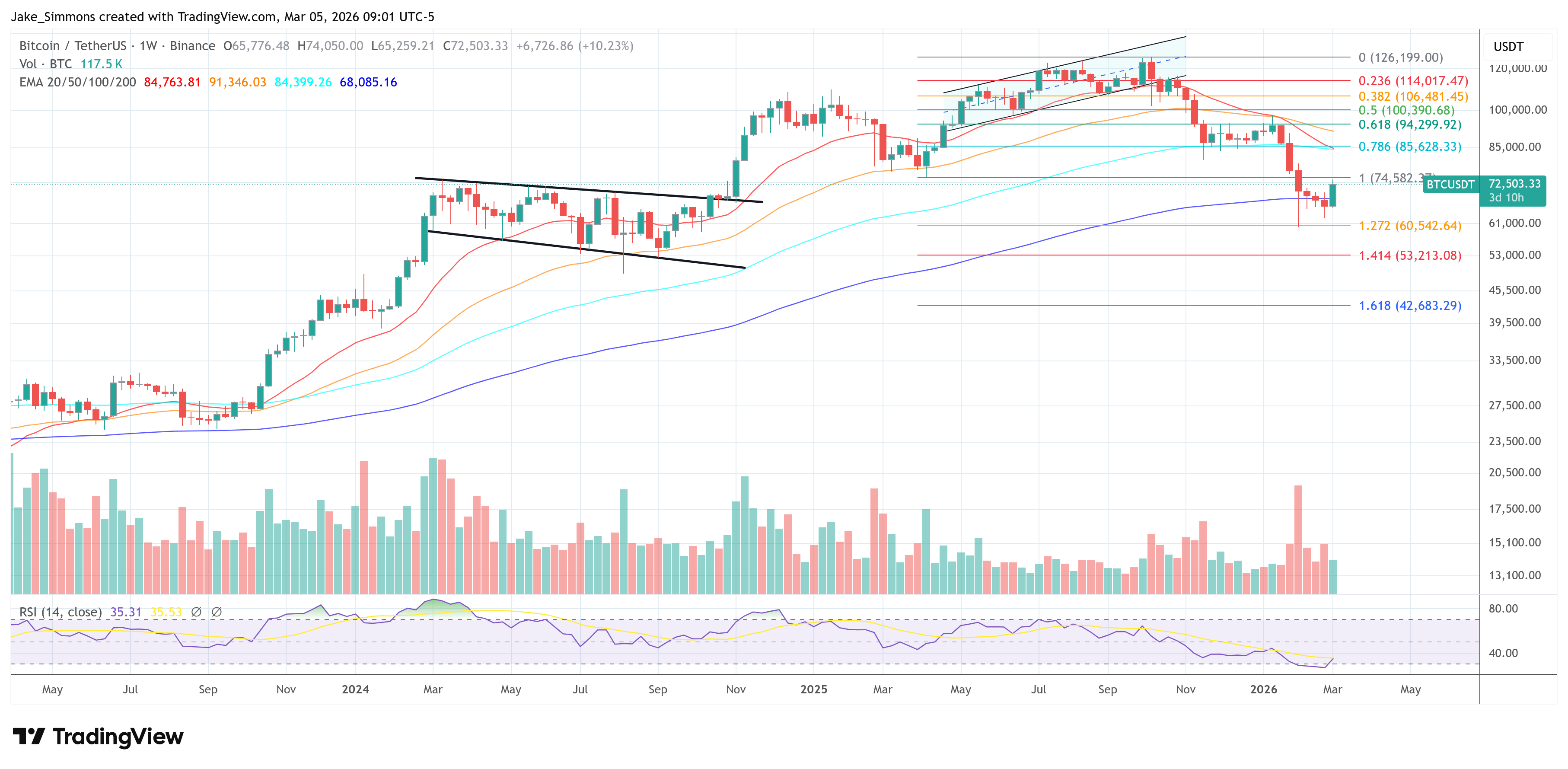
At press time, Bitcoin traded at $
Read More
- All Shadow Armor Locations in Crimson Desert
- Dark Marksman Armor Locations in Crimson Desert
- How to Beat Antumbra’s Sword (Sanctum of Absolution) in Crimson Desert
- Sega Reveals Official Sonic Timeline: From Prehistoric to Modern Era
- Genshin Impact Dev Teases New Open-World MMO With Realistic Graphics
- Where to Pack and Sell Trade Goods in Crimson Desert
- Keeping AI Agents on Track: A New Approach to Reliable Action
- Top 5 Militaristic Civs in Civilization 7
- The Limits of Thought: Can We Compress Reasoning in AI?
- Enshrouded: Giant Critter Scales Location
2026-03-06 05:12