Securing the Skies: Modeling Reliable Connections in Complex Networks
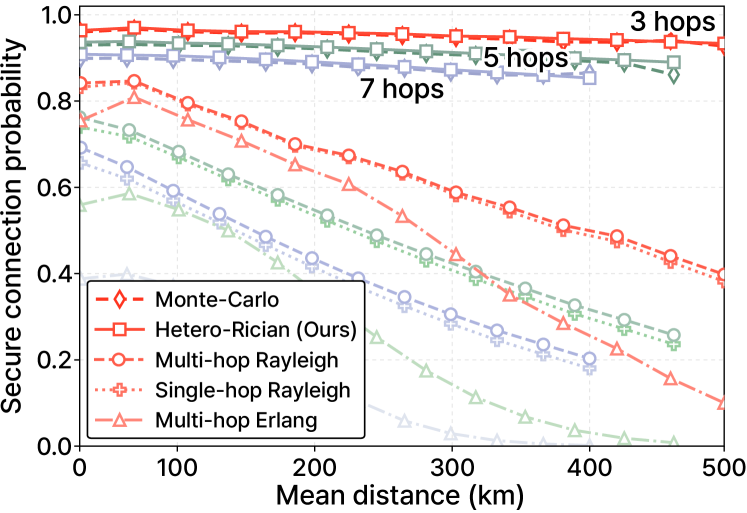
This review analytically determines the probability of establishing a secure connection across multi-hop, layered networks commonly found in emerging non-terrestrial communication systems.

![The study models electron and hole transfer within open-shell molecular systems by employing distinct minimal complete active space (CASSCF) configurations: [latex]CASSCF(1,2)[/latex] for electron transfer, focusing on unpaired electron excitation, and [latex]CASSCF(3,2)[/latex] for hole transfer, representing excitation from a doubly occupied orbital, thereby establishing a framework for understanding charge carrier dynamics based on fundamental quantum mechanical principles.](https://arxiv.org/html/2602.07746v1/x2.png)
![The effective number of configurations, [latex] eSe^{S} [/latex], shifts with coupling strength, diverging within specific intervals and demonstrating a sensitivity to perturbative order-a phenomenon suggesting the model's predictive power is not uniform across all parameter regimes.](https://arxiv.org/html/2602.08265v1/x4.png)