Building Better Quantum Error Correction with Classical Codes
Researchers are harnessing the power of established classical BCH codes to construct optimized, locally recoverable quantum codes for more resilient quantum computing.
Researchers are harnessing the power of established classical BCH codes to construct optimized, locally recoverable quantum codes for more resilient quantum computing.
This review introduces a novel approach to stochastic linear quadratic control, offering a robust method for optimizing systems under uncertainty.
![The study delineates constraints on parameters [latex]\alpha_{1}[/latex] and [latex]\alpha_{3}[/latex], establishing that a stable condition requires [latex] \frac{7}{2}\alpha_{1} + \frac{4}{5}\alpha_{3} \geq 0[/latex], while a further limitation dictates that [latex] 4\alpha_{1} - |\alpha_{3}| \geq 0[/latex].](https://arxiv.org/html/2601.20962v1/x2.png)
New research reveals how the subtle deformability of highly charged black holes connects to fundamental limits on gravity and the behavior of quantum fields.

Researchers are exploring whether Generalized Proca Theories, analyzed using advanced functional methods, offer a consistent framework for describing gravity at extremely high energies.
A new indexing method offers a promising alternative to traditional pointer-based approaches for rapidly accessing data stored in DNA.

New research reveals that AI-powered code evaluation systems can be easily fooled into accepting incorrect solutions simply by cleverly phrasing the instructions.

A new analysis reveals that the Low-Rank Adaptation (LoRA) technique, combined with strategic noise addition, can offer stronger privacy guarantees than previously understood.
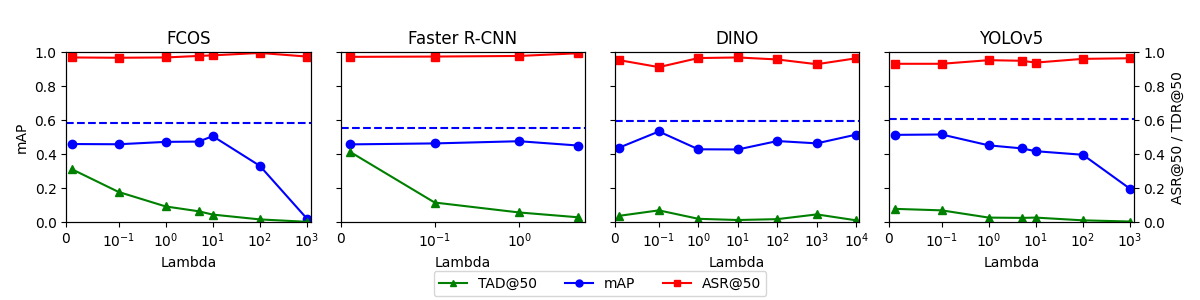
Researchers have developed a more potent and resilient method for injecting malicious triggers into object detection models, raising concerns about real-world security.
![SCuBA’s architecture integrates distinct components, enabling a system where decomposition and reconstruction occur not as endpoints of failure, but as inherent properties of its continued operation-a testament to designed impermanence rather than systemic collapse, much like the natural entropy of all complex structures [latex] \Delta S = \in t \frac{\delta Q}{T} [/latex].](https://arxiv.org/html/2601.21552v1/x1.png)
A new static analysis tool promises to bring elusive bugs in CUDA programs to light without sacrificing performance.

As large language models become integrated into complex workflows, the systems that direct those models are increasingly vulnerable to attack.