Defying Disorder: How Some Superconductors Stay Strong

New research reveals that unconventional superconductivity can be remarkably resilient to imperfections in materials, challenging conventional expectations of pair-breaking effects.
New research reveals that unconventional superconductivity can be remarkably resilient to imperfections in materials, challenging conventional expectations of pair-breaking effects.
A new approach to authenticated encryption prioritizes simplicity and efficiency for critical communications from resource-constrained satellites.
Researchers have developed novel error-correcting codes to improve the accuracy of nanopore sequencing by specifically addressing the common problem of deletions in DNA reads.
A new mathematical framework clarifies which operations can be reliably performed on CSS quantum codes, paving the way for more robust fault-tolerant computation.
![The study demonstrates QUARK’s sensitivity to the parameter α during lyric-retrieval simulations, quantifying changes relative to a baseline retriever established at [latex]\alpha = 1.0[/latex].](https://arxiv.org/html/2601.21049v1/x1.png)
A new framework tackles the challenge of information retrieval when search terms are vague, incomplete, or don’t quite capture what users intend.
![The Ethereum client’s request-response cycle operates as a layered system, where remote procedure calls [latex] RPC [/latex] facilitate communication between application logic and the blockchain, acknowledging that even decentralized systems are subject to the constraints of sequential processing and the inherent latency of network interactions.](https://arxiv.org/html/2601.21593v1/x1.png)
A new approach to fuzzing Ethereum clients uncovers hidden inconsistencies in RPC responses by intelligently simulating realistic blockchain conditions.
![The study demonstrates the relationship between block length and the decoding rate [latex]\frac{|\mathcal{A}|}{N}[/latex] for polar codes, illustrating how performance scales with increasing code size.](https://arxiv.org/html/2601.21330v1/x8.png)
A new analysis technique leveraging the structure of quantum channels promises more efficient decoding algorithms for critical error-correcting codes.
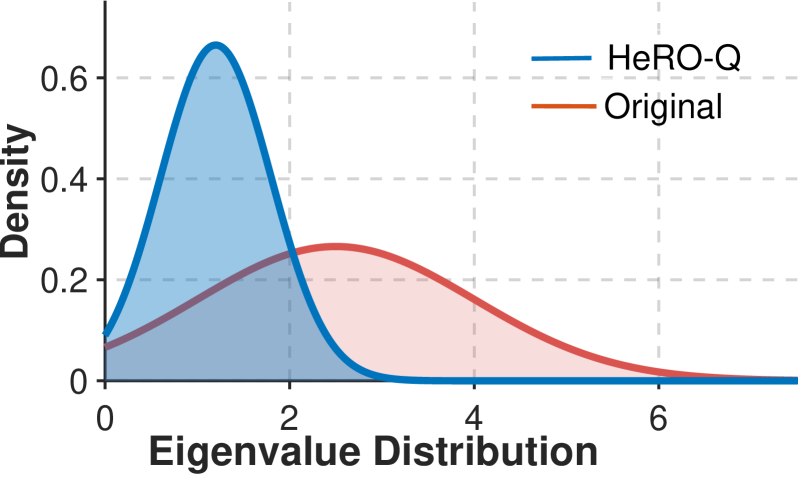
Researchers have developed a novel quantization framework that reshapes the underlying mathematical landscape of AI models to enable significantly more efficient low-bit inference.
A new study explores the delicate balance between wave behavior and stability in the face of strong nonlinear effects.
![The study investigates two cubic models-a homogeneous form, [latex]g_{3}(s)+\sigma\|s\|^{4}[/latex], and a non-homogeneous counterpart, [latex]g^{T}s+g_{3}(s)+\sigma\|s\|^{4}[/latex]-both characterized by randomly generated coefficients within the range of [0, -100], demonstrating that even with zero gradient terms, cubic terms significantly influence the resulting function’s behavior.](https://arxiv.org/html/2601.20418v1/change_from_sos.png)
Researchers have discovered conditions under which nonnegative quartic polynomials can be reliably expressed as a Sum-of-Squares, opening doors to more efficient optimization and verification techniques.