In a spectacle of bureaucratic supplication, the grandees of Cardano, Avalanche, Sui, and IOTA have collectively prostrated themselves before the altar of the UK Financial Conduct Authority, beseeching mercy in the form of a joint response to the CP25/40 consultation. Their plea? That the rulebook, like a well-bred butler, should know its place and not meddle with the sacred rites of “custody and control,” lest it trample upon the delicate flora of non-custodial crypto activity.
This missive, spearheaded by the IOTA Foundation-with the Sui Foundation, Cardano Foundation, and Avalanche Policy Coalition in tow-is a finely crafted arrow aimed at the heart of two matters deemed most susceptible to the vagaries of “scope, proportionality, and technical interpretation”: staking and decentralized finance. Heaven forbid the regulators should blunder into these arcana without a proper chaperone.
In a post on X (formerly known as Twitter, for those still clinging to the past), IOTA distilled its essence with the brevity of a Victorian telegram: “focus on custody & control, keep it proportionate, and support non-custodial, decentralized innovation for UK.” One can almost hear the clatter of a typewriter in the background.
The Crypto Quartet Warns: “Overregulation? Good God, No!”
The open letter, a masterpiece of legal equivocation, expands upon this theme with the gravitas of a bishop addressing his flock: “A consistent theme across our feedback on both staking and decentralized finance is the importance of clearly distinguishing between infrastructure functions and intermediary functions.” In plainer terms, they implore the FCA to recognize that not every crypto endeavor is a den of iniquity requiring the full force of regulatory wrath.
Developers and infrastructure providers, they argue, should be left to their noble pursuits without the burden of regulation. “[They] deliver software development, validation, communications, or other protocol-level services without controlling client assets or exercising unilateral decision-making,” the letter intones, “and warrant a proportionate and differentiated regulatory treatment.” One can almost see the authors adjusting their monocles as they pen these words.
The distinction, they insist, is as crucial as a properly tied cravat. Staking and DeFi, far from being monolithic, exist on a spectrum ranging from the fully custodial (where firms safeguard assets with the zeal of a dragon guarding its hoard) to the protocol-native (where users retain control of keys and assets, like free spirits unbound by the chains of intermediation).
IOTA’s X thread, with the clarity of a well-crafted aphorism, boiled the policy ask down to a binary: “regulation must clearly distinguish custodial vs non-custodial models.” Custodial staking, they concede, warrants “appropriate retail disclosures, consent + record-keeping,” while non-custodial staking should be left to its own devices, unencumbered by the heavy hand of the state.
The letter mirrors this sentiment, drawing a line in the sand with the precision of a garden party host arranging croquet wickets: “For non-custodial and delegated staking arrangements, where firms do not control client assets or private keys, we recommend that such activities remain outside the scope of regulated staking activity.” One can almost hear the collective sigh of relief from the crypto cognoscenti.
The second bone of contention is the FCA’s notion of a “clear controlling person” in DeFi. IOTA, with the indignation of a vicar confronted with a church bazaar gone awry, demands a “technical, objective definition,” warning that obligations should scale with “custody, discretion, and unilateral control; not with writing code, participating in governance, or providing neutral infrastructure.”
The open letter maintains this tone, acknowledging the FCA’s intent to capture cases where an identifiable party is “effectively carrying on regulated cryptoasset activities,” but pushing back against the notion that mere development or infrastructure provision should trigger regulatory status. Instead, it urges the FCA to anchor its expectations to “demonstrable, unilateral control over protocol operation, governance or economic outcomes,” particularly in DeFi, where “self-custody, automated execution, and open participation” reign supreme.
IOTA, ever the optimist, frames the argument as pro-scope rather than anti-rules: “smarter scoping = better consumer protection where risk is real, plus legal certainty that keeps non-custodial innovation from being regulated out of existence.” One can almost imagine them tipping their hats to the FCA as they make this point.
The letter concludes with a flourish, asserting that obligations tied to “custody, discretion, and unilateral control” would “strengthen legal certainty, enhance consumer protection where it is most needed, and reinforce the UK’s position as a jurisdiction that understands the architectural realities of decentralized technologies.” One can almost hear the faint sound of a string quartet playing in the background.
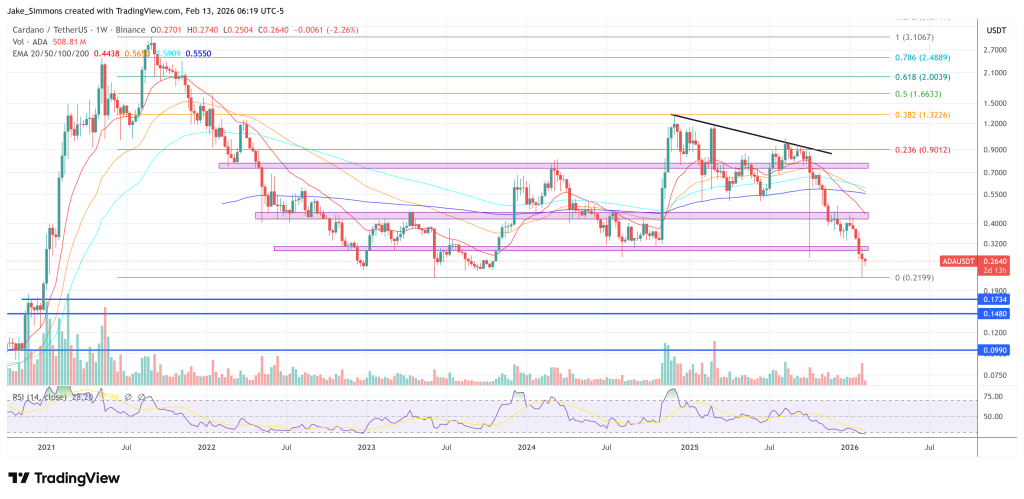
At press time, Cardano traded at $0.264, a figure as unremarkable as a Tuesday afternoon tea.
Read More
- All Shadow Armor Locations in Crimson Desert
- Jujutsu Kaisen Season 3 Episode 12 Release Date
- Dark Marksman Armor Locations in Crimson Desert
- How to Beat Antumbra’s Sword (Sanctum of Absolution) in Crimson Desert
- Genshin Impact Dev Teases New Open-World MMO With Realistic Graphics
- Top 5 Militaristic Civs in Civilization 7
- Sega Reveals Official Sonic Timeline: From Prehistoric to Modern Era
- Sakuga: The Hidden Art Driving Anime’s Stunning Visual Revolution!
- Keeping AI Agents on Track: A New Approach to Reliable Action
- How to Get the Sunset Reed Armor Set and Hollow Visage Sword in Crimson Desert
2026-02-13 18:41