The machinery of the state, that most reliable of engines, is now grinding inexorably towards the quaint little world of cryptocurrency. A flurry of activity, orchestrated with the usual bureaucratic efficiency – or lack thereof – is underway, as 48 jurisdictions prepare to participate in the Crypto-Asset Reporting Framework (CARF). It’s all frightfully modern, really.
According to the diligent, if somewhat dull, observers at the Organization for Economic Co-operation and Development (OECD), these 48 nations have committed to the rather intrusive act of collecting standardised crypto transaction data from January 1, 2026. The actual exchange of this information, presumably to be filed under ‘Miscellaneous and Slightly Suspicious,’ is anticipated in 2027. 🙄
Countries Begin Collecting Data
Service providers – the exchanges, broker platforms, those rather furtive crypto ATMs, and the custodians of digital wealth – will be obliged to record details. Account details, transaction histories, and, most importantly, the tax residency of their clients. All to be dutifully reported to the domestic tax authorities. One imagines a mountain of forms, and a distinct lack of joie de vivre among all concerned.
This information, naturally, will be formatted for automatic sharing with partner tax offices. The OECD, in its admirably exhaustive manner, has even outlined the specific fields that must be gathered and stored. A truly thrilling prospect.
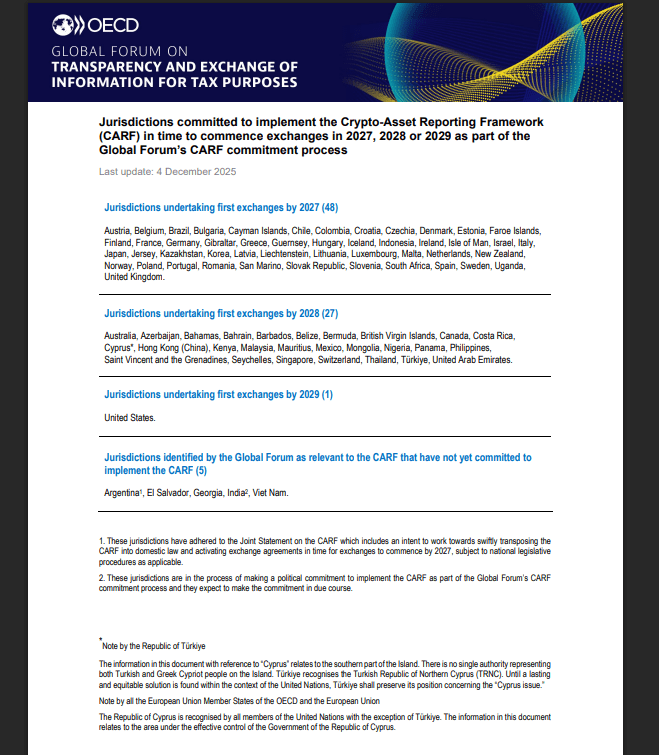
What Exchanges Must Report
The exchanges, ever adaptable, are already adjusting their onboarding processes and internal compliance systems. Verifying tax residency, apparently, is the new black. Capturing wallet-level activity is also de rigueur. The United Kingdom, in its characteristic eagerness, is leading the charge, demanding detailed purchase and sale records. Tax authorities will, of course, receive yearly reports detailing balances, transfers, and gains. One shudders to think of the spreadsheets.
Operational Strain And Privacy Questions
The new rules present, shall we say, practical challenges. Smaller platforms will be forced to upgrade their systems or employ individuals whose sole purpose is to track this data. A triumph for employment statistics, at least. 🤷♀️
Privacy advocates, and certain members of the crypto fraternity, are murmuring concerns about the sheer depth of data collection. How long will these sensitive records be held? And who, precisely, will have access to them? Legal teams are already engaged in the painstaking process of determining how domestic data-privacy laws – those charming attempts at protecting individual liberty – interact with this automatic exchange of information.

Middle Nations Join The Second Wave
A further 27 jurisdictions have promised to begin domestic collection ‘later’, targeting January 1, 2027, with information exchanges following in 2028. Some countries, it seems, are proceeding with a distinctly leisurely pace, citing local legislative calendars as the reason. The efficiency is truly breathtaking.
How This Will Play Out For Users
For the ordinary crypto user – the individual who simply wished to partake in a bit of digital speculation – the immediate consequence will be more questions during account setup and a general demand for clearer record-keeping. Not exactly a revolution, is it?
CARF, we are assured, does not create new taxes. It merely provides tax offices with the data they require to enforce existing rules. For some, this translates to past reporting gaps becoming rather glaringly obvious. A word to the wise, perhaps.
Implementation will, naturally, vary by country. Some administrations are prepared, others remain in the preparatory stages. Observers remark that this rollout represents a significant step towards treating crypto transactions with the same seriousness as other, more established, financial accounts. A sad day for libertarians, one imagines.
Read More
- All Shadow Armor Locations in Crimson Desert
- Jujutsu Kaisen Season 3 Episode 12 Release Date
- Dark Marksman Armor Locations in Crimson Desert
- How to Beat Antumbra’s Sword (Sanctum of Absolution) in Crimson Desert
- Genshin Impact Dev Teases New Open-World MMO With Realistic Graphics
- Sega Reveals Official Sonic Timeline: From Prehistoric to Modern Era
- Top 5 Militaristic Civs in Civilization 7
- Keeping AI Agents on Track: A New Approach to Reliable Action
- How to Get the Sunset Reed Armor Set and Hollow Visage Sword in Crimson Desert
- Where to Pack and Sell Trade Goods in Crimson Desert
2026-01-02 13:26