Ah, the Ethereum Foundation, ever the optimist, has unveiled its latest masterpiece-a step-by-step plan to let Ethereum’s main chain validate blocks using zkEVM proofs. 🧙♂️✨ As if validators didn’t have enough on their plates, now they’re expected to trust a cryptographic proof instead of re-running every computation themselves. Progress, they say. Progress! The proposal, shared via X on Jan. 15 by Tomasz K. Stańczak, Co-Executive Director at the Ethereum Foundation, is a veritable feast of engineering work, spanning execution clients, consensus clients, and new proving infrastructure. 🛠️
zkEVM on L1 – the plan
– Tomasz K. Stańczak (@tkstanczak) January 15, 2026
In July of last year, the Foundation announced its “zk-first” approach, a phrase that sounds more like a dating profile than a technical strategy. 💘 Today, validators laboriously check blocks by re-executing transactions, a process as tedious as a Chekhov family dinner. The new plan? Let validators verify a cryptographic proof instead. Brilliant, if it works. 🤹♂️
The document outlines the pipeline with the clarity of a Russian novel: an execution client produces a “witness” package (a term that evokes more mystery than it deserves), a zkEVM program generates a proof of correct execution, and consensus clients verify it. Simple, no? 🧩
The first milestone is the “ExecutionWitness,” a data structure so essential it’s practically the protagonist of this saga. It contains all the information needed to validate execution without re-running it. The plan demands a formal witness format, conformance tests, and a standardized RPC endpoint. The current debug_executionWitness endpoint is already in use by Optimism’s Kona, though the Foundation hints at needing a more zk-friendly alternative. Because, of course, nothing is ever quite right. 🛑
A key dependency is Block Level Access Lists (BALs), which track which parts of state a block touches. As of November 2025, this was not deemed urgent enough to backport to earlier forks. Priorities, priorities. ⏳
Next comes the “zkEVM guest program,” a stateless validation logic that checks if a block produces a valid state transition. Reproducible builds and standardized targets are emphasized, because who doesn’t love explicit and verifiable assumptions? 📜
Beyond Ethereum-specific code, the plan aims to standardize the interface between zkVMs and the guest program. Common targets, common I/O access, and agreed assumptions about program execution-because chaos is the enemy of progress. Or is it? 🤔
On the consensus side, the roadmap calls for changes to accept zk proofs during beacon block validation. Specifications, test vectors, and an internal rollout plan are all part of the package. Execution payload availability is also crucial, with a potential solution involving “putting the block in blobs.” Because why not? 🧊
Proof generation is treated as both an operational and protocol challenge. Milestones include integrating zkVMs into EF tooling, testing GPU setups (including the whimsically named “zkboost”), and tracking reliability. Benchmarking is ongoing, with goals like measuring witness generation time and proof verification time. These measurements could inform future gas repricing proposals, because nothing says fun like adjusting fees. 💸
Security is perpetual, with plans for formal specs, monitoring, and supply-chain controls. A “go/no-go framework” will decide when proof systems are mature enough for broader use. Because nothing says trust like a bureaucratic decision-making process. 📉
One external dependency stands out: ePBS, which gives provers more time. Without it, provers have a mere 1-2 seconds; with it, a luxurious 6-9 seconds. The document notes, “This is not a project we are working on. However, it is an optimization we need.” Expected deployment? Mid-2026 in “Glamsterdam.” Because every tech project needs a glamorous deadline. 🌃
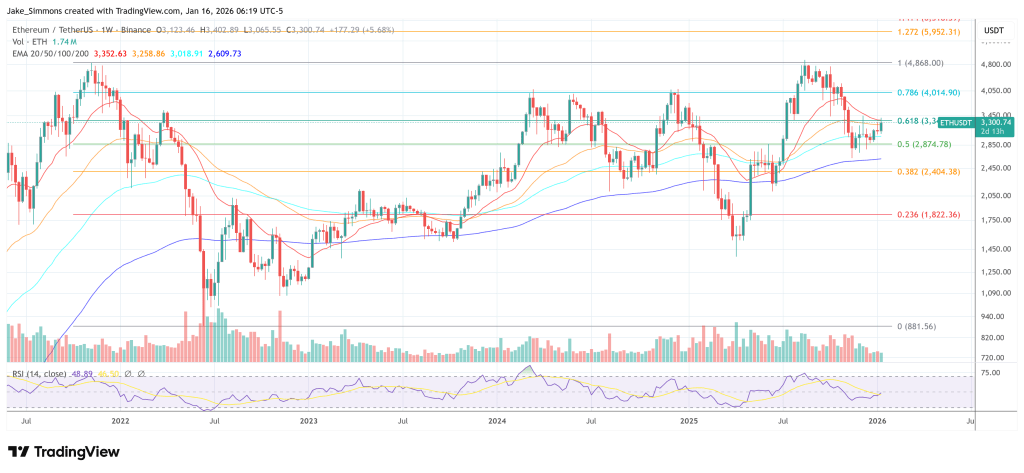
If these milestones are met, Ethereum will inch closer to proof-based validation on L1. Timing and operational complexity remain the gating factors, as they always do. At press time, ETH traded at $3,300, a number as stable as a Chekhov family gathering. 🤑
Read More
- All Skyblazer Armor Locations in Crimson Desert
- How to Get the Sunset Reed Armor Set and Hollow Visage Sword in Crimson Desert
- All Shadow Armor Locations in Crimson Desert
- One Piece Chapter 1180 Release Date And Where To Read
- Marni Laser Helm Location & Upgrade in Crimson Desert
- All Helfryn Armor Locations in Crimson Desert
- All Golden Greed Armor Locations in Crimson Desert
- All Icewing Armor Locations in Crimson Desert
- How to Beat Stonewalker Antiquum at the Gate of Truth in Crimson Desert
- Legendary White Lion Necklace Location in Crimson Desert
2026-01-16 23:35