Pray, allow me to impart upon you the latest musings from the International Monetary Fund (IMF), a body whose wisdom is as boundless as the pages of a particularly long-winded novel. They declare, with no small measure of gravitas, that crypto tokenization is not merely a trifling adjustment but a complete overhaul of the financial world’s underpinnings. How very daring of them!
The Newest Craze: Tokenization, or How to Turn Assets into Code
The IMF, in its infinite sagacity, has issued a report warning that shifting Wall Street’s venerable trading mechanisms onto blockchain systems may hasten financial crises beyond the poor regulators’ ability to respond. Imagine, if you will, a ball where the music quickens so abruptly that even the most skilled dancers stumble. Yet, the promise of reduced costs and swifter settlements has the financial elite quite besotted.
Tokenization, my dear reader, is the process by which assets and liabilities are transplanted onto programmable ledgers, where settlement, margin, and compliance are all neatly tucked into code. Mr. Tobias Adrian, a man of no small repute, asserts that this “atomic settlement,” coupled with round-the-clock markets and smart contracts, could amplify liquidity strains and market shocks. How very inconvenient for those tasked with keeping order!
The Fund, ever the Cassandra, foresees the most significant transformation occurring within the regulated system itself-banks, financial market infrastructures, and asset managers-rather than merely on the wild frontier of DeFi. Presently, real-world assets (RWAs) amount to a mere mid-tens of billions, though one suspects this figure may swell like a lady’s skirt after a season of indulgence.
Major banks, clearing houses, and asset managers such as BlackRock and JPMorgan are already dabbling in live pilots of this technology, no doubt hoping to plump their fee income by smoothing the rough edges of trading in stocks and bonds. How very enterprising of them!
On the decentralized front, Hyperliquid has taken to trading more tokenized commodities than digital assets. Since the recent conflict, tokenized oil has become a favorite, ranking among the most liquidated instruments on the leading perp DEX. How very… combustible.
Binance, ever the trendsetter, has joined the fray with its gold (XAU) and silver (XAG) futures, which have climbed into the top five by trading volume on Binance Futures. Crude oil benchmarks CL and BZ have also seen volumes of $760 million and $358 million, respectively. One can only imagine the excitement in the trading rooms!
The Four Perils of Tokenization, According to the IMF
First, there is the risk of interoperability and fragmentation. Liquidity scattered across siloed chains and platforms makes trading as inefficient as a poorly choreographed dance, increases slippage, and complicates risk management. How very untidy!
Second, with instant, continuous settlement, trades close immediately rather than over a day or two, leaving no natural pause in the system. Automated margin calls, once prices drop, liquidate positions by code rather than human judgment, adding more sell orders into an already falling market. One might say it’s like a domino effect, but with far more at stake.
Third, in a tokenized system, the roles once played by regulated human institutions are now performed by code and new infrastructure, each with its own peculiar failure modes-smart-contract bugs, oracle failures, or opaque governance. How very modern, and yet, how very precarious!
Lastly, there is the macro and emerging-markets risk. In smaller economies, large, rapid flows of crypto tokens and dollar-pegged stablecoins can weaken a central bank’s ability to manage its currency and interest rates. In essence, crypto and stablecoins create a parallel monetary system that may undermine local policy tools. How very colonial of them!
The IMF, ever the optimist, concedes that tokenization has its merits: lower settlement frictions, 24/7 liquidity, more transparent collateral chains, and potential gains in cross-border payments and inclusion. One might say it’s a mixed blessing, like a ball with both delightful company and a shortage of refreshments.
For all these reasons, the IMF implores us to adopt sharper legal rules and tighter international coordination. Without them, tokenized finance may exacerbate market fragmentation rather than deliver the promised efficiency gains. How very unfortunate that would be!
The report calls for safe settlement assets (central bank money, wCBDCs), clear legal treatment of tokenized claims, common standards for finality and interoperability, and upgraded crisis-management tools for a 24/7 market. It also emphasizes the governance of code (who controls upgrades and kill-switches), cross-border coordination, and the risk that poorly harmonized rules leave tokenized markets “fragmented and peripheral.” How very bureaucratic!
If tokenization truly does restructure global market plumbing, crypto-adjacent rails may sit much closer to the core of the financial system in the next cycle. Hence, the IMF’s early intervention. Traders may anticipate growing institutional flows into tokenized RWAs and money-market products, but also increased regulatory scrutiny on leverage, settlement, and platform governance. Tail-risk dynamics may shift: less settlement friction could mean sharper intraday moves and more binary liquidity squeezes during stress. How very thrilling!
Jurisdictions that move swiftly on legal clarity and standards are likely to capture tokenization volume and set de facto rules for the rest. How very competitive of them!
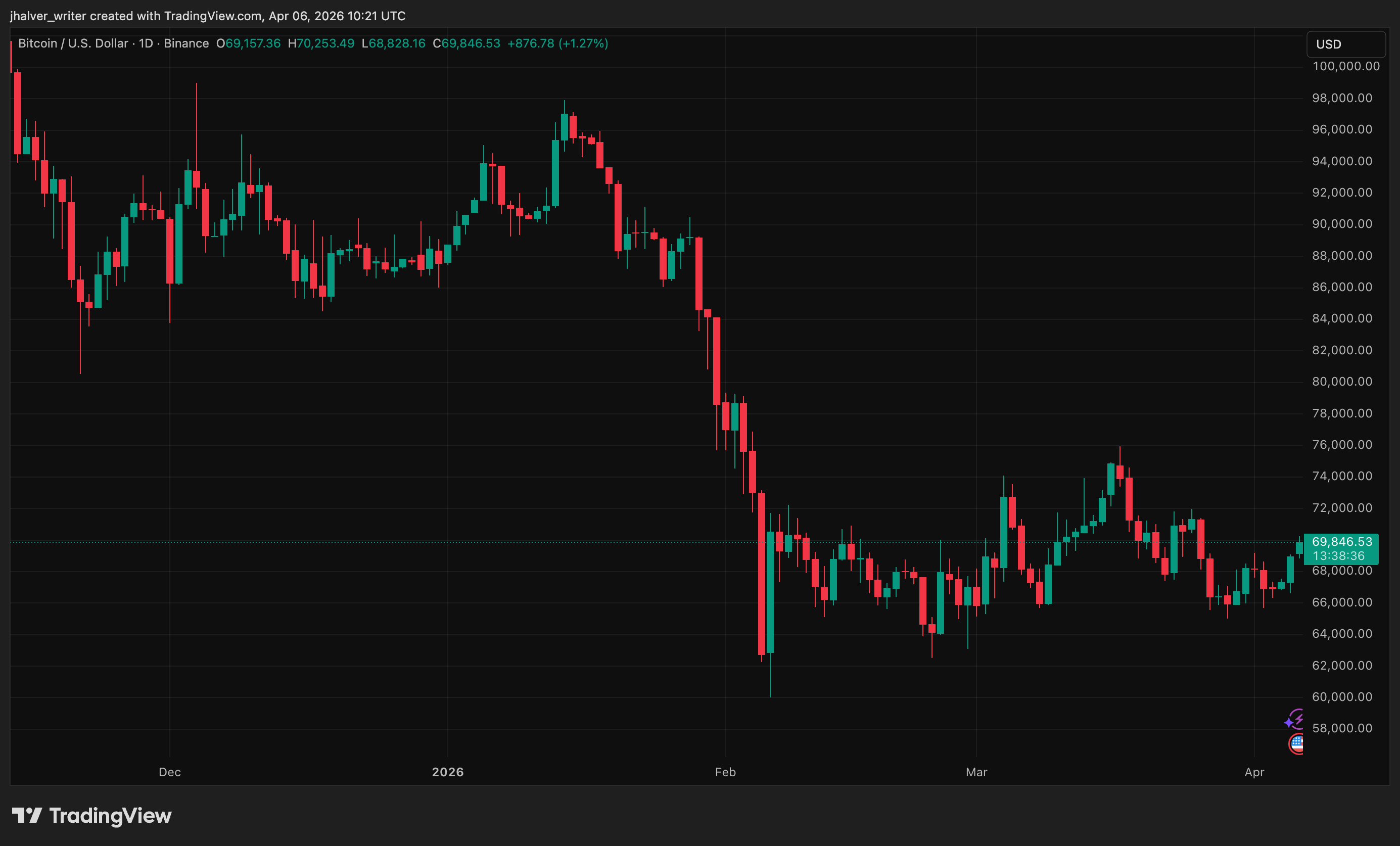
Cover image from Perplexity. BTCUSD chart from Tradingview.
Read More
- All Skyblazer Armor Locations in Crimson Desert
- How to Get the Sunset Reed Armor Set and Hollow Visage Sword in Crimson Desert
- All Shadow Armor Locations in Crimson Desert
- Marni Laser Helm Location & Upgrade in Crimson Desert
- All Golden Greed Armor Locations in Crimson Desert
- All Helfryn Armor Locations in Crimson Desert
- Best Bows in Crimson Desert
- Keeping Large AI Models Connected Through Network Chaos
- All Icewing Armor Locations in Crimson Desert
- How to Craft the Elegant Carmine Armor in Crimson Desert
2026-04-06 22:35