Author: Denis Avetisyan
A new theoretical approach investigates the exotic states of matter predicted to exist at the cores of neutron stars and in other environments with extreme densities.
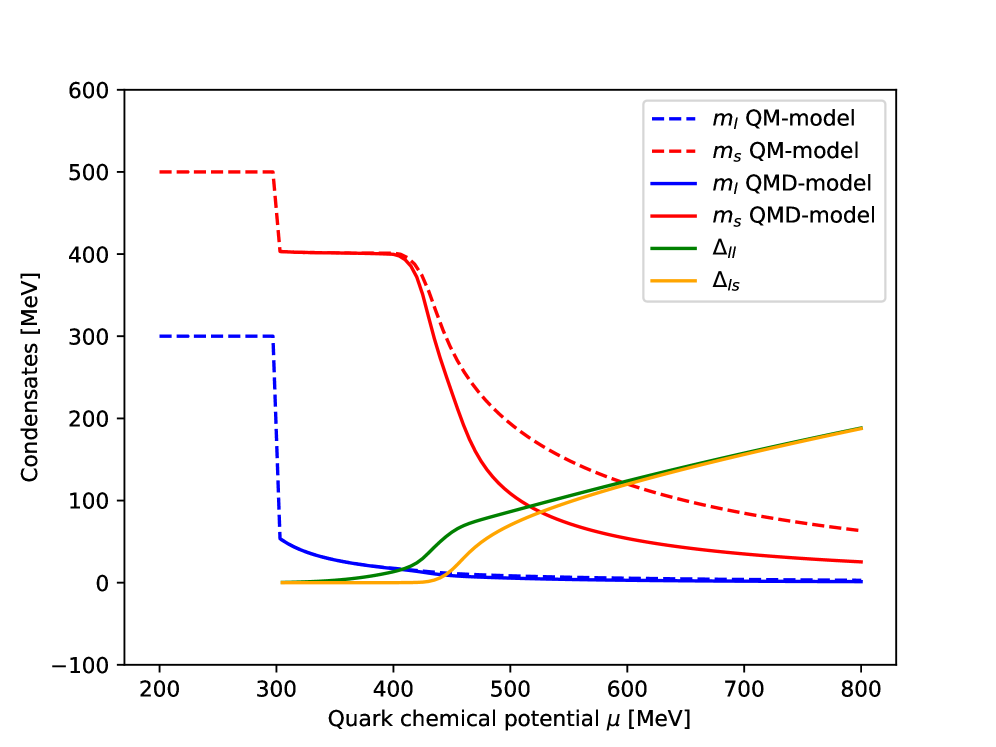
This review explores the properties of dense quark matter within the quark-meson diquark model, focusing on color superconductivity and its implications for the equation of state and thermodynamic behavior at finite density.
Understanding the behavior of matter at extreme densities remains a fundamental challenge in nuclear physics and astrophysics. This is addressed in ‘Quark-meson diquark model and color superconductivity in dense quark matter’, which investigates the properties of dense quark matter using a model incorporating quarks, mesons, and diquarks as effective degrees of freedom. The study reveals how different phases, including color superconductivity, emerge under varying chemical potentials, impacting thermodynamic quantities like the speed of sound and energy gaps. Ultimately, how do these findings refine our understanding of the equation of state of dense matter and the properties of hybrid stars?
Unveiling the Symmetry of Extreme Density
The investigation of matter at extreme densities, as found within the cores of neutron stars, represents a significant frontier in modern physics. These celestial objects pack the mass of the sun into a sphere only about 20 kilometers across, creating pressures and densities far beyond anything achievable in terrestrial laboratories. Consequently, the familiar laws of physics governing everyday matter begin to break down, and exotic states of matter – potentially including quark-gluon plasmas and hyperonic matter – may emerge. Understanding the equation of state – the relationship between pressure and density – for matter under these conditions is crucial, yet remains elusive, hindering accurate modeling of neutron star structure, evolution, and gravitational wave signals produced during mergers. The challenge lies not only in the extreme conditions themselves but also in the difficulty of directly observing and probing the interiors of these distant, compact objects, demanding innovative theoretical approaches and reliance on indirect observational constraints.
The quest to comprehend matter under extreme density, as found within neutron stars, hinges on a deep connection between fundamental symmetries and the laws of conservation. Noether’s Theorem, a cornerstone of theoretical physics, formally demonstrates this relationship: for every continuous symmetry in a physical system, there exists a corresponding conserved quantity. For instance, the symmetry of physics under time translation implies conservation of energy, while spatial translation symmetry guarantees momentum conservation. Within neutron stars, symmetries related to internal quantum numbers of particles – such as baryon number and isospin – dictate the allowable particle compositions and interactions. Understanding how these symmetries are broken or modified at ultra-high densities is therefore crucial to unraveling the equation of state of dense matter and predicting the observable properties of these enigmatic celestial objects. The subtle interplay between symmetry and conservation laws, as formalized by Noether’s Theorem, provides a powerful framework for navigating the complexities of matter at its most extreme.
Charge neutrality within ultra-dense matter, such as that found in neutron stars, isn’t merely a condition-it’s a governing principle. Because like charges repel with immense force, any deviation from neutrality would trigger catastrophic instability and rapid dispersal. Consequently, the composition of these systems is fundamentally constrained; positive charges from protons must be precisely balanced by negative charges from electrons or other exotic particles. This balance dictates the allowable configurations of particles, influencing everything from the equation of state – the relationship between pressure and density – to the star’s overall structure and stability. The need for charge neutrality also impacts the superfluidity and superconductivity observed in these environments, potentially leading to unique collective behaviors and complex internal dynamics that are still actively being investigated through both theoretical modeling and observational astronomy.
Color Superconductivity: A Novel State of Matter
Color superconductivity proposes a mechanism for pairing, analogous to conventional superconductivity, but involving quarks instead of electrons. In conventional superconductivity, electrons form Cooper pairs mediated by phonons; however, at sufficiently high densities and low temperatures, the strong force between quarks becomes dominant. This leads to the formation of Cooper pairs of quarks, specifically color-anticolor pairs, due to the exchange of gluons. The resulting condensate exhibits superconductivity with respect to color charge, rather than electric charge, and is fundamentally different from electron-based superconductivity. The interaction is governed by Quantum Chromodynamics (QCD), and the pairing occurs between quarks of different colors, minimizing the overall energy of the system. q + \bar{q} \rightarrow \text{Cooper Pair}
Color superconductivity exhibits multiple phases distinguished by the specific quark flavors and color charges involved in Cooper pair formation. The 2SC (two-flavor superconducting) phase, for instance, arises when only the two lightest quark flavors – up and down – participate in pairing. In this configuration, quarks with different color charges form Cooper pairs, leading to a condensate. Other phases, such as the CFL phase, involve a greater number of quark flavors and colors, resulting in different condensate structures and predicted physical properties. The emergence of these distinct phases depends on the relative strengths of the interactions between different quark flavors and colors, and the resulting symmetry breaking patterns determine the specific characteristics of each superconducting state.
The Color-Flavor-Locked (CFL) phase represents the most stable configuration within the broader framework of color superconductivity, characterized by the condensation of Cooper pairs involving all three colors and flavors of quarks. This complete pairing maximizes the energy gain and results in a state with a substantial energy gap, estimated to be on the order of several MeV. Crucially, the existence of the CFL phase within neutron star cores has observable implications; it predicts modifications to the star’s mass-radius relationship and can affect neutrino emission rates. The CFL phase also influences the star’s thermal evolution and potentially contributes to glitches observed in pulsar rotation, providing a pathway for linking theoretical predictions to astrophysical observations.
The predicted energy gap, denoted as 2Δ, in color superconducting phases is not simply a theoretical value but falls within a quantifiable range of 0.1 to 1 MeV. This magnitude is significant as it allows for direct comparison with results obtained from lattice Quantum Chromodynamics (QCD) calculations. Lattice QCD provides a first-principles approach to studying the strong interaction, and matching theoretical predictions for 2Δ with these calculations serves as a crucial test of the color superconductivity model. Discrepancies or agreement between the predicted energy gap and lattice QCD results can validate or refute the existence and characteristics of these exotic states of matter, particularly within the extreme conditions found in neutron stars.
The Quark-Meson-Diquark Model: A Computational Framework
The Quark-Meson-Diquark (QMD) model is a theoretical approach used to investigate the properties of matter at extreme densities, specifically focusing on the transition to quark matter and the potential emergence of color superconductivity. It represents a non-perturbative framework that goes beyond traditional hadronic models by explicitly incorporating the degrees of freedom associated with quarks and their interactions. This allows researchers to study the behavior of matter under conditions found in neutron stars and heavy-ion collisions, where confinement breaks down and quarks become deconfined. The model’s ability to describe both the quark and meson sectors, alongside the formation of diquark correlations, makes it a valuable tool for exploring the equation of state of dense matter and predicting observable signatures of color superconductivity, such as modifications to neutron star cooling rates and collective behavior in heavy-ion collisions.
The Quark-Meson-Diquark (QMD) model’s treatment of the quark sector directly addresses the kinetic energy of constituent quarks, employing a relativistic mean-field approximation to calculate momentum distributions and energy levels. This sector utilizes a Lagrangian density that includes both kinetic and interaction terms for the quarks. Complementing this is the scalar sector, which models interactions mediated by mesons, specifically the sigma and omega mesons. These mesons generate an effective potential influencing the quark dynamics and contribute to the overall energy density of the system. The strength of these meson couplings are key parameters within the model and are often determined by fitting to empirical data or through more fundamental theoretical considerations, ultimately influencing the equation of state for dense quark matter.
The diquark sector within the Quark-Meson-Diquark (QMD) model explicitly accounts for the pairing of quarks into diquarks, analogous to Cooper pairs in conventional superconductivity. These diquarks, formed by the strong force interaction between quarks, condense into a superfluid state at sufficiently high densities and low temperatures, manifesting as color superconductivity. The model treats diquarks as fundamental degrees of freedom, incorporating their kinetic energy and interactions alongside those of individual quarks and mesons. This allows for the investigation of the diquark condensate’s properties, including its energy gap and spatial structure, and its influence on the overall equation of state of dense quark matter. Calculations within this sector involve solving coupled equations for quark and diquark propagators, considering both scalar and vector interactions to determine the stability and characteristics of the color superconducting phase.
Effective implementation of the Quark-Meson-Diquark (QMD) model necessitates renormalization procedures due to the inherent complexities of defining physical parameters at high densities. These procedures address divergences arising from the strong interactions between quarks and mesons, and allow for the consistent calculation of observables at relevant energy scales. Specifically, renormalization involves redefining parameters like quark masses and coupling constants to absorb ultraviolet divergences and ensure finite, physically meaningful results. Furthermore, accurate exploration of the chemical potential μ up to asymptotic densities – where perturbative calculations are no longer valid – relies on a well-defined renormalization group flow and the consistent treatment of non-perturbative effects, enabling reliable predictions for the equation of state and the properties of dense quark matter.
Beyond Uniformity: Mixed Phases and Coupling Strengths
Current understanding of neutron star interiors suggests a complex structure beyond simple uniformity. Rather than existing as a completely superconducting fluid throughout, these stellar objects are theorized to harbor a mixed phase – a coexistence of superconducting regions and normal matter domains. This arises from the immense pressures and densities within the star, which modulate the conditions necessary for superconductivity. The boundaries between these phases are not sharply defined, but rather represent transitional zones where the superconducting state gradually diminishes. This mixed phase is not merely a static arrangement; it’s a dynamic interplay between the two states, influencing the star’s thermal properties, rotational behavior, and potentially its emission of gravitational waves. The presence of normal matter within the star’s core also impacts the transport of heat and other particles, differing substantially from scenarios involving complete superconductivity and affecting the star’s cooling rate over cosmic timescales.
The intricate behavior of neutron star matter extends beyond simple phases, often manifesting as a complex mixture of superconducting and normal regions, and the stability of this mixed phase is fundamentally linked to the strength of the Yukawa coupling. This coupling dictates the interaction between quarks – the fundamental constituents of matter – and scalar mesons, mediating a force that profoundly influences how quarks bind together within the neutron star’s dense core. A stronger Yukawa coupling encourages the formation of quark condensates, effectively altering the energy landscape and favoring specific arrangements of matter within the mixed phase. Consequently, the precise value of this coupling directly impacts the proportions of superconducting and normal regions, influencing macroscopic properties like the star’s moment of inertia and its response to external perturbations. Detailed analysis reveals that variations in the Yukawa coupling can induce phase transitions, shifting the balance between these phases and ultimately determining the overall stability and equation of state of the neutron star’s interior.
Charge neutrality within the mixed phase of a neutron star is not merely a condition, but a fundamental regulator of its composition and characteristics. Due to the extreme densities, the presence of charged particles – protons, electrons, and potentially exotic particles – necessitates a precise balance to avoid electrostatic instability. This constraint directly influences the allowable densities of each particle species; an excess of positive charge must be offset by an equivalent negative charge, shaping the particle composition throughout the star’s interior. Consequently, the requirement for charge neutrality intertwines with the superconducting properties of the neutron star material, affecting the critical fields at which superconductivity emerges and the overall equation of state. Subtle variations in particle densities, driven by the need to maintain neutrality, can dramatically alter the star’s mass-radius relationship and its response to external stimuli, making it a crucial factor in understanding these complex celestial objects.
Investigations into the behavior of matter at extremely high densities, as found within neutron stars, demonstrate a fascinating connection between the speed of sound and the fundamental properties of the material. Analyses conducted at zero temperature reveal that the speed of sound, denoted as c_s, within this dense matter approaches a theoretical limit known as the conformal limit – approximately 1/\sqrt{3}. This convergence isn’t merely a mathematical curiosity; it serves as a crucial validation of the theoretical model employed. The model accurately predicts this behavior, suggesting that the interactions between particles at these extreme densities are governed by the principles of conformal symmetry. Consequently, observing a speed of sound nearing this limit provides strong evidence supporting the model’s depiction of matter’s equation of state under conditions unattainable in terrestrial laboratories, offering insight into the ultimate fate of matter compressed to its absolute limit.
The study of dense quark matter, as detailed in this work, reveals a complex interplay between fundamental forces and emergent properties. Each calculation of the equation of state, each exploration of diquark condensation, uncovers structural dependencies that must be rigorously tested. It is not merely the prediction of phase transitions, such as color superconductivity, that is crucial, but the understanding of how these transitions arise from the underlying quantum dynamics. As Carl Sagan observed, “Somewhere, something incredible is waiting to be known.” This sentiment perfectly encapsulates the investigative spirit driving this research; the quest to unveil the hidden order within matter at its most extreme densities, where new forms of organization and behavior emerge, demanding a deeper understanding of the universe’s fundamental building blocks.
Where Do We Go From Here?
The exploration of dense quark matter, as presented through the lens of the quark-meson diquark model, inevitably reveals more questions than answers. The current formalism, while successful in describing certain features of color superconductivity and hybrid star properties, remains fundamentally an effective theory. The true nature of the confining potential, and how it evolves at extreme densities, continues to elude precise characterization. Future work must address the systematic uncertainties inherent in model building, moving beyond phenomenological constraints towards a more rigorous connection with the underlying QCD Lagrangian.
A crucial avenue for advancement lies in refining the treatment of finite density effects. The grand canonical ensemble, while a powerful tool, implicitly assumes equilibrium. The reality of astrophysical environments, particularly during stellar mergers or neutron star collisions, is likely far from equilibrium. Incorporating non-equilibrium dynamics, even in an approximate manner, could reveal entirely new phases and behaviors. Furthermore, a more detailed investigation of the interplay between color superconductivity and other potential phases, such as chiral restoration, is essential for a complete understanding.
Ultimately, the challenge remains to transform this theoretical landscape into a predictive science. Each calculated equation of state, each modeled phase diagram, is not an endpoint, but a provocation. Every image of dense matter, whether from theory or observation, is a challenge to understanding, not just a model input. The next generation of research must embrace this ambiguity, and rigorously pursue the patterns hidden within the complexity.
Original article: https://arxiv.org/pdf/2602.18256.pdf
Contact the author: https://www.linkedin.com/in/avetisyan/
See also:
- All Skyblazer Armor Locations in Crimson Desert
- How to Get the Sunset Reed Armor Set and Hollow Visage Sword in Crimson Desert
- Robinhood’s $75M OpenAI Bet: Retail Access or Legal Minefield?
- How to Catch All Itzaland Bugs in Infinity Nikki
- Speedsters Sandbox Roblox Codes
- Invincible: 10 Strongest Viltrumites in Season 4, Ranked
- Jojo’s Bizarre Adventure Ties Frieren As MyAnimeList’s New #1 Anime
- Top 10 Must-Watch Isekai Anime on Crunchyroll Revealed!
- Re:Zero Season 4 Episode 3 Release Date & Where to Watch
- Who Can You Romance In GreedFall 2: The Dying World?
2026-02-24 04:26