April 2026 won’t be known for big, sudden price increases, but rather for a period of market recovery. Following significant losses in February and March – including forced selling and widespread pessimism that pushed Bitcoin below $70,000 – the market gradually rebounded to close the month around $76,300, a gain of roughly 11-12%.
Summary
- Bitcoin price recovered more than 11% in April as institutional inflows and spot demand returned across major exchanges.
- ETF inflows, corporate Bitcoin purchases, and improving on-chain data supported the market’s recovery after the February and March selloff.
- Bitcoin’s April rebound reflected a structural recovery phase rather than a leverage-driven short squeeze.
The reported gains don’t fully reflect the strength of the recent recovery. We saw a solid foundation forming, with prices making higher lows instead of continuing to fall. For the first time since July 2025, buying pressure consistently outweighed selling pressure across all major exchanges, and investors started shifting their money into a wider range of alternative cryptocurrencies. This wasn’t just a temporary price spike driven by short covering; it was a sustained increase fueled by confidence from institutional investors and a healthier market environment.
Macro and geopolitics: the Strait of Hormuz as the central risk Toggle
Throughout April, every significant price change could be linked back to a specific 33-kilometer stretch of water: the Strait of Hormuz. Tensions between the U.S. and Iran, and how they affected this crucial waterway, largely determined whether investors were willing to take risks, and Bitcoin’s price reacted almost immediately to each new event.
The month began with tensions high. Iran responded to U.S. proposals with a ten-point counteroffer, and President Trump warned of attacks on Iran’s oil facilities if an agreement couldn’t be reached.
A two-week ceasefire was agreed upon on April 7th, just as a deadline approached. Financial markets reacted positively, with Bitcoin climbing above $73,000 and a record $470 million flowing into ETFs – the largest single-day increase in about six weeks. However, this positive reaction didn’t last long.
After the attacks in Lebanon, shipping through the Strait was halted again. The initial formal talks between the U.S. and Iran on April 12th failed to produce any progress. A temporary extension of the ceasefire was agreed upon in the third week, but didn’t lead to a solution. By the end of the month, Iran suggested a three-step plan for negotiations and received its first payment for ships passing through the Hormuz Strait – a symbolic payment made in Bitcoin, but actually settled using stablecoins.
As I analyzed the market data, a key behavioral pattern emerged. By late April, we started seeing smaller and smaller price changes with each ceasefire extension. It became clear the market wasn’t reacting to these extensions as new events, but rather had already factored in a state of ongoing, unresolved tension. Essentially, a level of managed conflict had become the expected norm.
The economic situation didn’t improve recently. Inflation remained high in March, with the Consumer Price Index exceeding 3%. The job market was also strong, adding 178,000 jobs. As a result, expectations for interest rate cuts by the Federal Reserve in 2026 have disappeared, and the first potential cut is now predicted for September 2027. Despite this challenging economic environment, Bitcoin increased in value by over 11%, suggesting strong underlying demand for the cryptocurrency.
Bitcoin price action and on-chain structure
Bitcoin had a predictable April, showing signs of recovery after a price drop in February and March. The price initially dipped into the $67,000–$70,000 range, forming a double bottom that suggested the selling pressure was easing. This was followed by four straight weeks of price increases – 2.5%, 4.32%, 6.56% – ultimately closing the month near $76,300.
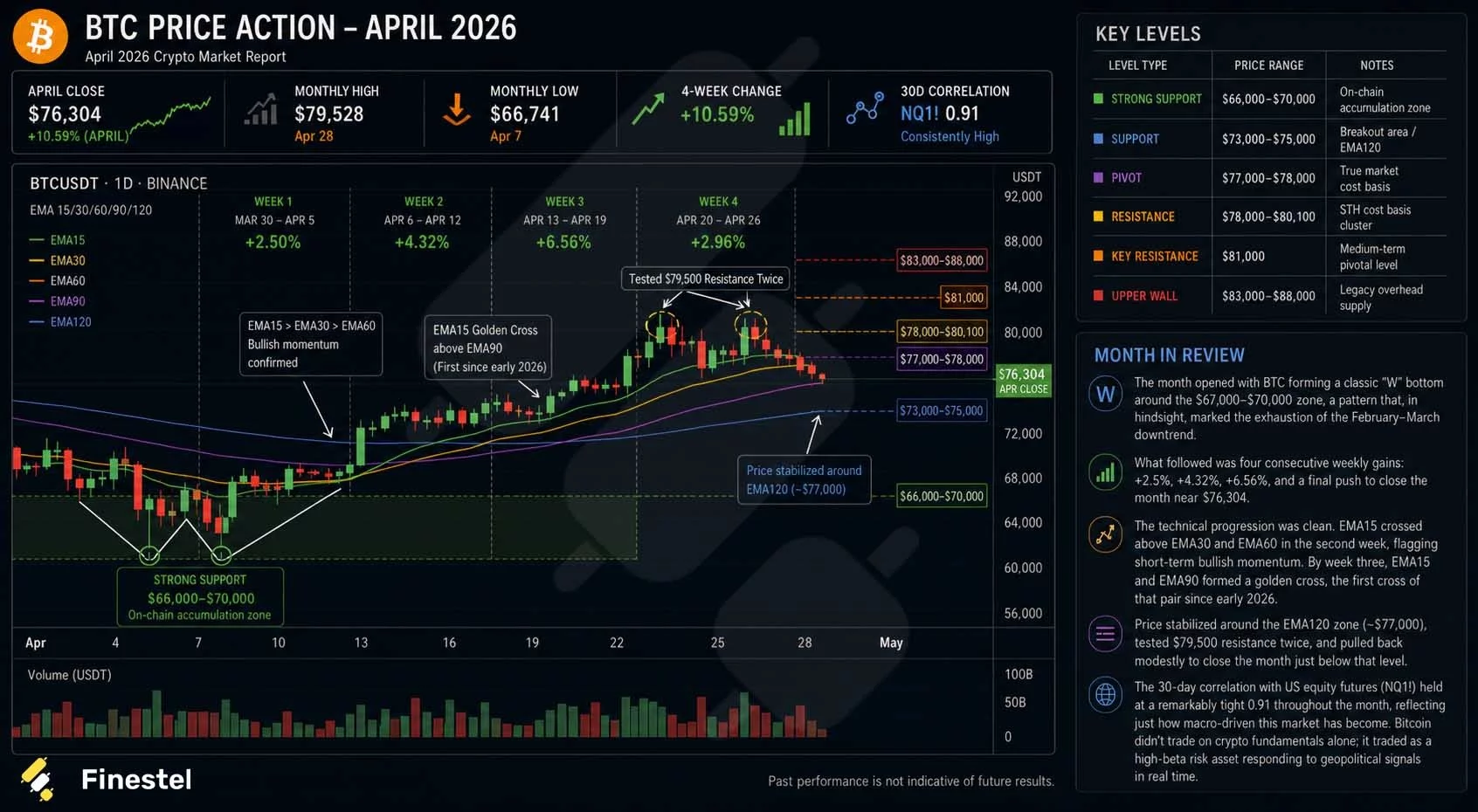
Bitcoin’s price showed steady improvement. In the second week, shorter-term moving averages (EMA15) moved above longer-term ones (EMA30 and EMA60), suggesting a positive short-term trend. By week three, a ‘golden cross’ formed between EMA15 and EMA90 – a pattern not seen since early 2026. The price faced resistance between $78,000 and $80,100, which is where many recent buyers initially purchased Bitcoin. It attempted to break through $79,500 twice, but ultimately saw a small decline at the end of the month.
Looking at blockchain data, the selling activity wasn’t straightforward. Initially, most sales came from people taking profits or cutting their losses after Bitcoin reached $65,000-$73,000. But later in April, the selling changed – it was mostly people who bought around $88,000 selling at small losses, which indicated a less urgent and dramatic shift in the market.
Price recently stabilized between $77,000 and $78,000, and the price range between $74,000 and $80,000 is gradually being filled. Long-term investors have stopped selling, but aren’t buying in large quantities yet.
Institutional capital: the engine behind the recovery
The gains seen in April weren’t due to typical individual investors. Instead, large institutions were the primary drivers, and one company, in particular, achieved a record-breaking performance.
Bitcoin ETFs have seen strong investment over the past three weeks, with net inflows of $786 million, $996 million, and $823 million. This represents the longest period of consistent inflows this year, lasting nine days. Additionally, Strategy made a large Bitcoin purchase – 34,164 BTC at an average price of $74,395, totaling $2.54 billion – increasing their total Bitcoin holdings to 815,061 BTC.
The company also suggested speeding up its financial processes by switching STRC’s dividend payments to every two weeks, allowing them to invest in Bitcoin more quickly.
More major financial institutions are entering the cryptocurrency space. Goldman Sachs plans to launch a Bitcoin fund that aims to generate income, while Morgan Stanley is moving forward with plans to list a Bitcoin fund on the stock exchange. Schwab is also introducing cryptocurrency trading for its clients. Notably, options trading for BlackRock’s Bitcoin fund is now exceeding that of Deribit, a major cryptocurrency derivatives platform, signaling growing institutional involvement in Bitcoin.
As I’ve been analyzing the data, a key trend has emerged regarding investment flows. We’re seeing a clear difference between U.S. and international institutional investors. Specifically, exchanges outside the U.S., like Binance, were driving the initial rebound in buying activity. Meanwhile, the Coinbase premium – a measure of U.S. institutional demand – stayed negative for around twenty days before finally starting to recover, which suggests American institutional investors were noticeably slower to return to the market.
This imbalance accounts for the slow pace of the economic recovery, even though it is happening. Usually, when the U.S. fully participates in the economy, growth is much faster. Looking ahead to May, the biggest factor that could boost growth is increased demand from U.S. businesses and organizations.
Market structure, sentiment, and the altcoin landscape
Throughout April, the market for global spot CVD continued to show positive trends, indicating that buyers were taking advantage of price drops.
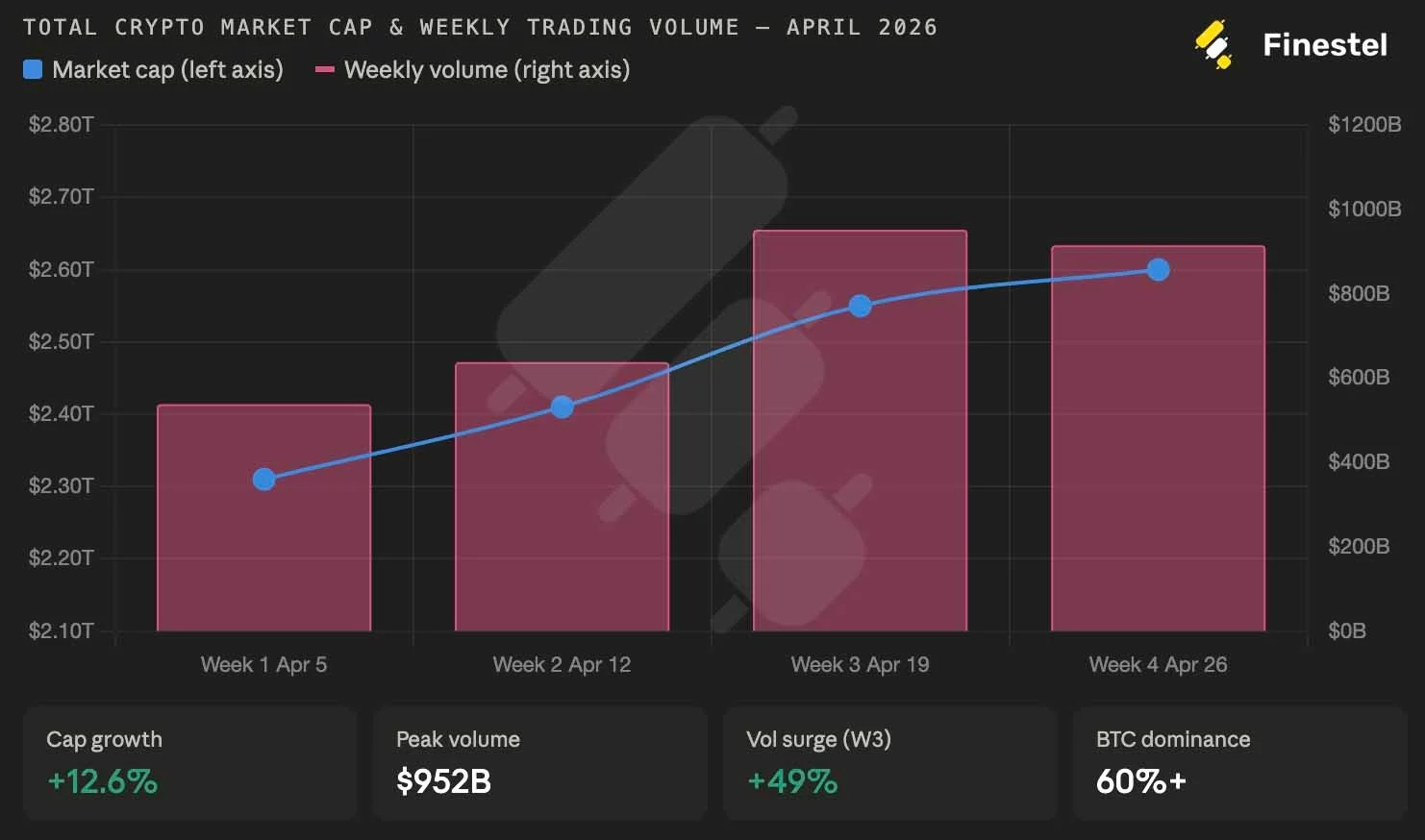
Total crypto market capitalization expanded from $2.31 trillion to $2.60 trillion, a 12.5% gain.
Weekly trading volume peaked in the April 13–19 window with a 49% surge.
By the end of the month, Bitcoin’s share of the cryptocurrency market rose above 60%. This is a typical sign of a market starting to recover, as investors often put their money into Bitcoin first before moving it into other cryptocurrencies.
In late April, we started seeing a shift in the crypto market, with some alternative cryptocurrencies (altcoins) gaining value due to actual improvements and developments, not just hype. For example, EDGE (edgeX) increased by 62.1% thanks to growing revenue from decentralized exchanges and a program to buy back tokens. Zcash (ZEC) went up 42.8% after Grayscale filed for an ETF and more people started using its privacy features.
ARIA’s price increased by over 50%, driven by large investments and growing interest in AI-powered gaming. However, like many cryptocurrencies, it also experienced volatile, short-term spikes fueled by social media hype – RAVE saw an extreme example of this with a nearly 3,600% jump, demonstrating artificial price increases rather than sustained growth.
How professional asset managers navigated April: discipline over FOMO
Finestel’s analysis of professional asset manager performance showed a key takeaway: the most successful managers weren’t those who correctly predicted the market’s recovery, but rather those who proactively managed risk in February and March, positioning them to capitalize on the April rebound.
| Allocation Category | March 2026 | April 2026 | Change | Commentary |
| BTC/ETH Core | 53.5% | 54.5% | +1.0% | Increased on dips; viewed as the highest-conviction anchor amid improving structure |
| Stablecoins | 28.0% | 23.0% | -5.0% | Selective deployment into strength; reduced dry powder as confidence returned |
| Yield-bearing DeFi / RWA | 13.0% | 13.5% | +0.5% | Slight increase for consistent yield in still range-bound environment |
| High-Conviction Alts | 5.5% | 9.0% | +3.5% | Targeted rotation into AI infrastructure, privacy, and select L1/L2 plays |
These managers followed a clear and consistent strategy. Instead of selling when prices dropped, they either held onto their main Bitcoin and Ethereum investments or cautiously bought more.
They minimized their risk by avoiding heavy borrowing and instead used options trading to protect themselves against unpredictable events in April, such as the inflation report, unsuccessful talks on April 12th, and news regarding the ceasefire extension.
They gradually added altcoins to their portfolios, avoiding hasty or large investments. They focused on coins with clear reasons for potential growth, not just those driven by hype, and importantly, they didn’t jump into investments simply because prices were rising.
Bitcoin’s price jumped above $73,000 on the day news of a ceasefire emerged, but the most successful investors had already prepared for this move. They purchased Bitcoin when it was trading between $67,000 and $70,000, acting on concerns rather than optimism.
Our strategy focused on being slightly cautious during uncertain times, so we could quickly take advantage of opportunities when they arose. This approach proved successful during a volatile month filled with unexpected global events and economic shifts.
By the end of the month, investors were more willing to take risks, but this happened gradually and thoughtfully. This is the type of cautious risk-taking that builds gains over the long term, unlike riskier behavior that could quickly lead to losses.
The outlook: structural progress without structural confirmation
Bitcoin is starting May in a stronger position than it’s been in since late 2025, but that doesn’t guarantee success. For the price to really go up, it needs to convincingly close above $81,000 with a lot of trading activity. If that happens, it could then move towards the $83,000–$88,000 range, where a lot of sell orders are currently waiting.
Several factors suggest a potential market rally: money continues to flow into ETFs, excessive risk-taking has been reduced, and a peaceful resolution to the U.S.-Iran situation would remove a major source of global uncertainty. However, if the price falls below $73,000-$75,000 during any significant sell-off, especially considering many recent buyers are holding at a loss, that would strengthen the argument for a continued downturn.
As a crypto investor, here’s my take: what we’re seeing feels like a solid bounce back, but it needs to hold up. It’s not the start of a full-blown bull run just yet – we need to see if this recovery can be confirmed before getting too excited.
The next month for Bitcoin will likely hinge on three key things: if it can stay above $77,000, if large U.S. institutions start investing heavily again, and whether global political tensions ease or continue to create uncertainty and risk.
April rewarded preparation. May will reward patience combined with readiness.
Read More
- Forza Horizon 6: Find the Ohtani Treasure Chest Location
- NTE Drift Guide (& Best Car Mods for Drifting)
- LEGO Batman Legacy of the Dark Knight Batcave Minikits & WayneTech Caches
- Diablo 4 Best Loot Filter Codes
- Boruto: Ikemoto Has Already Hinted At Sasuke’s New Eye After Return
- USD RUB PREDICTION
- Top 10 Must-Watch Isekai Anime on Crunchyroll Revealed!
- Cookie Run Kingdom Timeline of Fate Update Guide
- Deltarune Chapter 1 100% Walkthrough: Complete Guide to Secrets and Bosses
- Starsand Island’s Rarest Achievements and How to Earn Them
2026-05-26 12:52