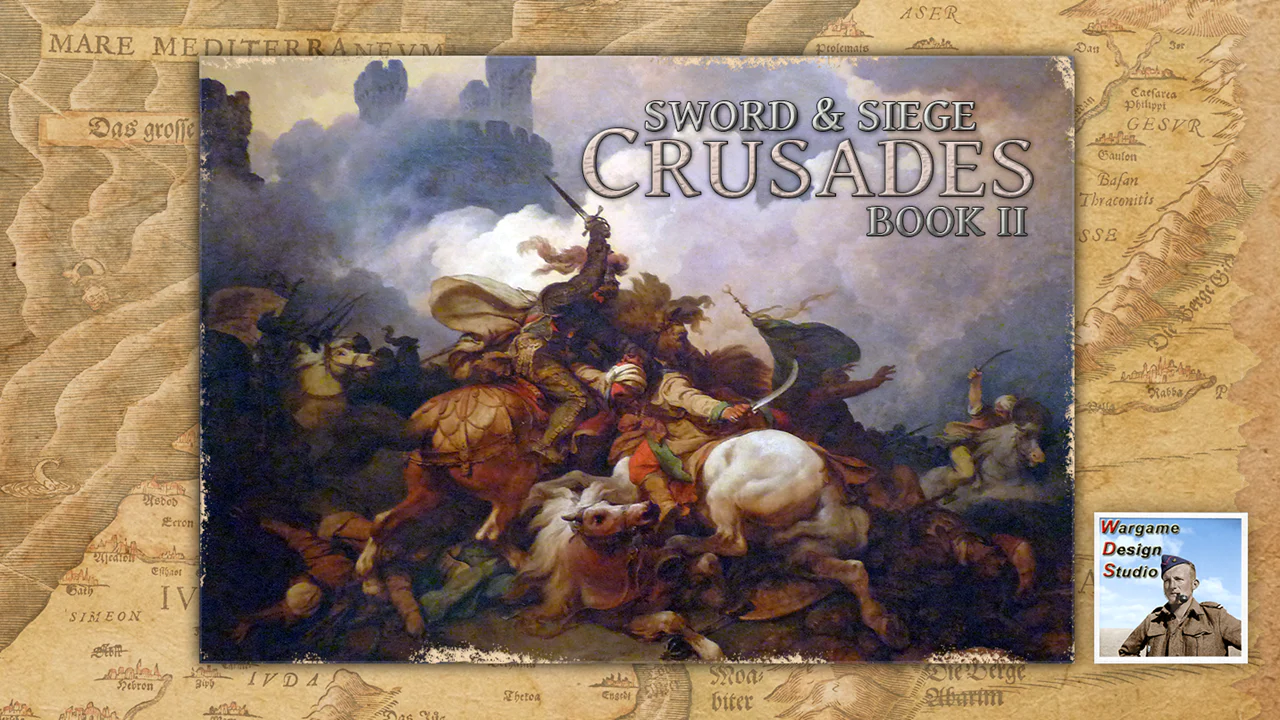
The Crusades are often used by politicians and religious groups to gain attention, but this era is frequently misunderstood and twisted to fit current beliefs. Even history books aren’t always objective. At Firaxis, we aim to be as unbiased as possible. While my colleague Nuno specializes in European Medieval history, I’ve been studying Islamic history, law, and theology for over 20 years, even taking courses through an online school in Jordan. This expertise led to an opportunity to discuss regional history with an Afghan General, at the invitation of a U.S. Army Colonel.
- Genre: Turn-Based Strategy | Wargame | Historical Strategy
- Developer: Wargame Design Studio
- Publisher: Wargame Design Studio
- Price: $39.95
- Release Date: 13 February 2026
- Reviewer: Chris Irwin (PC)
- Target Audience: Turn-Based Strategy Players, Wargamers, Crusades History Buffs
- Final Score: 9/10
I researched the Crusades using several sources to prepare for this review, including Thomas Asbridge’s scholarly book The Crusades, James Reston Jr.’s engaging Warriors of God, and the How the Crusades Changed History lectures. Despite a slight delay in receiving the game itself, these resources gave me a solid understanding of the historical period to assess its accuracy.
Who is This Game For?
This game will appeal to players who enjoy turn-based strategy and tabletop games, especially those interested in the history of the Third and Fourth Crusades. The period is particularly captivating due to the well-known relationship between King Richard the Lionheart and Sultan Saladin. If you want to get a feel for the setting, I suggest watching Ridley Scott’s Kingdom of Heaven and then the 1963 Egyptian film Saladin – they make a great pairing that brings the story of these famous rivals to life.
Players might wonder how this game compares to Field of Glory II: Medieval. While Field of Glory II: Medieval only focuses on a single major battle from the Third Crusade (Arsuf), this game offers over 100 scenarios that feel just as grand. Although some scenarios are based on historical events with slight variations, these variations are well-researched and carefully designed. This game continues the story begun in the first Crusader game, covering Nur ad-Din’s campaigns, the defense of the Crusader states, and the turbulent events of the Fourth Crusade.
Historical Scope and Scenarios
A Feast for History Buffs
The game begins in 1149, during a period when Nur ad-Din is battling Crusader armies led by figures like Prince Raymond of Antioch, who is seeking a risky alliance with the infamous Ismaili Assassins. Later, in 1167, you’ll play as a young Saladin, fighting with his uncle Shirkuh under Nur ad-Din’s command against the weakening Shia Fatimid empire. The game also depicts the dramatic standoff between Saladin and Raynald de Châtillon in 1183 during the Siege of Kerak.

The game’s 1187 scenarios prominently feature the well-known Battle of Hattin, with the return of Raynald de Châtillon, and then move into the famous sieges of Jerusalem, Tyre, and Acre. King Richard the Lionheart enters the conflict to challenge Saladin’s strategies, and the game even includes a scenario based on Barbarossa. It all culminates with the Fourth Crusade and the attack on Constantinople. This isn’t simply a collection of the most famous battles; it’s a remarkably detailed overview that any serious history enthusiast would appreciate. Each battle is accompanied by thorough historical background information. While I did find a few minor omissions – like Saladin’s takeover of Zengid lands or the Battle of Myriokephalon – they were difficult to spot.
If you’re looking for battles based on real historical events, with specific armies and landscapes, this game is a great choice. Unlike Field of Glory II: Medieval, which often sets you up for or right after a major battle, this game puts you right in the heart of the action – the siege itself.
Sieges and Mechanics
The sieges in this game were carefully designed to be different from those in other strategy games. Instead of quickly destroying walls with large weapons, like in Age of Empires, it focuses on realistic tactics like using sappers and siege towers. The game avoids over-the-top, instant destruction, aiming for a more believable and tactical experience.

This game differs from its predecessor by focusing on moving troops across significantly larger maps. Players can switch to a 2D view, choosing between detailed unit graphics or simpler board game counters. Though it doesn’t have the same flashy effects as the previous version, the artwork is historically accurate and visually appealing, with details like Templar crosses and Islamic calligraphy appearing on shields. The portraits of key leaders like Saladin and Richard are particularly well-done, adding to the game’s immersive and realistic feel.
Tactical Impressions
I began by testing the game with the Battle of Inab, where I used quick attacks to defeat the Ismaili army. Then, I played as the Muslim side during the Siege of Bilbeis to evaluate the AI. While the AI is still being improved – I noticed the Crusader AI sometimes left its siege weapons vulnerable to my archers and spearmen – the game generally plays best when you choose the side that’s recommended.
Okay, so the Battle of Al-Babein was tough. I seriously failed playing as both sides. I tried getting clever with the Muslim army, setting up spear walls to protect my archers, but the AI was just too smart – it countered everything I did. Then I switched to the Crusaders, thinking they’d be easier, but I was wrong! I tried to just rush the Muslim forces, assuming they’d fall quickly, and got completely destroyed. It’s cool though, because the game really nails how these armies fought historically. The Muslims were all about speed and wearing you down, while the Crusaders were heavily armored and just wanted to smash through everything. You can feel that difference in the gameplay.
Balance and Realism
I noticed a strange issue with the game’s mechanics: Muslim infantry units, like spearmen and swordsmen, can’t directly attack Crusader cavalry. They can only defend themselves by moving to areas where the cavalry can’t reach. Other games in the series let you try to attack, even if it’s not very effective. Historically, Arab infantry certainly weren’t incapable of fighting knights with spears, so this seems to be a deliberate choice by the game designers.

I was playing as Saladin’s army in the Battle of Hattin and struggled to achieve a convincing win. My horse archers didn’t seem very effective – they could only eliminate a few enemy soldiers with each attack, while the opposing archers were causing much more damage. This didn’t seem realistic, considering how strong Saladin’s forces were known to be. Ultimately, I won the battle not through superior firepower, but by finding and exploiting a weakness in the enemy’s positioning to capture their flags.
Final Thoughts on Authenticity
I thought the landscape for the Constantinople siege looked a little too dry and desert-like—it would be great to have a mod that adds more greenery. However, the map itself is fantastic and makes for a really tough siege to pull off.
You might wonder why I emphasized the Muslim viewpoint. Historian Paul Cobb points out that most Muslim writings about the Crusades haven’t been translated into English yet. Because the game developers put so much detail into portraying the Muslim side – named after Richard the Lionheart – it’s clear they also devoted significant effort to the Crusader side. The game features all the major historical figures, including King Amalric, Baldwin IV, Conrad of Montferrat, King Guy, even King Phillip lurking among the armies, and the battle-ready King Richard.
Honestly, I’m really digging how well they did the Crusader faction in this game. It’s cool because you don’t see that perspective a lot in historical stuff, and it feels more like a grimdark fantasy world, almost like Warhammer. They’ve got these awesome holy relics that give off a powerful aura, and your King Champion is a total beast – he just charges into battle and starts wrecking everything with pure strength.
Minor Critiques
Right now, the campaign is designed to be played from the perspective of the Crusaders. However, the Third Crusade is also a fascinating story from the Muslim side, and it would be fantastic to add a campaign that lets players experience it from their point of view.
Honestly, as a fan, I’m a little disappointed with the names “Crusade” and “Anti-Crusade” for the factions. It just feels…flat. It’s like if we called World War II a fight between the “Allies” and the “Anti-Allies” – it doesn’t really capture the spirit or feel of the time, you know?
The game sometimes portrays the Crusaders as a well-equipped, modern army and the Muslim forces as less organized rebels. However, historically, both sides were actually quite similar in terms of technology and training. This difference in the game is probably a design choice to keep things balanced – if the Muslim horse archers were as powerful as the Crusader longbowmen, the game might become too difficult.
Byzantine Emperor Leo 6 noted in his military guide, “Taktika,” that Muslim armies fought with comparable skill and equipment to the Roman forces of his era. Historian David Nicolle suggests in his book, “Warriors and their Weapons around the Time of the Crusades,” that Crusader technology may have originated in Central Asia and spread to Europe. This indicates a relatively even playing field in terms of weaponry and equipment. However, during this period, the Muslim world was weakening due to the decline of the Abbasid Caliphate, while Western Europe, revitalized by the Carolingian dynasty, was gaining strength. Saladin’s Ayyubid Dynasty, though, began to restore momentum to the Muslim world after the initial Crusades.
Regarding naval and logistical elements, it would be great if water wells functioned as important supply hubs or strategic points, reflecting the challenges of fighting in the desert. It’s a bit of a shame there aren’t ships for transport or combat, but I understand the developers might add those later. Score:
Final Score: 9/10
If you love the classic gaming style of the early 2000s and are fascinated by the history of the Crusades, this game is perfect for you. It offers a wealth of content whether you prefer to play as Western European or Islamic forces. While games like this can sometimes be expensive, and the AI might need improvement for certain campaigns, a ‘Play by Email’ option lets you enjoy everything the game has to offer. No matter your playstyle, you’ll find enough content here to keep you entertained for years. Unlike other strategy games like Age of Empires or Stronghold, this game is deeply rooted in historical detail, bringing the past to life with every turn.
If you liked this review, be sure to explore our other reviews to discover the top strategy games available!
Read More
- Re:Zero Season 4, Episode 6 Release Date & Time
- NTE Drift Guide (& Best Car Mods for Drifting)
- How to Get the Wunderbarrage in Totenreich (BO7 Zombies)
- How to Beat Turbines in ARC Raiders
- How to Get Necrolei Cyst & Strong Acid in Subnautica 2
- All Aswang Evidence & Weaknesses in Phasmophobia
- Alan Wake Event in Phasmophobia, Explained
- Diablo 4 Best Loot Filter Codes
- How to Craft Repair Tools in Subnautica 2
- Best Where Winds Meet Character Customization Codes
2026-03-18 17:45