In the long corridor of finance, where numbers bite like frost and the mind grows numb, Goldman Sachs strategist Ben Snider spoke on Monday with the gravity of a man who has learned to count the earth’s throb. He warned that the fear of AI-driven disruption will suppress growth stock valuations for quarters, perhaps years, and that broad exposure to the sector is no longer a viable strategy. A warning that tastes like stale rye, but with a glossy chart instead of bread.
Key Takeaways:
- On April 13, Snider warned that AI disruption fears could weigh on growth stocks for years, like a winter that never ends.
- Servicenow fell 48% and Salesforce dropped 36% YTD as per-seat licensing stumbles into AI-driven “seat compression,” according to Yahoo Finance’s Brian Sozzi.
- Meta, Amazon, and Alphabet are positioned to recover first as Goldman leans toward selective exposure into 2027.
AI Fears Drive Software’s Collapse in 2026; Goldman Warns of a Prolonged Rebound
The warning, reported by Yahoo Finance’s Brian Sozzi on Monday, lands as software equities stumble through 2026. Servicenow is down 48% year-to-date; Salesforce has shed 36%; Docusign off 42%. These declines are not mere bad luck; investors price in “seat compression”-the idea that a single AI agent replaces many human users, gutting per-seat licensing revenue.
Sozzi notes the sector has lost roughly $2 trillion in market capitalization this year. Snider’s note, published by Goldman’s U.S. Portfolio Strategy team, states the core problem plainly: resolving investor uncertainty “will likely require evidence that AI is not displacing existing business models.” Until earnings beats and improving unit economics arrive, shares in vulnerable sectors may struggle to find a floor.
In Sozzi’s report, Citi analyst Tyler Radke echoed the concern, warning that worries about “software application architecture, business model durability and terminal value” could deepen. Yet the piece reminds that private AI firms may generate more than $100 billion in net-new revenue, edging ahead on growth metrics.
The ‘SaaSpocalypse’ and What Goldman Is Watching
The Goldman note builds on the firm’s March 2026 report titled “Will AI Eat Software?” That 31-page analysis concluded AI is unlikely to fully replace software but will force major architectural changes around large language models and autonomous agents. Incumbents hold advantages in proprietary data and entrenched workflows, but the window to adapt is not open forever.
Three large-cap names got partial exemption in Snider’s framework. Meta Platforms, Amazon, and Alphabet are positioned to “regain their growth stock stride” on the back of strong expected results in 2026 and 2027. Their scale and AI integration give them a credible path that smaller SaaS platforms cannot yet claim.
The broader Magnificent Seven, however, is struggling, the Yahoo Finance report explains. JPMorgan strategist Mislav Matejka, quoted in Sozzi’s editorial, says the group is no longer performing its historical safe-haven role relative to the S&P 500. Only Amazon and Alphabet are marginally positive year-to-date. Tesla is down roughly 23%.
Capital is rotating toward sectors with physical assets, including data centers and infrastructure, where exposure to pure software disruption is lower, and AI infrastructure spending remains a direct tailwind.
Public Skepticism Adds Pressure Beyond Wall Street
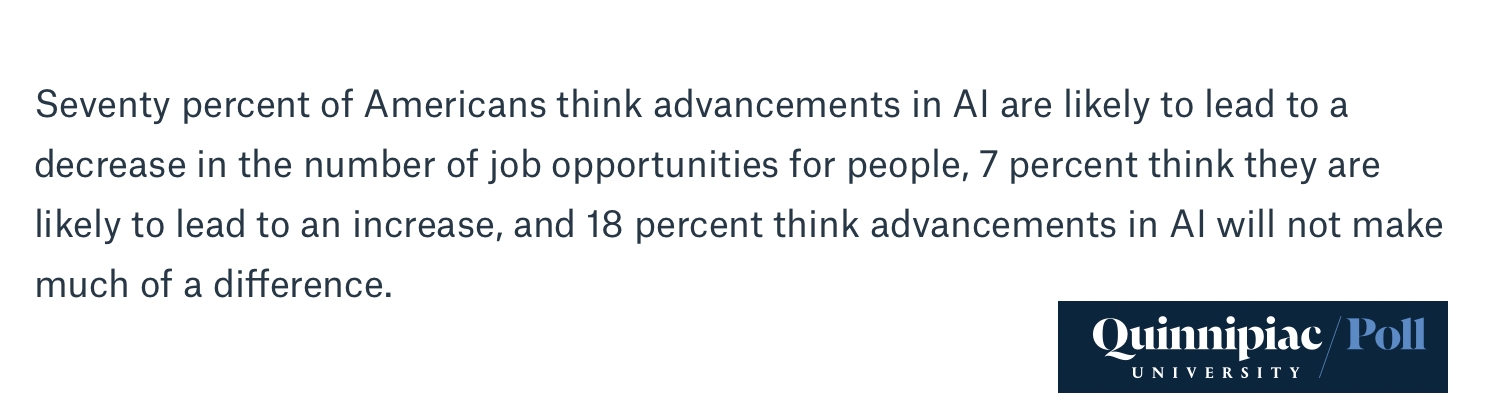
Goldman’s institutional caution has a counterpart in public opinion. A Quinnipiac University poll surveyed 1,397 U.S. adults and found 80% are concerned about AI, with 70% believing it will reduce job opportunities. That figure is up sharply from 56% in Quinnipiac’s April 2025 poll.
Trust in AI-generated information remains thin. 76% of respondents said they trust AI outputs only “hardly ever” or “some of the time.” A separate NBC News poll found 57% of registered voters believe AI risks outweigh benefits.
Opposition to AI data centers is also hardening. 75% of Americans oppose having one built in their community, with 72% of opponents citing higher electricity costs and 64% pointing to water consumption. That local resistance is producing real project delays at a time when hyperscalers are still pushing capital expenditure projections higher for 2026.
74% of the poll’s respondents said the government is not doing enough to regulate AI, and 76% said businesses lack sufficient transparency about their AI use.
The tension the Quinnipiac data captures is real: personal AI tool usage is climbing, with 51% of respondents reporting they have used AI for research, up from 37% in 2025. But adoption is running well ahead of trust. That gap, combined with Goldman’s call for prolonged valuation pressure on growth stocks, suggests the AI cycle is entering a phase where skepticism, not enthusiasm, drives the narrative.
Read More
- Forza Horizon 6: Find the Ohtani Treasure Chest Location
- LEGO Batman Legacy of the Dark Knight Batcave Minikits & WayneTech Caches
- NTE Drift Guide (& Best Car Mods for Drifting)
- Diablo 4 Best Loot Filter Codes
- PS Plus Monthly Games for June 2026 Wish List
- USD CNY PREDICTION
- USD RUB PREDICTION
- GBP CNY PREDICTION
- Cookie Run Kingdom Timeline of Fate Update Guide
- CNY RUB PREDICTION
2026-04-14 00:27