South Korean authorities have filed charges against a group of people believed to have orchestrated a “rug pull” scam involving CATFI, a meme cryptocurrency built on the Solana blockchain.
Summary
- South Korean prosecutors charged CATFI operators in the country’s first DEX rug pull arrest case.
- Investigators say the Solana meme coin surged 1,001-fold before 256 investors suffered heavy losses.
- The case shows Korean prosecutors moving virtual asset fraud enforcement beyond centralized exchanges and influencers.
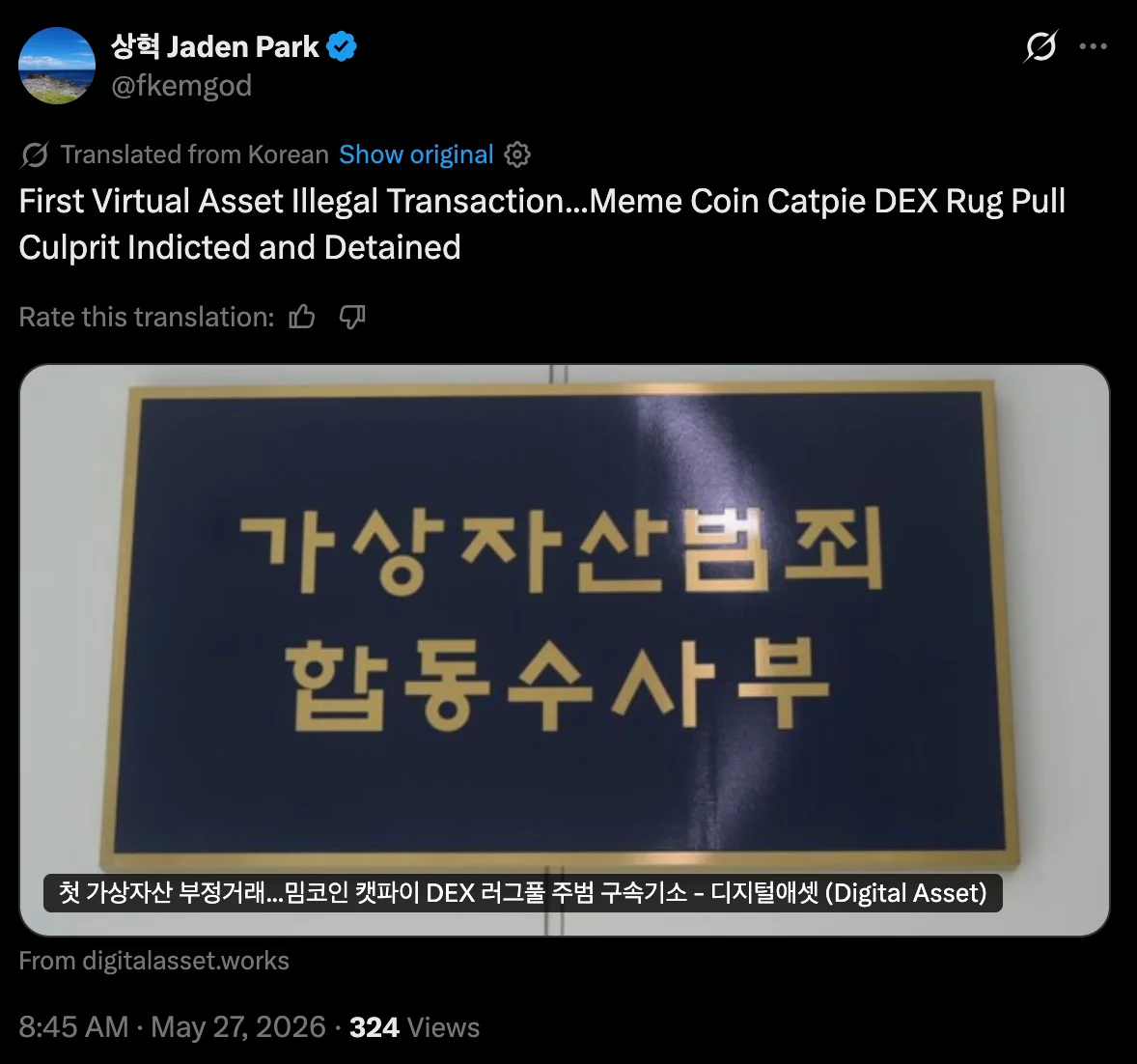
This is the first time someone in the country has been arrested and prosecuted for a “rug pull” on a decentralized exchange (DEX), according to Digital Asset. The case falls under the new Virtual Asset User Protection Act.
Prosecutors in Seoul have arrested and charged two individuals with manipulating the virtual asset market. Another person was indicted but remains free, and two more face charges for assisting the primary suspect in attempting to evade authorities.
Prosecutors say CATFI was promoted through false posts
According to investigators, the group launched a token called CATFI on the platform Pump.Fun in early 2025. They listed it on a decentralized exchange and then quickly abandoned the project, taking investors’ money – a practice known as a ‘rug pull.’ Pump.Fun is popular for launching new meme coins on Solana because it’s easy and inexpensive to create tokens there.
Park, the primary suspect, is accused of operating under the online persona “Eth Father.” According to prosecutors, he pretended to be an independent individual to promote purchases of CATFI. He also allegedly controlled the project’s social media, artificially increased its follower numbers, and published misleadingly positive news.
The group is accused of distributing CATFI tokens across multiple accounts and then engaging in a specific type of trading – where they bought and sold the token amongst themselves – to disguise the fact that they were the primary controllers of the token. Prosecutors argue this was a deliberate attempt to mislead investors through fraudulent practices and false information related to digital asset trading.
CATFI surged 1,001-fold before losses
The price of the CATFI token increased an astonishing 1,001 times within just 26 hours of its release, according to Digital Asset. While approximately 6,000 investors initially purchased the token, 256 of them later experienced losses totaling around 900 million won, which is about $586,000.
The prosecutors stated that the group illegally obtained around 400 million won, which is approximately $260,000, using about 10 million won in illicit funds. This case marks only the second time authorities have pursued legal action under the Virtual Asset User Protection Act, following a previous case involving a traditional cryptocurrency exchange.
In January 2025, South Korean authorities arrested two individuals accused of manipulating the price of the Fusionist token (ACE) on the Bithumb exchange, according to crypto.news. This case was previously noted as the first to be expedited by the Financial Services Commission under the relevant regulations.
South Korea expands crypto enforcement
South Korea is increasing its regulation of cryptocurrencies. Earlier this year, officials suggested new rules that would require financial influencers to reveal their crypto investments and any payments they receive for promoting cryptocurrencies or stocks.
Financial regulators have increased oversight of cryptocurrency exchanges. Following a significant error with a recent payout on Bithumb, the Financial Services Commission instructed exchanges in April to implement more frequent balance checks (every five minutes), automatically pause trading when large discrepancies are detected, and conduct monthly audits to ensure accuracy.
The CATFI case demonstrates a new approach to enforcement, specifically targeting decentralized exchanges (DEXs). It signals that prosecutors are expanding their focus beyond traditional, centralized exchanges, established tokens, and geographically-limited trading platforms when pursuing virtual asset fraud cases.
Prosecutors stated they will firmly address any actions that destabilize the cryptocurrency market and erode public confidence. This case could set a precedent for how South Korea regulates meme coin scams, online promotion, and decentralized exchange (DEX) trading under its new virtual asset laws.
Read More
- Forza Horizon 6: Find the Ohtani Treasure Chest Location
- LEGO Batman Legacy of the Dark Knight Batcave Minikits & WayneTech Caches
- NTE Drift Guide (& Best Car Mods for Drifting)
- Diablo 4 Best Loot Filter Codes
- USD RUB PREDICTION
- USD CNY PREDICTION
- Cookie Run Kingdom Timeline of Fate Update Guide
- PS Plus Monthly Games for June 2026 Wish List
- Top 10 Must-Watch Isekai Anime on Crunchyroll Revealed!
- GBP CNY PREDICTION
2026-05-27 10:44