What to know:
- Two of the most powerful stock exchange operators, the Nasdaq and ICE, partnered with major crypto exchanges to create and trade tokenized versions of traditional stocks on blockchains.
- These alliances reflect a broader push toward an “everything exchange,” in which all asset classes trade on a shared blockchain infrastructure.
- Tokenized equities remain small today but could transform how the $126 trillion global stock market trades and settles. The race for that prize makes incumbents and crypto firms rivals and partners at the same time.
Major stock exchanges like those on Wall Street are exploring ways to use blockchain technology to modernize the $126 trillion stock market. However, they’re partnering with cryptocurrency exchanges to make this happen, rather than building the technology themselves.
In the last week, leading stock exchange companies Nasdaq and Intercontinental Exchange (ICE, which owns the New York Stock Exchange) partnered with digital asset exchanges. They’re working to connect traditional stocks with blockchain technology by turning them into tokens.
Nasdaq is creating a system that would let publicly traded companies offer digital versions of their stock on a blockchain, while still maintaining the usual ownership and company control. They’re partnering with Payward, the company behind the cryptocurrency exchange Kraken, to distribute these digital stocks worldwide. This new offering could be available as early as the first six months of 2027.
Just days before, Immigration and Customs Enforcement (ICE) announced it was investing in the cryptocurrency exchange OKX, valuing the company at $25 billion. This partnership will involve launching new digital versions of stocks and cryptocurrency futures, giving OKX access to its 120 million users.
The “everything” exchange
The flurry of deals points to a bigger transformation in how markets might function in the future.
Traditionally, stocks, bonds, and other investments were bought and sold on different platforms with restricted trading times. Blockchain technology offers the potential for a single, 24/7 marketplace where all financial assets could be traded as digital tokens, and many in the financial industry believe this is a likely future.
According to Antoine Scalia, the CEO of Cryptio, a crypto accounting and compliance company, recent changes suggest a move towards a unified marketplace – what he terms the “everything exchange.” This would allow all types of assets to be traded on a single system.
Historically, the idea of traditional finance and cryptocurrency coming together was mainly promoted by those within the crypto community. Now, however, we’re actually seeing major financial exchanges take steps in that direction, according to Scalia.
“That’s a realization that eventually all assets will settle on blockchain rails,” he said.
The pace of change is picking up, especially after a January statement from the SEC. This statement confirmed that digital versions of stocks, known as tokenized equities, are legally equivalent to traditional stocks. This provides established financial firms with the confidence they need to start trading these digital stocks.
‘Frenemy’
But the main issue, Scalia pointed out, is determining which platforms will lead the future of trading – established exchanges like Nasdaq, or newer, crypto-focused platforms like Coinbase and Kraken.
But that doesn’t mean the two sides are purely rivals. In many cases, they need each other.
According to Scalia, traditional financial exchanges are eager to attract traders who are already familiar with cryptocurrency, and cryptocurrency platforms are seeking the wider reach and trustworthiness that come with established financial systems.
Both traditional financial companies and crypto firms can benefit from working together. Traditional exchanges want to attract crypto traders, while crypto users are eager to trade things like stocks and bonds. Meanwhile, crypto companies can reach a wider audience by partnering with these established financial players, bringing more people into the crypto world.
The companies have developed a strange relationship – they’re both rivals and partners at the same time. According to Scalia, this creates a unique mix of conflict and cooperation. It remains to be seen how this unusual situation will evolve.
Why tokenized stocks matter
Although currently a small part of the overall stock market at $1 billion, tokenized stocks have huge potential. This is because more and more assets are being traded 24/7.
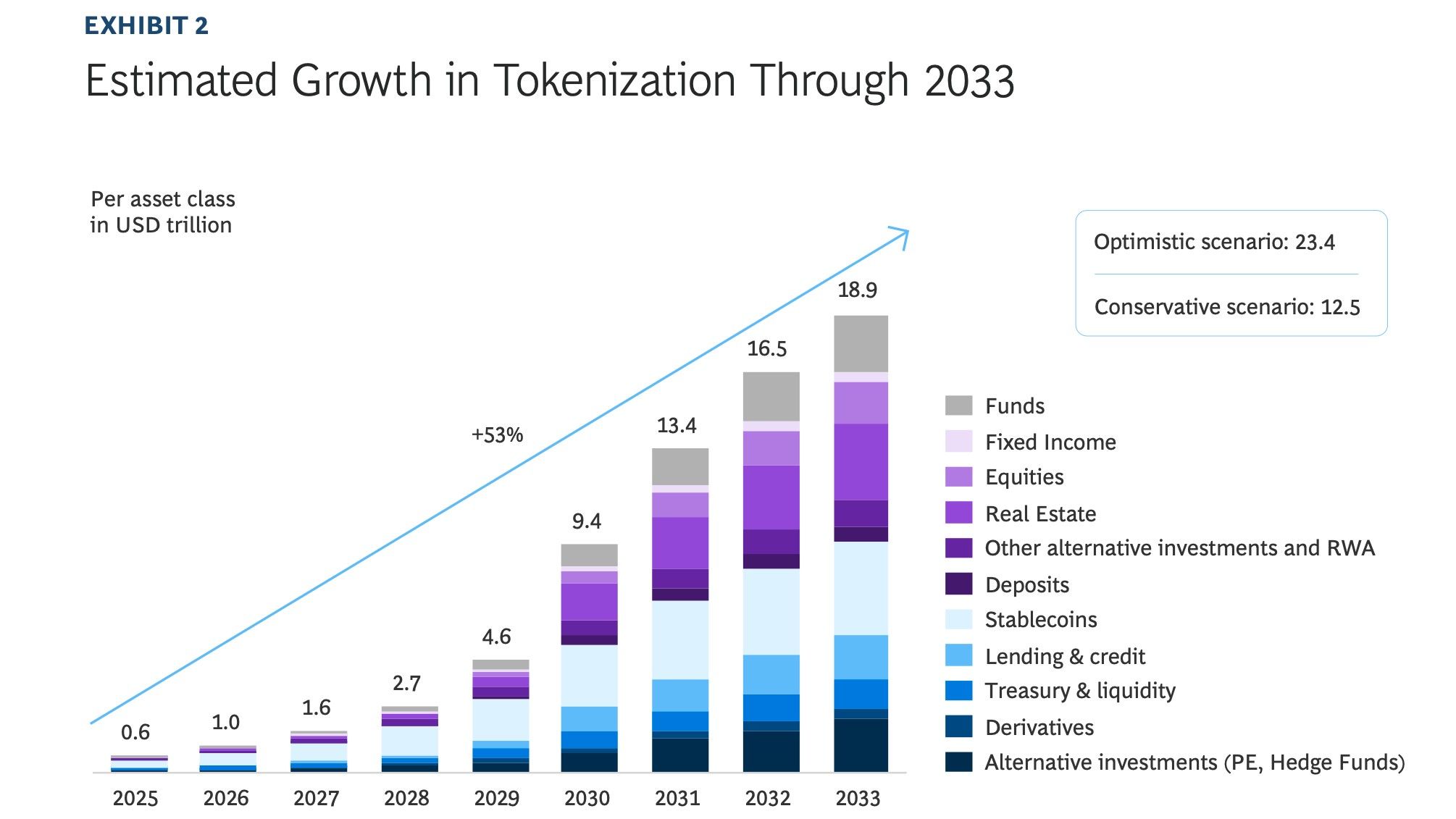
As a crypto investor, I was really interested to see a new report from Boston Consulting Group and Ripple. They’re predicting that tokenized assets could grow at a crazy rate – around 53% each year! If that happens, they estimate the total value of all tokenized assets could hit $18.9 trillion by 2033. That’s their most likely scenario, which is pretty exciting for the future of crypto and traditional assets.
Tokenized stocks are becoming increasingly popular. Their value has tripled since mid-2025, according to data from RWA.xyz, with companies like Kraken, Ondo Finance, and Robinhood now offering digital versions of traditional stocks.
According to Yuki Yuminaga, founder of Tenbin Labs, the main benefit of using blockchains for traditional stocks is that prices are constantly updated. Unlike today’s stock markets with limited trading hours, blockchain-based stocks can be bought and sold 24/7. This continuous trading is expected to attract more investment, make it easier to buy and sell shares, and stabilize prices.
As an analyst, I see a significant benefit in tokenizing stocks – it could really streamline lending and borrowing within the decentralized finance (DeFi) space. Essentially, tokenized shares could be used as collateral for loans, making capital more efficient and opening up new avenues for companies to secure funding. It’s a potentially game-changing development for how capital flows.
Major stock exchanges like Nasdaq and NYSE getting involved in tokenized stocks could significantly improve how easily these assets can be bought and sold.
According to Yuminaga, trading tokenized stocks has been difficult due to a disconnect between traditional stock exchanges and blockchain-based markets. Connecting these two markets, like Nasdaq could do, has the potential to significantly improve trading activity.
Read More
- Re:Zero Season 4, Episode 6 Release Date & Time
- NTE Drift Guide (& Best Car Mods for Drifting)
- How to Get the Wunderbarrage in Totenreich (BO7 Zombies)
- How to Beat Turbines in ARC Raiders
- How to Get Necrolei Cyst & Strong Acid in Subnautica 2
- Diablo 4 Best Loot Filter Codes
- Alan Wake Event in Phasmophobia, Explained
- Top 8 UFC 5 Perks Every Fighter Should Use
- How to Craft Repair Tools in Subnautica 2
- USD RUB PREDICTION
2026-03-15 19:11