The U.S. has been busy turning its piggy bank into a firehose-$39 trillion in the hole and counting, with economist Peter Schiff warning we might hit $50 trillion before the next president even remembers their own name.
Fiscal Imbalance Worsens as Debt Climbs Beyond $39 Trillion
If you’ve ever seen a man chase a train with a pocketwatch, you’ll understand the U.S. fiscal situation. Borrowing’s gone from a brisk stroll to a full gallop, and Schiff, that old prophet of gold and grim forecasts, dropped a bombshell on X March 18. He noted that debt had passed $39 trillion since Trump took office 14 months ago-a pace that’d make a hare blush. “If this keeps up,” he said, “we’ll be writing checks from the moon.”
Schiff’s missive on X read like a circus barker’s pitch:
“The U.S. national debt just surpassed $39 trillion, up $2.8 trillion since Trump took office 14 months ago. But as war costs soar, interest rates rise, and recession ensues, budget deficits will skyrocket. The national debt could hit $50 trillion before Trump leaves office.”
Schiff claimed forces like economic slowdowns and spending sprees are colliding like two drunken horses at a racetrack, accelerating the debt accumulation faster than a squirrel hoarding acorns in a hurricane.
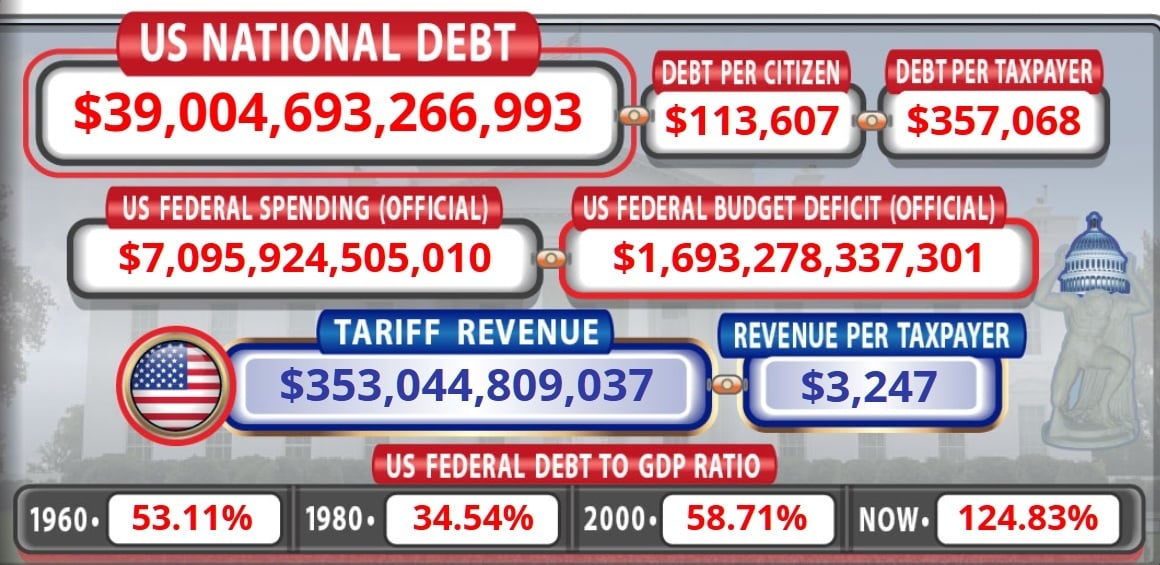
The U.S. Debt Clock website, our nation’s most honest barista, reports total debt at $39,004,693,266,993. Per capita? $113,607. Per taxpayer? $357,068. Tariff revenue? $353 billion. That’s like trying to fill a bathtub with a thimble while the plug’s out. The numbers scream that the fiscal gap is wider than the Grand Canyon, and the U.S. is still building bridges over it.
Meanwhile, the U.S. Treasury, that old ledger-keeper, confirms the debt is inching toward $39 trillion. One might say it’s less of a “surge” and more of a “gasp” followed by a sprint.

The recent Middle Eastern fireworks added a new chapter to the fiscal saga. Six days of war cost $11.3 billion-enough to buy every man, woman, and goat in the country a brand-new smartphone. The Strait of Hormuz closed, energy prices spiked, and the U.S. military’s tab grew faster than a loaf of bread in a bakery.
Kent Smetters, that budget wizard from Penn Wharton, says if you include Social Security and Medicare liabilities, the real debt is closer to $100 trillion. That’s like saying your mortgage is $200,000, but forgetting to mention the second house you’re building in the backyard.
War Spending and Interest Costs Intensify Risks
Schiff’s $50 trillion forecast implies adding $11 trillion in three years. That’s like expecting a frog to eat a horse. With interest rates rising, the U.S. is now paying over $1 trillion annually in interest-money that used to buy schoolbooks, now it buys IOUs. It’s a loop: borrow to pay, borrow to survive, borrow to wonder why the piggy bank’s empty.
Meanwhile, Social Security and Medicare costs are rising like a soufflé in a sauna. Aging populations and inflation adjustments have turned these programs into fiscal leviathans. Defense spending? Nearly $1 trillion a year. One might say the U.S. is building a fortress made of debt and hope.
Jamie Dimon, Ray Dalio, Elon Musk Sound Alarm as US Fiscal Path Spins out of Control
Wall Street’s finest are throwing up their hands. Jamie Dimon warned that borrowing endlessly is a “recipe for fiscal disaster,” while Ray Dalio likened the situation to the final act of a Shakespearean tragedy. Elon Musk, ever the optimist, declared the U.S. “1,000% going to go bankrupt” unless someone invents a time machine to reverse spending habits. Jerome Powell, the Fed’s cautious captain, called the path “unsustainable,” and David Kelly of JPMorgan quipped, “We’re going broke slowly. It’s the genteel way.”
FAQ 🧭
- Why is U.S. debt rising so quickly?
Expanding deficits, higher interest costs, and war spending are accelerating borrowing like a toddler on a sugar high. - How do rising interest rates affect federal debt?
They turn the budget into a game of musical chairs where the chair is always one seat short. - What risks do investors face from higher U.S. debt?
Volatility, inflation, and the joy of watching fiscal policy dance with a chainsaw. - Could U.S. debt reach $50 trillion soon?
If deficits keep climbing like kudzu, it’s not a question of “if,” but “how many zeros we’ll add for fun.”
Read More
- Re:Zero Season 4, Episode 6 Release Date & Time
- How to Get the Wunderbarrage in Totenreich (BO7 Zombies)
- NTE Drift Guide (& Best Car Mods for Drifting)
- How to Beat Turbines in ARC Raiders
- All Aswang Evidence & Weaknesses in Phasmophobia
- How to Get Necrolei Cyst & Strong Acid in Subnautica 2
- Diablo 4 Best Loot Filter Codes
- Conduit Crystal Location In Subnautica 2
- Best Where Winds Meet Character Customization Codes
- How to Craft Repair Tools in Subnautica 2
2026-03-19 03:29