The Federal Reserve’s latest Financial Stability Report lands with the calm, precise gravity of a librarian announcing that the building may soon be haunted by clever machines. Artificial intelligence is creeping into the financial system as a bona fide concern, with about 50% of surveyed market participants naming AI as a possible shock. They link the risk to valuations, leverage, labor conditions, and private credit-because nothing says “fun” like a spreadsheet with personality.
Key Takeaways:
- AI is among the most-cited risks in the Fed’s latest financial-stability survey.
- Debt-financed AI spending could push leverage across companies, lenders, and funding markets.
- Private credit and labor pressures may widen AI’s impact if market expectations sag.
AI Moves Into the Fed’s Financial Stability Risk Debate
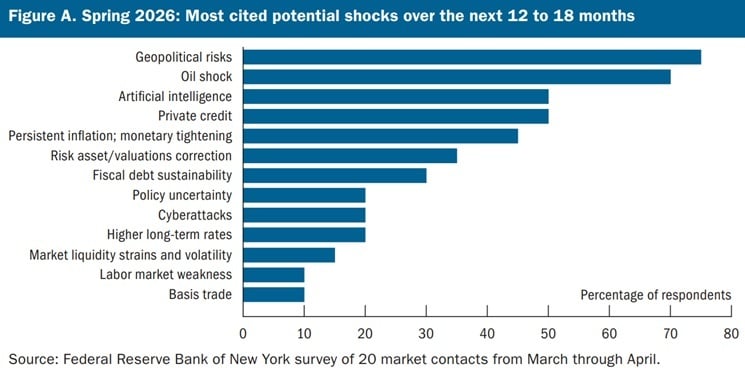
The Federal Reserve released its latest Financial Stability Report on May 8, and yes, AI is casually marching into the national psyche as a potential problem. In spring 2026, 50% of surveyed market participants flagged AI as a possible shock, up from 30% in fall 2025. That places AI among the leaders of risk over the next 12 to 18 months, right up there with geopolitics, an oil price shock, stubborn inflation, and the ever-popular private credit stress.
The report sits in the Fed’s Financial Stability Report, a document that sounds like it’s been written for grown-ups who prefer their risk with a side of charts. The Fed says financial stability underpins full employment, stable prices, a safe banking system, and an efficient payments system. The AI commentary in the survey signals a broader worry-that this clever technology could nudge multiple parts of the financial system, including asset values, borrowing, labor markets, and the ever-sensitive credit conditions.
The report stated:
“AI-related risks were in focus as well, particularly concerns around equity valuations, debt-financed capital spending, and risks to the labor market.”
During March and April, New York Fed staff surveyed 20 financial-market participants, including pros at broker-dealers, banks, investment funds, and advisory firms. They were asked which shocks could do the most damage to U.S. financial stability over the next 12 to 18 months. The report emphasizes that these findings reflect market participants’ views, not official positions of the Federal Reserve Board or the New York Fed.
Debt-Funded AI Spending Creates a Wider Risk Channel
Beyond the glimmer of technology stocks, respondents connected AI to broader financial vulnerabilities. Elevated equity valuations fostered by AI optimism could tremble if growth or profit expectations falter. Debt-financed capital spending was another worry, because borrowing can create leverage across companies, lenders, and funding markets. Weakness in the labor market also crept into the discussion, reflecting concern that broader AI adoption could weigh on employment in some sectors.
Capital spending tied to AI drew attention as more investment is financed by borrowing. The Fed did not forecast an AI-driven crisis, nor did it claim AI spending is already destabilizing markets. Still, the survey shows market professionals are watching how AI-related debt could interact with high asset prices and tighter financial conditions if expectations shift.
The Fed report detailed:
“Respondents raised several risks related to AI, including equity valuations; that capital expenditures are increasingly funded by debt, creating leverage in the system; and that widespread adoption of AI may contribute to labor market weakness.”
Private credit added another channel. Respondents suggested AI-driven disruption could weaken credit quality for some borrowers. The report also noted redemption requests and weaker sentiment in parts of private credit. That makes AI relevant beyond the public tech scene, linking it to borrowers, lenders, leveraged financing, and broader market confidence.
Taken together, the survey shows AI sinking its hook deeper into the Fed’s financial-stability framework. It wasn’t the top risk-geopolitical tensions and an oil shock outrank it-but the jump from 30% to 50% implies market participants increasingly view AI as a possible amplifier of valuation pressure, leverage buildup, credit stress, and labor-market strain.
Read More
- How to Get the Wunderbarrage in Totenreich (BO7 Zombies)
- Change Your Perspective Anomaly Commission Guide In NTE (Neverness to Everness)
- How to Beat Turbines in ARC Raiders
- NTE Drift Guide (& Best Car Mods for Drifting)
- Beware! Phishing Emails Are Deceiving Robinhood Users in a Sneaky Plot!
- Robinhood’s $75M OpenAI Bet: Retail Access or Legal Minefield?
- All Nameless Hospital Endings Full Guide In NTE
- NTE Fan Shows Off Mint Cosplay
- NTE Banners (Current, Next, And Upcoming Banners)
- Deltarune Chapter 1 100% Walkthrough: Complete Guide to Secrets and Bosses
2026-05-10 06:28