Iran has introduced a new system for insuring goods shipped through the Strait of Hormuz, and payments will be made using Bitcoin, according to Fars News Agency. This initiative brings Bitcoin into a crucial and often tense shipping route, where concerns about energy supplies, international sanctions, and maritime dangers are all significant.
Iran Officially Turns To Bitcoin
Iran has launched a new insurance platform called “Hormuz Safe” to cover cargo ships traveling through the Strait of Hormuz. According to reports, the Iranian government has been developing this plan for several months, aiming to manage traffic through the strait with insurance coverage. This scheme could allow Iran to issue insurance policies and financial guarantees, potentially earning the country over $10 billion.
The key feature of this platform is how it handles payments. Fars reports that it offers quick, secure insurance for cargo traveling through the Persian Gulf, the Strait of Hormuz, and nearby waters. Payments are made using Bitcoin, and coverage begins immediately upon confirmation, with owners receiving a digital receipt.
This phrasing clarifies that the project focuses specifically on Bitcoin, unlike broader initiatives involving various cryptocurrencies or payment technologies. The report details a system designed for the maritime industry – specifically, to improve insurance and compliance for ships and cargo – rather than a typical service for consumers like a digital wallet or exchange.
This launch is happening at a time of increased attention on the Strait of Hormuz, the vital shipping lane between Iran and Oman. It connects the Persian Gulf to the Gulf of Oman and the Arabian Sea. The U.S. Energy Information Administration identifies Hormuz as the world’s most critical point for oil transport, with approximately 21 million barrels of oil passing through it daily in 2022 – roughly 21% of the world’s total oil use.
Recent months have seen increased tension in the region. Iran started permitting some Chinese ships to pass through the Strait of Hormuz, following an agreement on how Iran would manage traffic in the area. Previously, Iran had significantly limited passage after the US and Israel began military actions on February 28th. Then, a US naval blockade of Iranian ports, imposed after a ceasefire in early April, further complicated the situation in this vital waterway – a route for about 20% of the world’s oil and gas.
Fars hasn’t shared specifics about how it handles Bitcoin payments. It’s unclear if payments are processed directly on the Bitcoin network, held by a third party, tracked internally, or exchanged for other currencies. We also don’t know who Fars works with – its partners, financial backers, wallet providers, or any insurers involved.
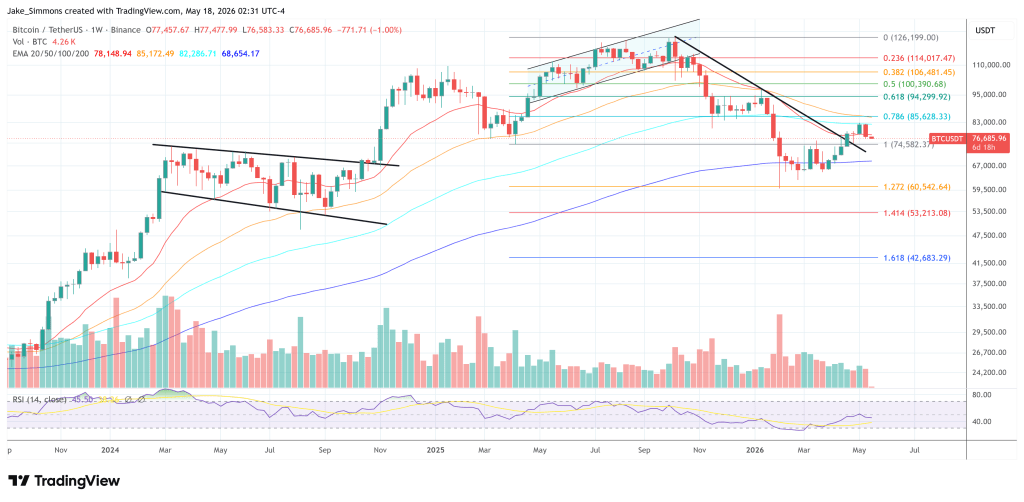
At press time, BTC traded at $76,685.
Read More
- Re:Zero Season 4, Episode 6 Release Date & Time
- NTE Drift Guide (& Best Car Mods for Drifting)
- How to Get the Wunderbarrage in Totenreich (BO7 Zombies)
- How to Beat Turbines in ARC Raiders
- How to Get Necrolei Cyst & Strong Acid in Subnautica 2
- All Aswang Evidence & Weaknesses in Phasmophobia
- Alan Wake Event in Phasmophobia, Explained
- How to Craft Repair Tools in Subnautica 2
- Diablo 4 Best Loot Filter Codes
- Best Where Winds Meet Character Customization Codes
2026-05-18 09:43