Wall Street’s love affair with bitcoin? A farce – U.S. regulators have cooked up a Basel III rule so hot, banks may forget their ovens are even on.
Fed’s Basel Proposal Slaps Bitcoin With 1,250% Risk Weight – Banks Face Capital Shock
Federal Reserve Vice Chair Michelle Bowman, that sly fox of regulation, dropped hints on March 12 at the Cato Institute, hinting that U.S. regulators are about to unleash a Basel III “endgame” proposal so punishing, it could make Sauron weep. The plot? To force banks to treat bitcoin as if it were a cursed artifact from a bygone era.
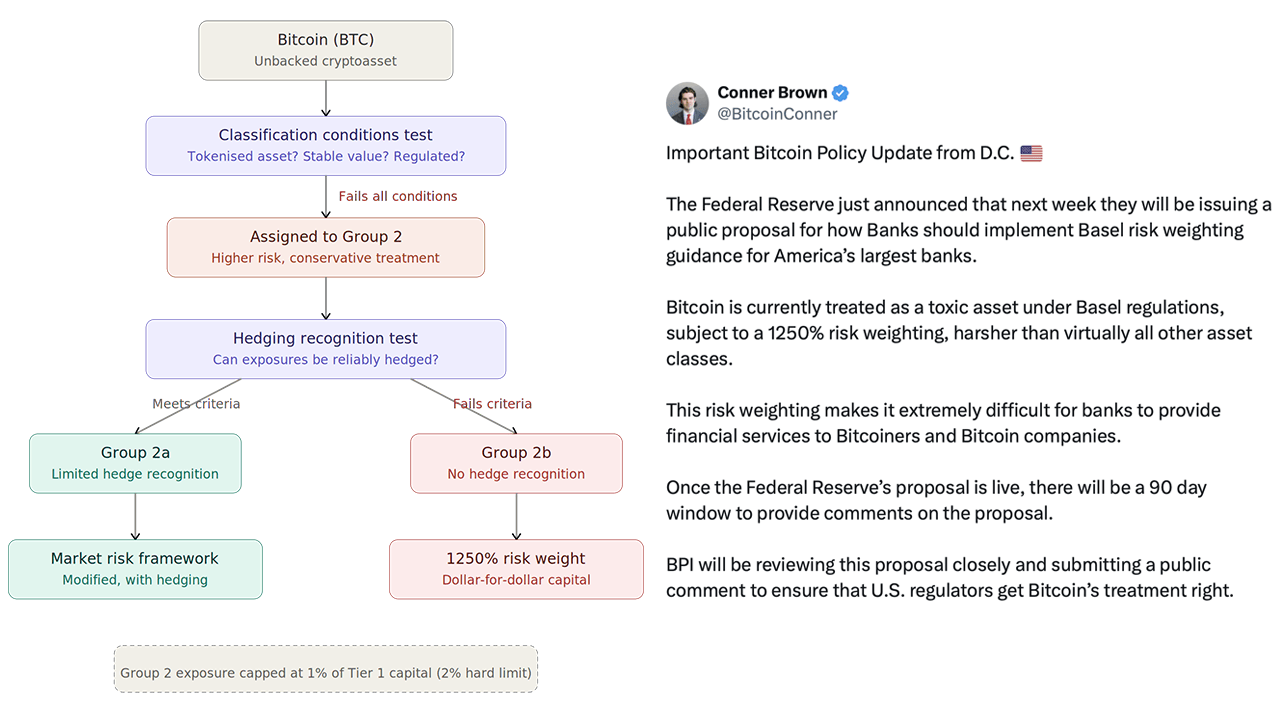
Buried in the fine print is a rule so draconian, it would make Kafka blush: a 1,250% risk weight for bitcoin, the regulatory equivalent of labeling it “Handle with oven mitts and a prayer.”

“In the coming weeks,” Bowman declared, “we will propose rules to implement the final phase of Basel III in the United States.” A line that might as well have been scribbled on a scroll of doom.
This bureaucratic masterpiece, arriving March 17-21, is a trinity of regulatory terror: the Fed, OCC, and FDIC, united in their quest to turn banks into nervous wrecks. Once unleashed, the draft will invite a 90-day public comment period – a chance for banks, crypto firms, and policy groups to politely scream into the void, as if it ever listened.
The villain? The Basel Committee’s 2022 crypto framework, which categorizes bitcoin as Group 2b: the digital asset equivalent of a ticking time bomb. Volatile, unhedgeable, and, apparently, worthy of a 1,250% risk weight – the nuclear option in regulatory math.
Here’s the rub: If a bank holds $100 million in bitcoin, regulators treat it as $1.25 billion in risk-weighted assets. Thus, the bank must hold $100 million in capital – a financial straitjacket that makes holding bitcoin akin to driving a sports car with the parking brake on.
Compared to cash, gold, or Treasurys (all with zero risk weights), bitcoin now resembles the black sheep of the asset family. Corporate loans? A mere 20-100% risk weights. Bitcoin? The regulatory equivalent of a red flag waved at a bull.
Industry voices, predictably, are howling. The Bitcoin Policy Institute argues the Basel framework misclassifies bitcoin as an “opaque securitization” – ignoring its liquidity and transparency. Managing Director Conner Brown calls it a “regulatory mismatch,” a bureaucratic blunder that stifles innovation as effectively as a bureaucrat’s red pen.
Even Phong Le, CEO of Strategy (MSTR), publicly begged regulators to reconsider. After all, Basel’s rules shape how banks interact with digital assets – and right now, they’re shaping a path to extinction for bitcoin intermediaries.
And yet, demand for bitcoin persists. Corporate treasuries hold 1.1 million BTC, derivatives trade like mad, and institutional products bloom. But banks, those cautious custodians of capital, now face a paradox: demand exists, but touching bitcoin feels like holding a live grenade.
Advocates suggest swapping the 1,250% penalty for risk-sensitive models, graduated limits, and hedging recognition. But until then, the Basel Committee plans a “review” – a bureaucratic nod to progress, while the clock ticks toward the proposal’s release.
Once it drops, the 90-day comment period begins – a fleeting window for banks, crypto firms, and policy groups to plead their case. A farcical dance of compliance, where the rulebook isn’t final, but the penalties are.
FAQ 🔎
- Why does Basel III assign bitcoin a 1,250% risk weight?
Because regulators, in their infinite wisdom, labeled it Group 2b – the crypto equivalent of a cursed relic. - What does a 1,250% risk weight mean for banks?
It forces them to hold capital equal to their bitcoin exposure, turning the asset into a financial straitjacket. - What did Strategy CEO Phong Le say about the Basel rules?
He urged regulators to rethink the framework, lest they strangle bitcoin’s potential in a bureaucratic noose. - When will the Federal Reserve release the Basel proposal?
March 17-21, followed by a 90-day comment period – a bureaucratic farce in five acts.
Read More
- Re:Zero Season 4, Episode 6 Release Date & Time
- NTE Drift Guide (& Best Car Mods for Drifting)
- How to Get the Wunderbarrage in Totenreich (BO7 Zombies)
- How to Beat Turbines in ARC Raiders
- Diablo 4 Best Loot Filter Codes
- How to Get Necrolei Cyst & Strong Acid in Subnautica 2
- Top 8 UFC 5 Perks Every Fighter Should Use
- Alan Wake Event in Phasmophobia, Explained
- Brent Oil Forecast
- Danganronpa 2: A Complete Guide To Gifts
2026-03-13 01:27