
What to know:
Stay informed about the world of crypto with Crypto Long & Short, our weekly newsletter designed for serious investors. Subscribe here to receive it directly in your inbox every Wednesday.
Welcome to our institutional newsletter, Crypto Long & Short. This week:
- Dovile Silenskyte provides an alternative to the “bitcoin as a risk asset” narrative.
- Joshua de Vos shares insights and analysis on global exchanges.
- Top headlines institutions should pay attention to by Francisco Rodrigues.
- CoinDesk 80 Leads as Crypto Outperforms Across Asset Classesin Chart of the Week.
Thanks for joining us!
-Alexandra Levis
Expert Insights
Bitcoin vs. gold: 26% relative undervaluation
By Dovile Silenskyte, director of digital assets research, WisdomTree
For a long time, it’s been hard to categorize bitcoin in financial markets. Right now, most news and analysis portray it as a risky investment that goes up when there’s plenty of money available and goes down when investors become cautious.
That framing increasingly misses the bigger structural shift underway.
Bitcoin is increasingly seen as a store of value, similar to gold. Both are being considered by investors as long-term holdings and potential hedges against economic uncertainty.
- Sit outside the traditional fiat system.
- Respond to inflation expectations, real yields and confidence in sovereign currencies.
- Attract investors looking for scarce and politically neutral stores of value.
Gold is often seen as a safe haven during economic uncertainty, while Bitcoin is more about creating new possibilities in finance. Because of this key difference, we need to approach analyzing Bitcoin differently than we do with gold.
Instead of comparing bitcoin to stocks or other risky investments, we think it makes more sense to compare it to gold. The important question isn’t whether bitcoin’s price will go up overall, but whether it’s currently valued appropriately compared to gold, considering the current economic environment.
Our Bitcoin in Gold (BiG) model attempts to answer precisely that question. As of March 31, 2026:
- Actual bitcoin/gold ratio: 15.6
- Model fair value: 21.1
That gap implies bitcoin is 26% undervalued relative to gold.
Figure 1: The actual bitcoin/gold ratio is sitting clearly below model estimate
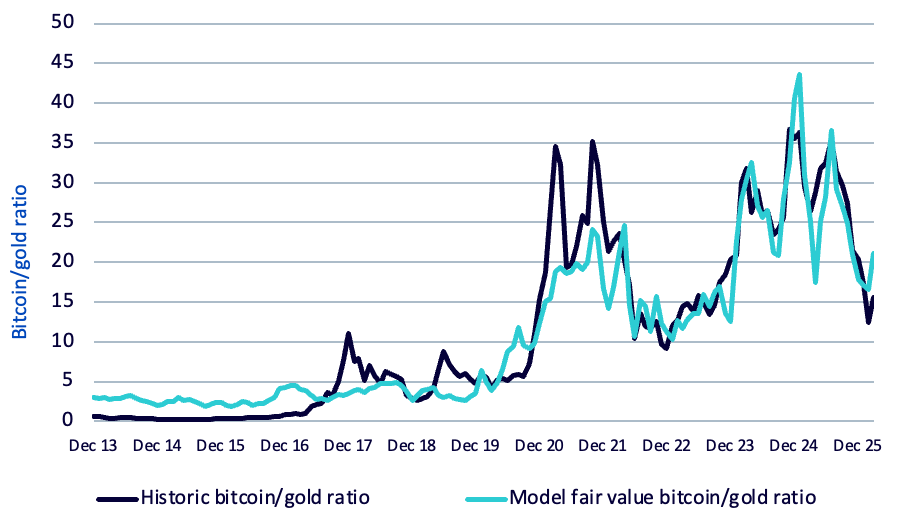
This difference isn’t just theoretical. It’s based on how current economic factors are built into the model. Essentially, Bitcoin tends to be more sensitive to changes in the economy than gold.
- Falling real yields / easier liquidity: bitcoin outperforms.
- Stronger USD / risk-off: gold outperforms.
- Rising inflation expectations: typically supports gold first.
Today’s mix implies a higher bitcoin/gold ratio than observed.
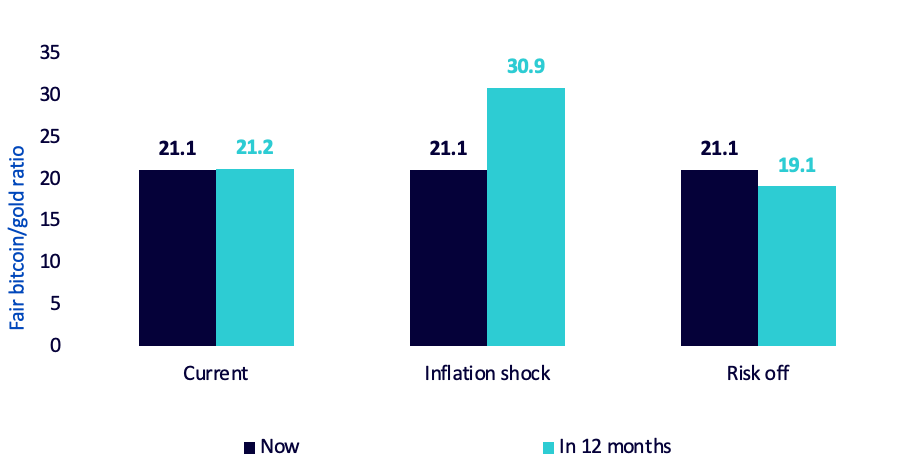
According to our model, as of March 31, 2026, these are the three most likely broad economic scenarios for the next 12 months, and each one would result in a different set of consequences.
- Current: no shock; gradual convergence to fair value.
- Inflation shock: gold leads initially; bitcoin catches up later.
- Risk-off: stronger USD; gold outperforms.
Figure 2: Scenario paths for the bitcoin/gold ratio
For investors, there are three practical applications of the BiG model:
- Relative value trade: long bitcoin and short gold is one potential implementation approach.
- Allocation tilt: if holding both, increase bitcoin weight when the gap is wide.
- Macro overlay: combine with real yields, dollar trend and liquidity indicators.
The BiG model helps traders find optimal positions in the market. It works by capitalizing on widening discrepancies and reducing exposure when those discrepancies narrow. The core principle is simple: monitor the spread, base your choices on the broader economic picture, and don’t overreact to temporary price fluctuations.
See further detail in Bitcoin vs gold: bitcoin looks 26% undervalued relative to gold blog.
Principled Perspectives
The centralized exchange market is pulling apart
By Joshua de Vos, research lead, CoinDesk Data
For a long time, major cryptocurrency exchanges have claimed the industry is now fully grown. CoinDesk’s May 2026 Exchange Benchmark – a detailed evaluation of 75 exchanges using over 100 different measures – puts that claim to the test. The results are mixed: while some areas show improvement, the data reveals that even the best exchanges remain vulnerable to potential market crashes and failures.
The bar rises
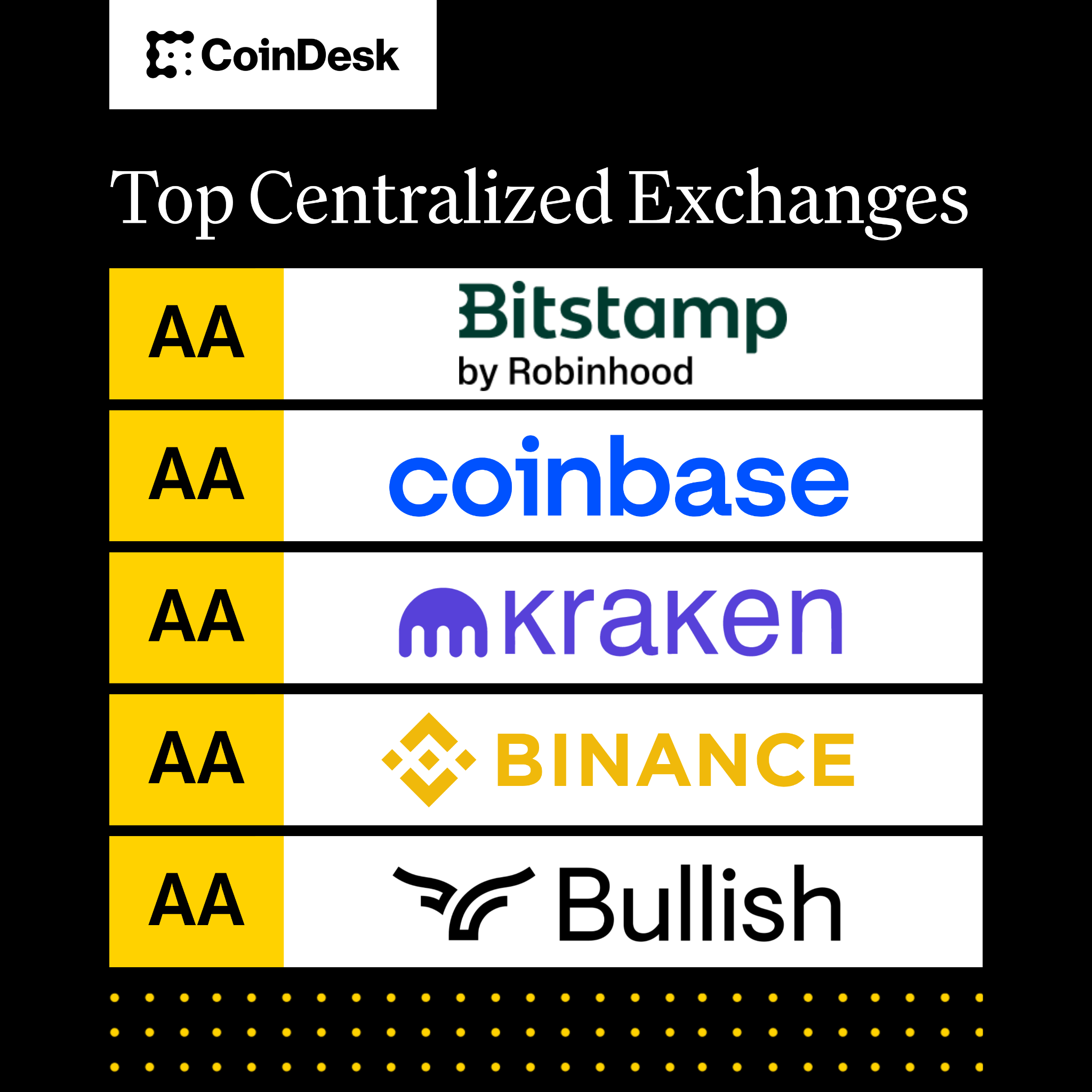
This review cycle saw a key change in how exchanges were rated. We increased the score needed for an “AA” rating from 80 to 85, reflecting increasingly high standards. Six exchanges achieved this new standard: Bitstamp by Robinhood (90.26), Coinbase (88.58), Kraken (87.77), Binance (87.25), Bullish (86.99), and Crypto.com (86.22). Bitstamp topped the rankings for the first time in three years, surpassing Binance. Gemini and OKX were moved down to an “A” rating, but this wasn’t due to a drop in performance – both actually improved their scores, but didn’t meet the higher “AA” threshold.
The latest Exchange Grade Distribution shows considerable improvement over the past three months. The biggest change is at the lower end: failing exchanges (receiving an E grade) decreased significantly from 11 to just 4, while seven exchanges moved up to a D grade – the largest single-month improvement ever recorded. Overall scores also rose, reaching an average of 58.42 for the third month in a row. Furthermore, the number of top-performing exchanges (rated BB or higher) increased from 20 to 21.
Volume concentrates at the top
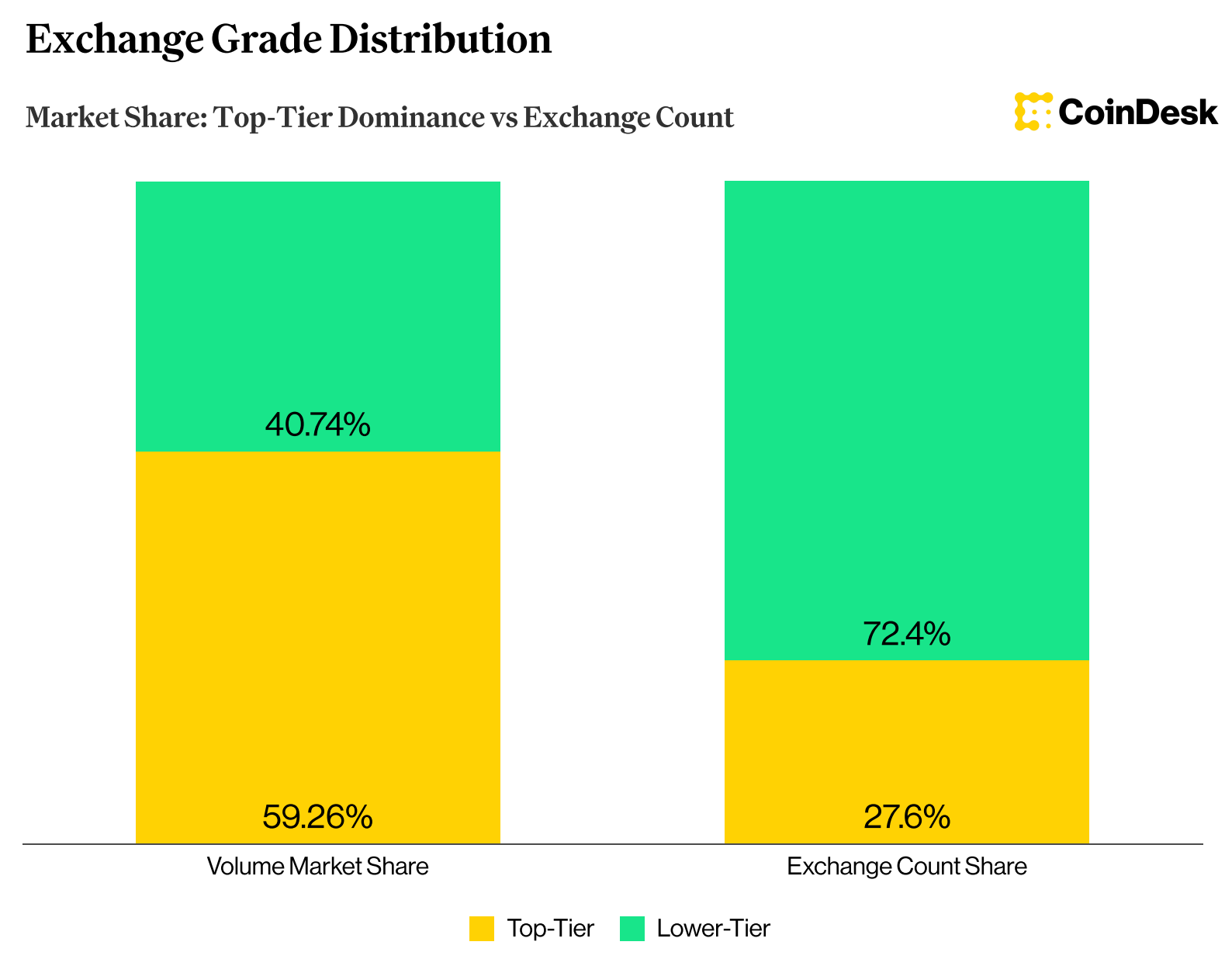
Leading cryptocurrency exchanges now handle 59% of all spot trading volume in the first quarter, even though they only represent 27% of the total number of exchanges. This is a significant jump from 40% in October 2025. This trend shows that institutional investors are increasingly choosing exchanges with reliable technology and security. Binance is still the largest exchange, processing nearly four times the volume of its closest competitor, with 24% of all spot trading. However, MEXC accounts for 6.25% of global volume despite being considered a higher-risk exchange, suggesting some investors are prioritizing trading volume over established security standards when dealing with less common cryptocurrencies.
October’s lesson
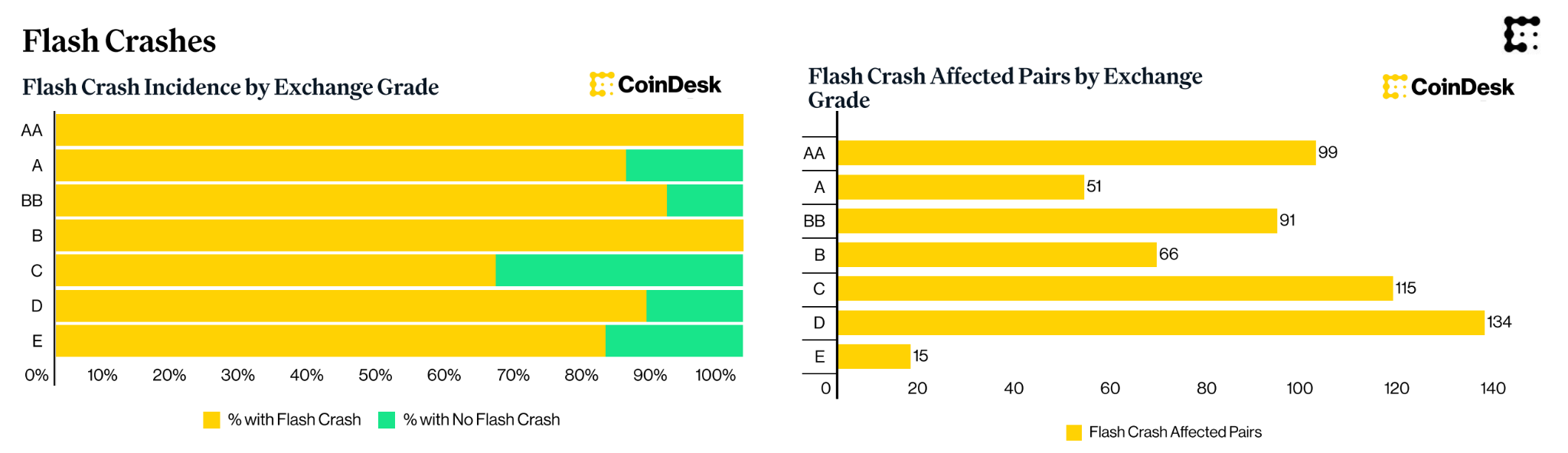
Recent analysis revealed widespread issues on October 10th, where trading failures across most major exchanges (62 out of 75) caused significant price fluctuations for hundreds of trading pairs (at least 571). Nearly all exchanges experienced brief, sharp drops in price – known as flash crashes – including those considered top-tier. This indicates these failures aren’t limited to smaller, less reliable platforms, but are a broader problem affecting the entire market. To keep a closer watch on this, we’ve expanded our monitoring to better assess how well exchanges can handle these types of events.
What the data still shows
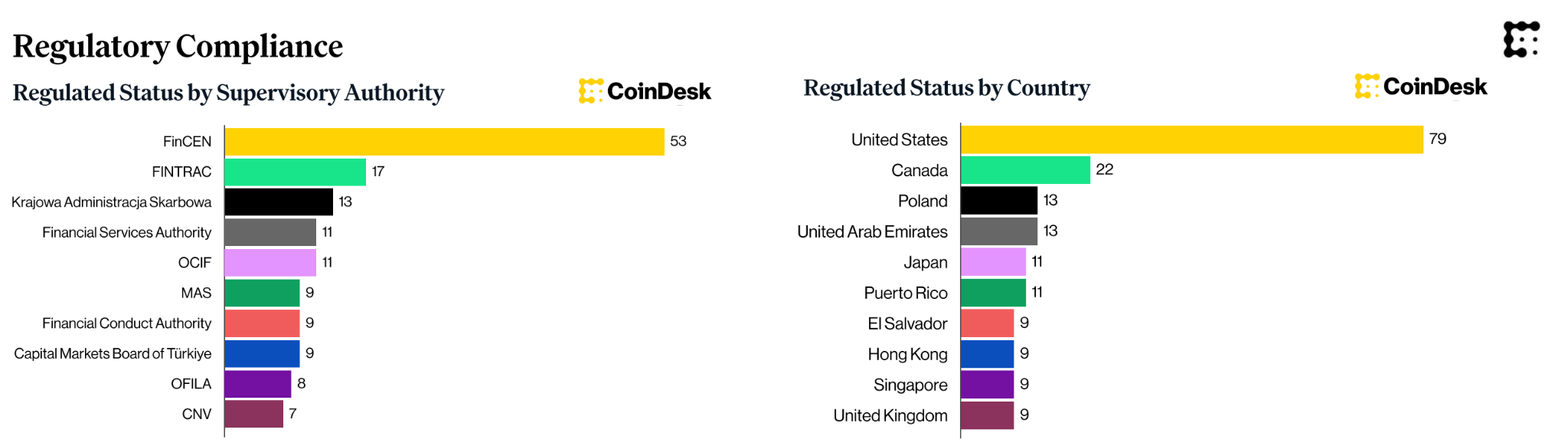
Openness and accountability are increasing in the crypto space. We’ve now verified reserves for 63% of assets, and a record 21 exchanges have completed our detailed questionnaires. However, regulations are still inconsistent globally. While the new MiCA rules have been in place since late 2024, only 16 out of 75 major exchanges are fully licensed. A significant 66% don’t have any regulatory oversight within the European Union. Specifically, HitBTC, Thalex, and Woo haven’t yet established any legal presence anywhere.
Starting in October, preparations will begin for the November 2026 exchange submissions. With more institutions investing in digital assets and increased oversight from business partners, it’s becoming increasingly expensive to operate outside of standard institutional risk management practices. This benchmark helps highlight those costs.
Headlines of the Week
– By Francisco Rodrigues
Recent news indicates a surge of investment into the foundational technology of cryptocurrency. Banks, investment firms, and companies specializing in turning assets into digital tokens are all competing to create the necessary infrastructure for wider use by institutions. This is happening despite warnings from a major Bitcoin investor who anticipates potential price drops due to increased selling.
- Circle raises $222 million for Arc, beats Q1 earnings estimates but misses on revenue: The USDC issuer closed the round at a $3 billion valuation for its Arc blockchain token, with backing from BlackRock, Apollo and Bullish, alongside Q1 results that topped earnings expectations but came in light on the top line.
- Ripple raises $200 million from Neuberger Berman to expand its Ripple Prime platform: The new facility will fund the buildout of an institutional prime-brokerage offering, addressing rising demand for margin financing and trading services that span both traditional and digital asset markets.
- Morgan Stanley brings crypto trading with lower fees than rivals: The bank is rolling out spot crypto on E*Trade at a 50-basis-point transaction fee, undercutting Coinbase, Robinhood and Charles Schwab while giving its wealth clients a bank-run route into the asset class.
- Crypto platform Bullish to buy Equiniti for $4.2 billion, building tokenized securities infrastructure: The deal adds regulated transfer-agent, shareholder-record and issuer-services capabilities to the exchange’s stack as it positions for tokenized securities, 24/7 trading and stablecoin-based settlement.
- Michael Saylor’s Strategy signals potential bitcoin sale to fund dividend obligations: After reporting a $12.54 billion Q1 loss, the company said it may sell BTC to meet dividend payments, refocusing attention on the leverage, financing costs and potential supply overhang tied to listed bitcoin-treasury firms.
Chart of the Week
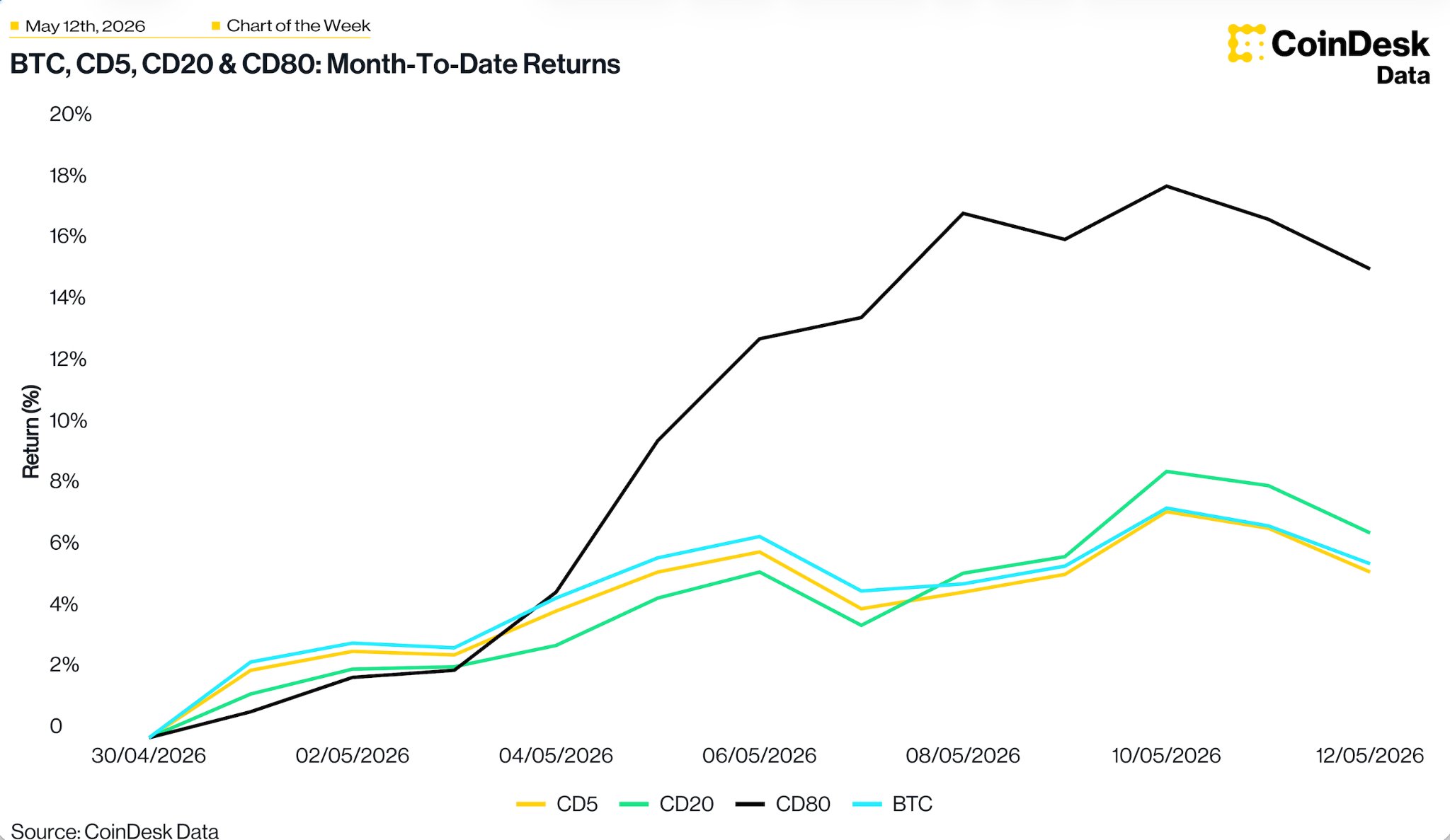
CoinDesk 80 Leads as Crypto Outperforms Across Asset Classes
Since the beginning of May 2026, Bitcoin has increased by 5.7%, performing better than major investments like the S&P 500, gold, and oil. This positive trend is also affecting smaller cryptocurrencies, with the CoinDesk 80 (CD80) index rising by 15.32% – a substantial gain compared to larger cryptocurrencies. ZEC has seen a particularly strong increase of 57%. The difference in performance between the CD80, BTC, CD5, and CD20 indexes (which are all growing at a rate of 3-5%) indicates that momentum is shifting towards smaller altcoins as the overall crypto market continues to rally.
Want to stay informed? Get the newest cryptocurrency news at coindesk.com and find market insights for institutions at coindesk.com/institutions.
Read More
- Re:Zero Season 4, Episode 6 Release Date & Time
- NTE Drift Guide (& Best Car Mods for Drifting)
- How to Get the Wunderbarrage in Totenreich (BO7 Zombies)
- How to Beat Turbines in ARC Raiders
- Change Your Perspective Anomaly Commission Guide In NTE (Neverness to Everness)
- Diablo 4 Best Loot Filter Codes
- Top 8 UFC 5 Perks Every Fighter Should Use
- Brent Oil Forecast
- Danganronpa 2: A Complete Guide To Gifts
- All Fish & How to Catch Them in NTE
2026-05-13 19:18